Key takeaways
- Name the water source and draw the surface path before you name a drain product.
- A channel drain, a low-point grate, and a French drain answer different paths.
- Leave pipe size and slope blank until the drawings or a rain walk supply them.
- Orlando's grading checklist is one city's submittal example, not a national slope.
Updated October 2026
Standing water on a pool deck damages the concrete and leaves a slippery edge. Record the catchment, the surface path, and the outlet shown on the drawings before you choose a channel drain or a French drain.
A pool drainage channel collects sheet flow on a hardscape when that surface slopes toward the channel and the water has a release point. NDS, in a patio and pool-deck article retrieved 11 October 2026, describes three collectors: a channel drain for moderate sheet flow on larger hardscapes, a pipe grate for a smaller low spot with lighter flow, and a catch basin or dry well when deck water spills onto the lawn. The same company’s solution page lists 3-inch and 4-inch pipe, with quantity varying by system length, rainfall intensity, and the number of problem areas. Those pages tell you to slope the hardscape toward the drain. They do not state a rate. Orlando’s residential pool checklist, retrieved the same day, asks for deck-edge elevations and a runoff arrow. The walkthrough below is the sheet you fill from a rain walk and those documents.
Scroll horizontally to read all columns.
| Input | What you record | Why it matters |
|---|---|---|
| Catchment / source | Roof, deck, lawn, neighbor, or pool splash | Names the water the drain is supposed to catch |
| Surface flow | Arrows from the rain you watched | Separates a sheet across the deck from one low spot |
| Grade observations | High point, low point, standing water, mud path | A channel works when the hardscape sheds toward it |
| Inlet | Channel line, low-point grate, catch basin, or none | Matches the device to the path |
| Outlet | Pipe end, infiltration, swale, or not shown | A collector without a release point holds the puddle |
| Legal discharge | Whether the plan keeps flow on the property | Orlando bars concentrating flow onto a neighbor; your city writes its own rule |
| Maintenance access | Whether the grate can be cleared of leaves | NDS says leaves and debris on the grate keep water from draining |
| Designer review | Who signs the grading plan if the site is regraded | Orlando requires a Florida engineer or architect when regrading is proposed |
Where does the rain enter the deck?
Name the water before you name a product. A roof downspout that lands on the deck is a point source. A wide concrete surface that carries a sheet of water is a different source. Soil that turns to mud and then reaches the coping is a third. NDS treats those as different jobs: sheet flow on a larger hardscape, a smaller low spot with lighter flow, and excess water spilling off the deck onto the lawn.
Write the source in plain words. “North downspout” is a record. “Drainage problem” is not. If you cannot walk the yard in the rain, leave the cell blank and schedule the walk. A dry-day guess about which way the deck falls is a weaker note than arrows you watched.
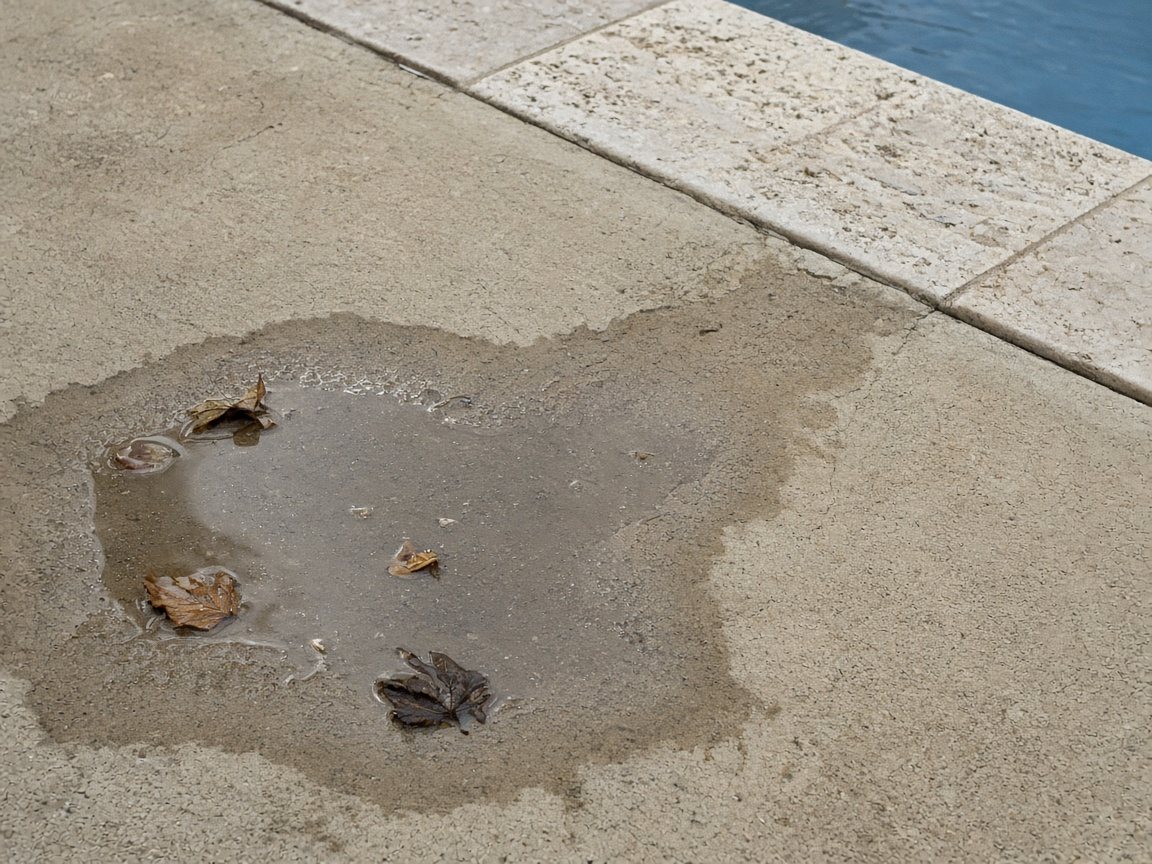
Takeaway: Name the source, then draw the path, before you pick a channel, a grate, or a buried pipe.
Which collector matches the path you saw?
Use the path you wrote down.
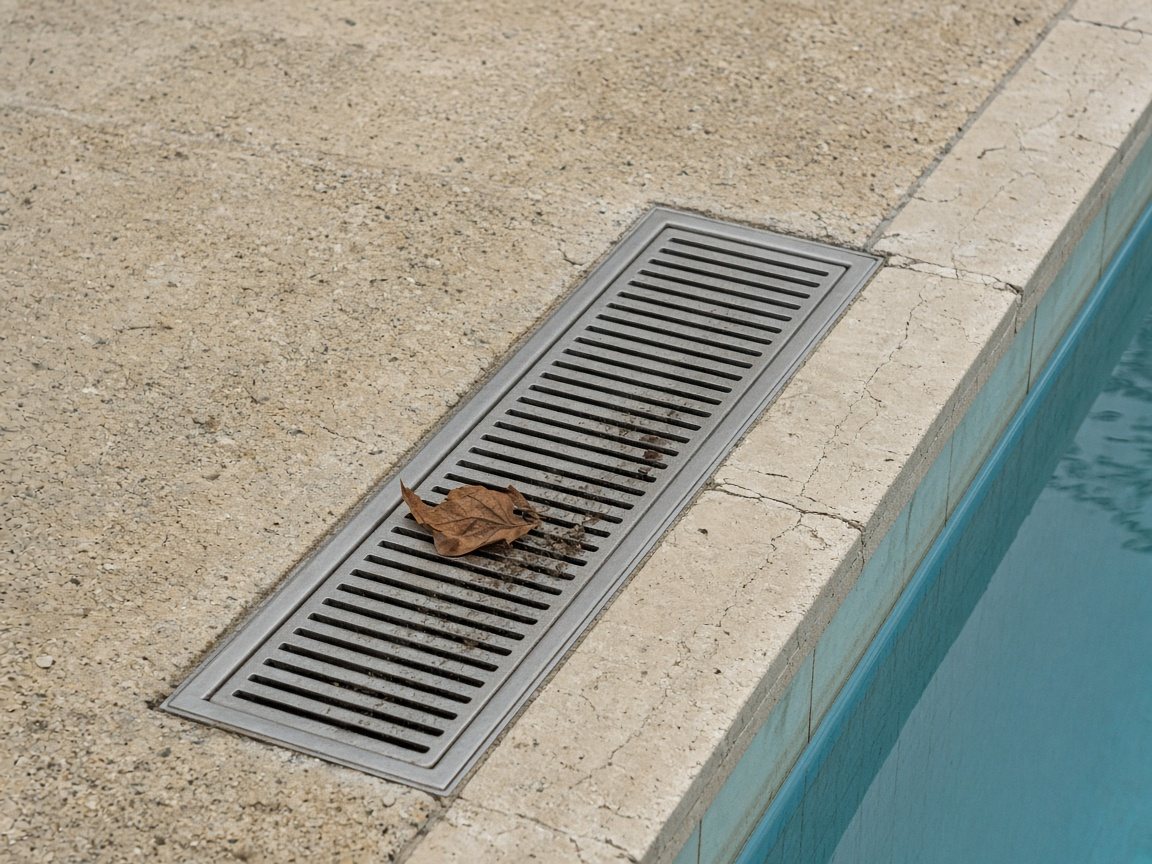
If water sheets across a larger deck, patio, or walk, NDS points to a channel drain: a long, narrow grate that picks up water from the surrounding surface and sends it into a drain pipe. The same article says the hardscape has to slope toward the channel, and the grate has to stay clear of leaves. A channel on the high side of a deck that sheds the other way does not intercept that sheet.
If the water already sits in one small low spot, and the flow is light, NDS points to a grate on a pipe fitting in that spot, or a short series of them. The surface still has to slope toward the grate. The article limits this option to lighter flows and smaller areas. It does not give a square-foot cutoff, so “smaller” stays a judgment for the person sizing the system.
If deck water spills onto the lawn and makes mud, NDS points to a catch basin, a grate, and a pipe to a discharge point downstream. It also names the Flo-Well dry well as an infiltration device that collects water, holds it for a time, and releases it into the ground. Put the inlet where it intercepts the spill. Whether infiltration is allowed on your lot is a question for the local authority.
Scroll horizontally to read all columns.
| Observed path | Collector NDS describes | Condition NDS states | Write this down before you buy |
|---|---|---|---|
| Sheet flow on a larger hardscape | Channel drain with grate, piped away | Slope toward the channel; grate kept clear; moderate flows | Outlet location, and who clears the grate |
| One small low spot, lighter flow | Pipe grate in the low spot | Slope toward the grate; light flow; grate kept clear | That the area matches “smaller,” which NDS does not quantify |
| Spill from the deck onto soil | Catch basin and pipe, or a dry well | Inlet placed to intercept the spill | Whether that discharge or infiltration is allowed |
Takeaway: Match the collector to the path you watched, and write the outlet on the same row.
What does a French drain do that a channel does not?
A channel drain is a surface slot. A French drain, in the contrast NDS draws, is a subsurface collector. On its high-capacity patio solution, NDS describes one product as a “gravel-free alternative to a traditional French drain” used for collection, retention, and dispersion of water. That sentence is a product description. It names the jobs NDS associates with a French drain: collect water below grade, hold it, and disperse it. It does not give gravel size, pipe slope, or a flow rate, and this page does not supply those numbers.
Keep the two paths on separate rows. A channel can sit in the deck. A French drain can sit in the soil beside it. If the deck sheds away from the channel, a perforated pipe in the nearby soil does not turn that sheet into the grate. If the drawings already show a trench or French drain, copy the start, the end, and the outlet onto the sheet. When a trench or French drain is part of an Orlando submittal, the checklist asks for the invert elevation at the beginning and at the end, and for the drain on the cross-section between the pool and the property line. Those elevations come from the sealed plan.
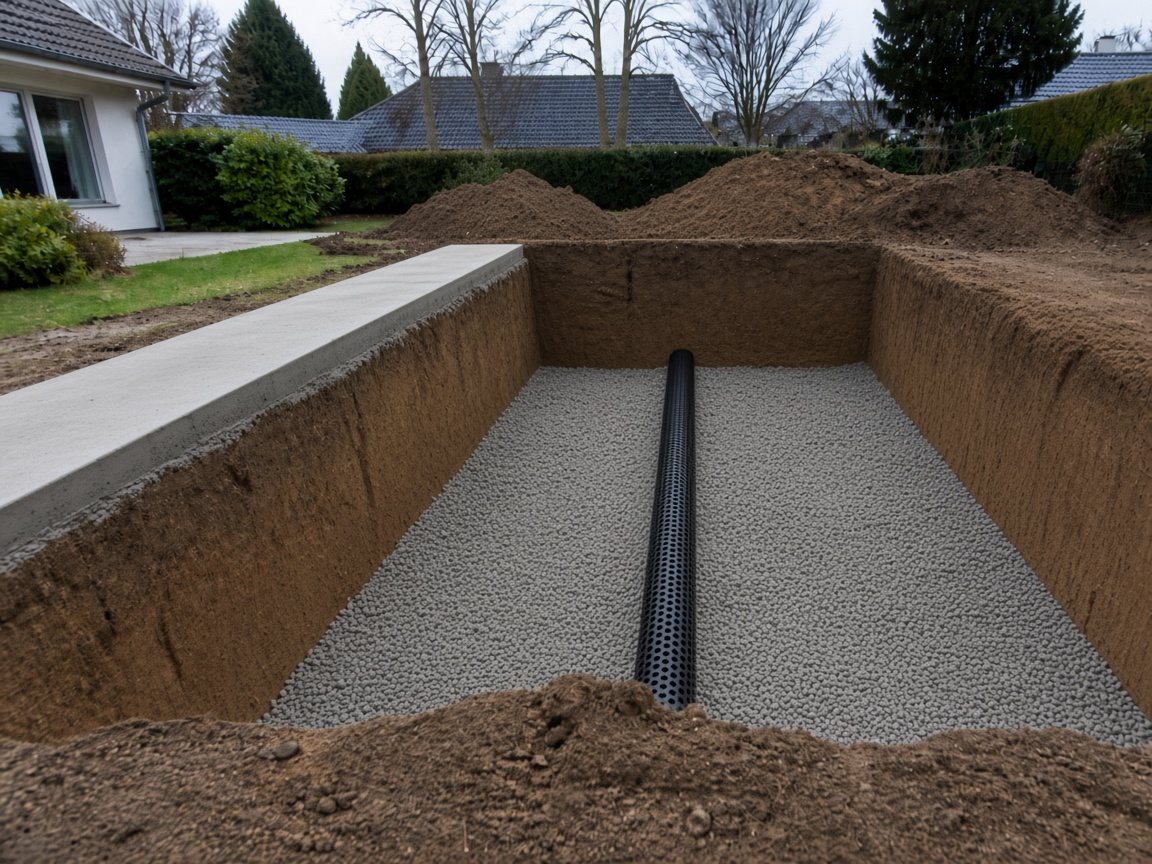
Takeaway: Write the surface inlet and the subsurface pipe as two lines, each with its own outlet.
What do you write on the rainfall walkthrough?
Print this table and put it with the project file. Empty cells stay empty until a rain walk or a document fills them.
Scroll horizontally to read all columns.
| Field | Your project | Where the note comes from |
|---|---|---|
| Catchment / source | Rain walk or roof plan | |
| Surface flow arrows | Rain walk, sketched on a copy of the site plan | |
| Grade observations | What you saw: high point, low point, standing water, mud. Survey elevations if the plan prints them | |
| Inlet | Channel, grate, catch basin, or none on the drawings | |
| Outlet | Pipe end, infiltration, swale, or “not shown” | |
| Legal discharge question | Does this route stay on the property, and which office has to accept it? | |
| Maintenance access | Can someone clear the grate after the deck is finished? | |
| Designer review | Name and stamp, or “not required on this submittal” |
File the sheet with the new pool project checklist, beside the coping, deck, and drainage row. The construction sequence closes that edge at the coping and deck stage. After the pour, the path you did not record is under the concrete.
Cover-vault water is a different record. Use the vault drainage and power page for the housing, not this sheet. Emptying the pool, and drainage that belongs only to the equipment pad, stay off this sheet as well.
What does Orlando ask for on a grading plan?
This is one city’s checklist, retrieved 11 October 2026, not a national slope. The City of Orlando residential swimming pool and spa checklist says the grading and drainage plan shows proposed elevations at the edge of the pool and deck, and a flow arrow for stormwater runoff. It says a pool or deck installation cannot increase or concentrate flow onto the downstream neighbor, or impound water on the upstream neighbor. A diversion has to remain on the subject property. If the site will be regraded, the plans are signed and sealed by a professional engineer or architect registered in Florida. No fill comes on site without an approved grading plan.
When a trench drain or bubble-up is part of the work, the site plan shows it. The cross-section between the pool and the property line includes existing grade, proposed grade, the property-line elevation, the pool and deck edge, and the trench or French drain. If a trench or French drain is proposed, the plan shows the invert elevation at the start and at the end. The survey item asks for existing contours at a minimum of 1-foot intervals, extending at least 25 feet past the property lines or to the roadway centerline, whichever is greater, so the existing drainage pattern can be read. A Florida professional surveyor signs that survey. The checklist dates its development standards to the 2022 code update, Ordinance No. 2022-55, adopted 12 September 2022. Open the current Orlando checklist before you treat any line as still in force. Outside Orlando, keep the same blanks and fill them from your own authority.
Takeaway: Use Orlando’s list as the questions to ask of your grading plan, then replace the city name.
What stays off this sheet?
This page does not size a pipe. NDS says part quantities vary with system length, rainfall intensity, and the number of problem areas, and that its patio solution offers 3-inch and 4-inch pipe whose availability changes by region and store. Those are catalog facts about NDS parts. A diameter chosen without your rainfall, your catchment, and your outlet is a guess, so the size cell stays blank until the designer or the product sheet fills it.
This page does not state a universal deck slope. The retrieved NDS articles say the hardscape should slope toward the channel or the grate. They do not state the rate.
How this page was put together
The comparison is compiled from two NDS pages and the Orlando checklist, all retrieved 11 October 2026. NDS statements describe NDS products and the conditions NDS names. Orlando statements are a Florida municipal submittal example. Neither source was a survey of a particular pool. This page reports no installation and no flow test. Video results for the query “pool drainage channel” were not used. Catalog pages that sell drain sections were not used as design rules. Search checked 11 October 2026, desktop, United States, English.
Frequently asked questions
Are channel drains effective?
NDS says a channel drain collects sheet flow from hardscapes such as patios and pool areas when the surface slopes toward the channel and the grate stays clear of leaves. Without that slope and a release point, the grate is a slot in the deck.
How deep does a channel drain need to be?
The NDS articles retrieved on 11 October 2026 do not state a depth. Copy the section depth from the product sheet and any invert elevations from the grading plan. If neither document has a number, leave the cell blank.
Do you need gravel under a channel drain?
Those NDS pages do not call for gravel under a surface channel. They describe a different product as a gravel-free alternative to a traditional French drain. Follow the installation sheet for the product shown on your drawings.