Key takeaways
- Auto-fill is a construction-stage plumbing item; the leveler housing and fill line belong in the ground with the rest of the pipe.
- Confirm the accepted protection for the potable connection with the local water authority and inspector.
- Float-valve levelers are simple and unpowered; electronic sensors add control but need power and maintenance.
- Watch the water it adds: an unmonitored auto-fill is the classic way a leak stays invisible.
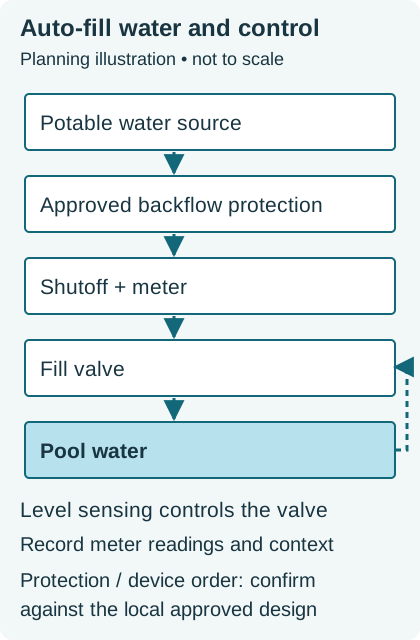
A steady waterline can hide unusual consumption. Auto-fill handles topping up, but it needs a way to observe the water added. On this site it belongs to water management planning, because the decision belongs before the plumbing is buried.
How the systems work
Scroll horizontally to read all columns.
| Control | How it responds | What to check |
|---|---|---|
| Mechanical float | Water level moves a valve; no electronic controller | Housing, valve access and accepted potable connection |
| Electronic | Sensor/controller operates a fill valve | Power, sensing route, timing, diagnostics and supported automation |
A manufacturer’s public IntelliLevel guide, P/N 523307 Rev. D (December 2018), describes solenoid control, diagnostic indicators and stand-alone/automation power arrangements. Those features do not establish remote alerts, scheduling or integrations for all electronic levelers. This discontinued model is a documentation example, not a product recommendation.
Backflow example: Oklahoma’s official posted OAC 310:315-5-1(c), for public bathing places (official compilation dated 30 September 2024; accessed 8 October 2026), calls for an RPZ backflow preventer for auto-fill without an air gap. This is a jurisdiction-specific example, not a residential rule for other states. Have the plumber identify the adopted rule and accepted protection for this project.
Put pipe and conduit routes on the construction drawings and equipment schedule before they are concealed. For climate-related water planning, see hot-climate pool design.
Takeaway: Verify model functions and local protection requirements before specifying connections.
The leak-masking problem
Compare fill records with weather, bathing use, cover use and recent service. Do not set a leak threshold from this sheet. An unexplained change calls for checking the fill valve, visible plumbing and possible leakage with a pool professional.
Scroll horizontally to read all columns.
| Date / time | Meter start / end and unit | Water added | Weather / use / cover changes | Check or follow-up |
|---|---|---|---|---|
If there is no dedicated meter, mark consumption as unknown rather than estimating from a valve indicator.
Takeaway: Record context with the readings before deciding what changed.
Planning notes for the checklist
Record the leveler location, fill-line routing, backflow device, and any power or automation tie-in in the new pool project checklist so they reach the drawings. On remodels, ask whether a shared trench is permitted and practical for the planned services.
Takeaway: Put accepted device locations and unresolved routes on the project sheet.
What this page does not decide

Which backflow assembly your jurisdiction accepts, and where it must sit, is a local-code question for your plumber and inspector. The planning decision here is to give the system a place in the ground before the ground is closed.
Frequently asked questions
How does an automatic pool fill system work?
A small housing beside the pool holds a float valve, or a sensor watches the level electronically. When the water drops below range, the valve or a solenoid opens a dedicated fill line until the level recovers. The pool stays in its working band without anyone standing there with a hose.
Can I add auto-fill to an existing pool?
Often, but it means trenching a water line and cutting in a leveler housing, so coordinate those changes with planned construction or remodel work. Confirm which retrofit layout fits the site and what backflow protection the local authority accepts before connecting it.
Does an auto-fill hide leaks?
It can. Because the level never visibly drops, a slow leak just becomes higher water consumption. Use measured fill consumption where available and record weather and use. A controller indicator is not necessarily a volume meter; ask a professional to investigate unexplained changes.