Key takeaways
- Four rows are non-negotiable: pump, filter, sanitization, and compliant safety fittings; everything else is a project decision.
- Confirm pump efficiency and control requirements for the market, equipment class and manufacture date; certification or rebates do not establish code compliance.
- Heat, automation, and cover drives change electrical loads and pad space, so the list must exist before the pad is designed.
- Write the list as an equipment schedule with model, power, and clearance columns, not as a shopping basket.
An equipment list is the input for the pad layout, the electrical plan, and half the equipment guide decisions that follow. Build it as a schedule of rows with power, space, and service requirements before anyone pours concrete.
Required systems and selected additions
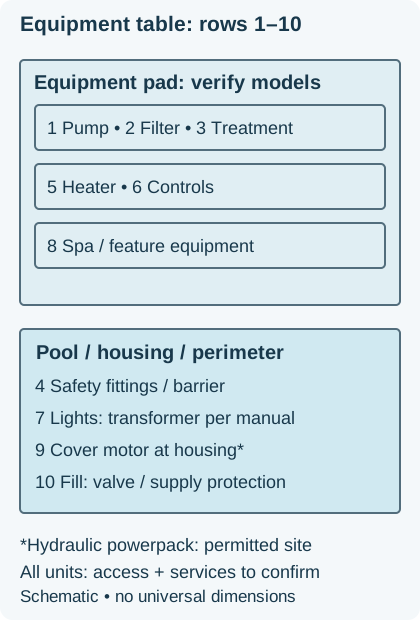
For residential mechanical circulation, use this planning schedule; safety and equipment requirements follow the approved project and selected manuals.
Scroll horizontally to read all columns.
| ID / equipment | When needed | Electrical / plumbing inputs | Location | Manual space to record |
|---|---|---|---|---|
| 1 / Pump | Circulation design | Supply, controls, flow/head and ports | Verified pad position | Motor/drive removal and ventilation |
| 2 / Filter | Filtration design | Rated flow, ports and drain | Circulation route | Lid removal height and clamp access |
| 3 / Sanitization | Water-treatment plan | Feed/cell power, ports and protection | Per treatment/heater documents | Cell or feeder access |
| 4 / Safety fittings | Local approved design | Suction layout, bonding and barrier inputs | Pool and perimeter | Code and product installation requirements |
| 5 / Heat | Heating selected or future provision | Fuel or electrical load and flow | Approved heater location | Exhaust or heat-pump airflow |
| 6 / Controls | Automation selected | Supply, wiring and valve interfaces | Permitted control position | Panel access |
| 7 / Lights | Lighting selected | Fixture, transformer and wiring requirements | Manual-approved locations | Fixture/transformer access |
| 8 / Spa / features | Spa or feature selected | Pumps, blower and valve requirements | Per feature plan | Each unit’s envelope |
| 9 / Cover | Automatic cover selected | Circuit or powerpack/hoses; cover-pump discharge | Motor may be at housing; powerpack per manual | Both housing and powerpack access |
| 10 / Fill | Automatic filling selected | Water supply, protection and control | Per fill plan | Valve/controller access |
Takeaway: Keep optional purchases separate from reservations needed now.
Pump rules and lighting locations
For the U.S. market, 10 CFR 431.465(f) sets class-dependent efficiency requirements for covered non-submersible dedicated-purpose pool pumps manufactured from July 19, 2021; (g) covers timers for integral filter pumps. This is not a blanket statement that every pump must be variable-speed. Check the applicable pump/motor class, manufacture date and current state/local rules. ENERGY STAR certification and utility rebate eligibility are separate checks, not proof of mandatory compliance.
Place lights, transformers and junctions according to the selected lighting manual and approved electrical plan; a transformer is not automatically placed on the pad.
Takeaway: Record the actual rule and manual used for each selection.
Turning the list into a schedule
For each row record the model or placeholder, flow or capacity, electrical load, fuel or plumbing needs, physical footprint, and clearance for service. That table is what the pool equipment BOM template is for, and it feeds the pad layout drawing.
Resolve the schedule before the construction sequence closes pad and conduit routes. Later additions may require trenching.
Takeaway: Transfer confirmed models and access envelopes to the layout.
What the list does not decide
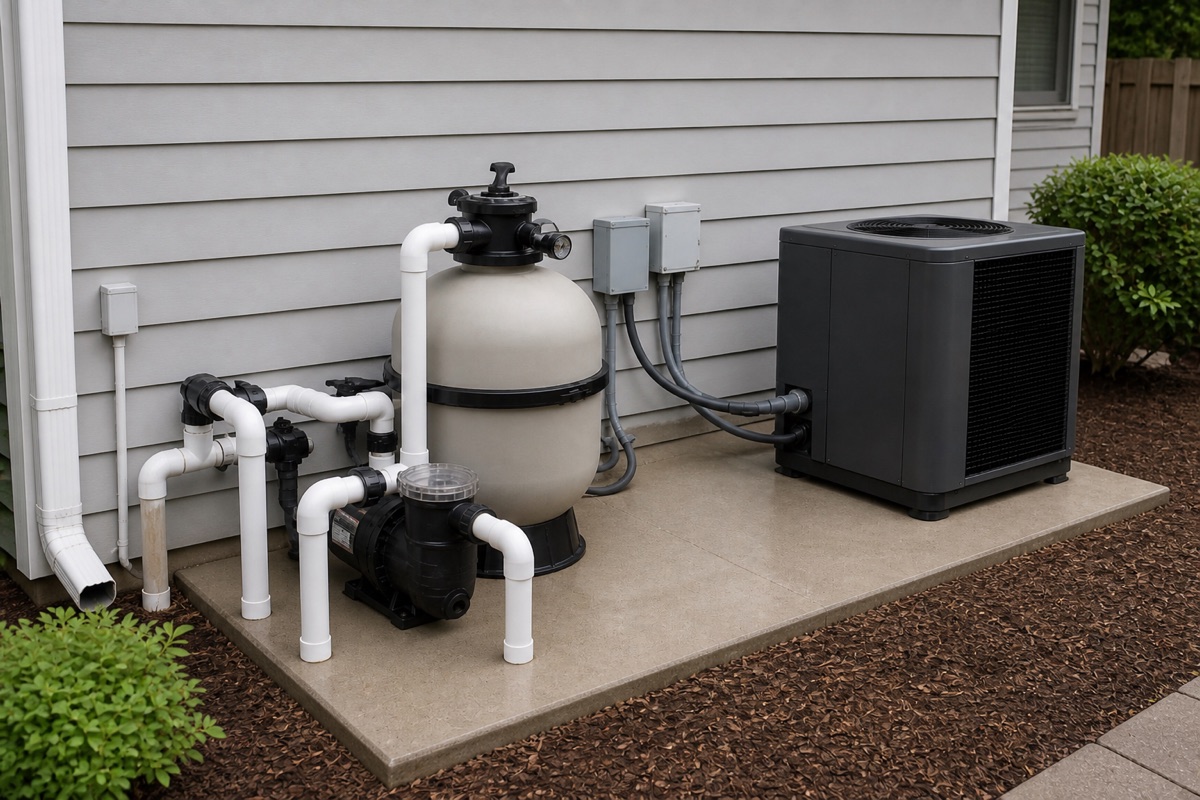
Brand choices, exact sizing, and code sign-off stay with your builder, your utility’s efficiency rules, and your inspector. Use the list to confirm that nothing needs space, power, or pipe that was never reserved.
Frequently asked questions
What is the minimum equipment for a functioning pool?
A properly sized circulation pump, a filter matched to that pump's flow, a sanitization method such as a chlorine feeder or saltwater chlorine generator, and the safety fittings your local code requires, including compliant suction outlet covers. Everything beyond that serves comfort, efficiency, or convenience.
Do I have to decide on a heater before construction?
You have to decide whether heat is possible, even if you defer the purchase. A gas heater needs fuel supply and venting clearances; a heat pump needs airflow and a larger electrical circuit. Reserving space and conduit costs little during construction and a lot afterwards.
Where do automatic covers fit in the equipment list?
The cover drive (electric motor or hydraulic power pack) is an equipment row with its own power, location, and service-access needs, and covered pools usually add a cover pump for rainwater. The electric motor may sit at the cover housing; a hydraulic powerpack has its own permitted location. Record each location and its routes.
Sources
- 10 CFR 431.465(f)–(g), U.S. pump efficiency classes and manufacture-date requirements — U.S. Office of the Federal Register
- Pool pumps product criteria and certification — U.S. EPA ENERGY STAR
- IntelliFlo3 VSF / IntelliPro3 VSF Installation and Maintenance Guide, P/N 356231 Rev. E (June 30, 2025), Installation and Technical Data — Pentair
- Clean & Clear Plus Installation and User Guide, P/N 178558 Rev. U (May 10, 2023), Filter Location / Table 2 — Pentair
- Save-T 3 / Autosave general installation overview, 800024 Rel-0024 (2015), PDF pp. 4–7, 10, 14–16 — Cover-Pools