Key takeaways
- Review cover use with local wind, humidity and water-temperature inputs.
- Makeup water needs a planned, protected fill path, not a garden hose over the coping.
- Record dust exposure and confirm filtration duty and cleaning access for the project.
- Sun and heat punish materials and equipment; specify UV-stable finishes, corrosion-resistant hardware, and shaded, ventilated pad locations.
A climate label alone can miss water loss or equipment constraints. Record the site’s wind, humidity and exposure before choosing the planning priorities.
Scroll horizontally to read all columns.
| Climate input to record | Project action |
|---|---|
| Dry heat: temperature, humidity, wind and exposed water area | Assess cover use and locally applicable evaporation depth |
| Humid heat: humidity and shade through the day | Check water balance and the selected equipment’s environment limits |
| Coastal: salt exposure and wind direction | Confirm material suitability and maintenance instructions |
| All sites: fill-meter readings, dates and weather | Investigate unexplained changes; do not equate all make-up water with evaporation |
| Equipment: manual revision, airflow and service envelope | Keep shade outside required intake/discharge space |
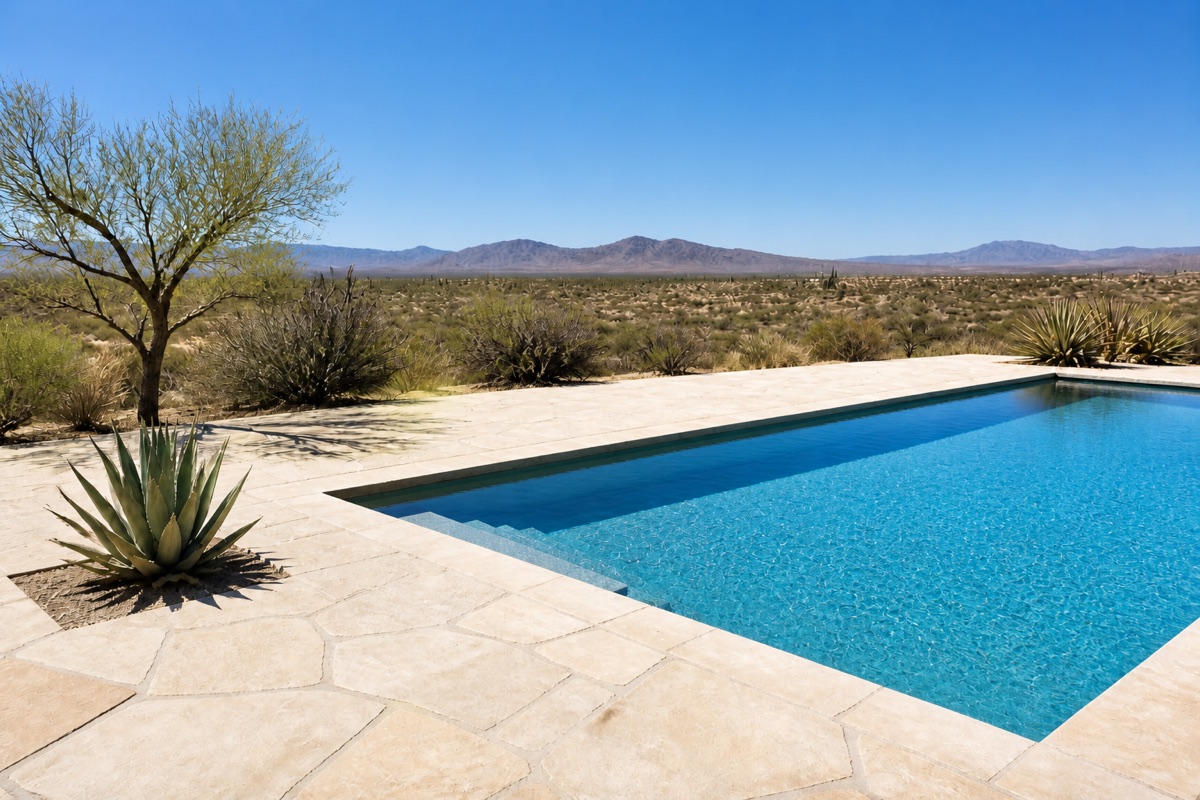
Evaporation is the main event
DOE guidance identifies evaporation as a major source of pool heat loss and relates it to temperature, humidity and wind. Review these options against the site:
- A cover, ideally an automatic one that actually gets used daily. See automatic pool cover planning for the structural decisions this requires.
- Windbreaks: walls, planting, and structures that slow air over the water.
- Restraint with sprays and waterfalls. Record feature operating hours when reviewing water use.
Takeaway: Use the local inputs to evaluate cover and feature use.
Water in must be planned like water out
A pool that loses water daily needs a deliberate way to gain it back. That means a metered, protected fill line, usually an automatic fill system with proper backflow protection, so makeup water is measured and visible rather than hidden in a hose habit. An unexplained increase is a reason to investigate weather, use, backwashing and leaks; it does not identify the cause.
Takeaway: Keep a dated fill record and investigate unexplained changes.
Dust, sun, and materials
Record dust exposure and check filtration/cleaning access with the designer. Confirm UV and corrosion suitability from the selected material literature; the materials hub separates those decisions.
EPA cool-pavement guidance discusses solar reflectance, material properties and climate. It does not guarantee a barefoot-safe pool deck. Compare candidate surfaces at representative temperatures, sun/shade and wet/dry conditions; use shade and measured surface temperatures rather than color or texture alone.
Takeaway: Check actual exposure and surface temperature before accepting a material.
Equipment placement in heat
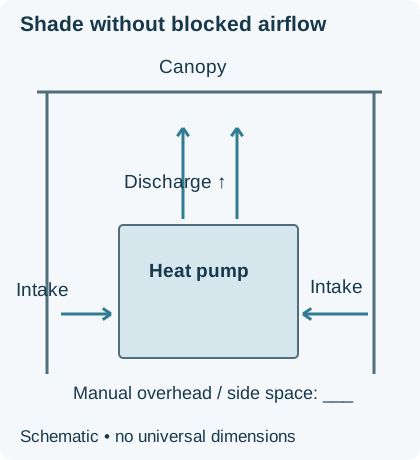
Keep the equipment pad within the model’s operating environment and ventilation requirements. A manufacturer’s UltraTemp manual, P/N 474099 Rev. AA (May 4, 2023), Location and Clearances / Figure 1, specifies intake, service and overhead space; a shade roof must not obstruct the discharge. Record the actual model limits, not a generic enclosure size.
Carry all of these line items into the new pool project checklist so the climate answers are on paper before the first drawing is approved.
Takeaway: Check shade against the equipment’s airflow envelope.
What this page does not claim
No single design fits every climate. Humid heat, coastal salt, and freeze-thaw sites each shift the priorities again, and local codes and utilities set the binding rules. Use this page to ask climate questions early, while the answers are still inexpensive to change.
Frequently asked questions
How much water does a pool lose in a hot, dry climate?
Use an applicable local evaporation depth and water-surface area for the same period: estimated volume in litres = depth in mm × area in square metres. Weather, cover use and pool conditions affect applicability. Make-up water also includes other losses, so a fill meter is not an evaporation measurement or a leak diagnosis.
Does a pool cover really matter more than pool size or shape?
DOE guidance identifies evaporation as a major pool heat-loss mechanism and covering as a way to reduce it. This does not rank a cover above size or shape for every project; compare climate, surface area, cover use and the selected system.
What changes for the equipment in hot climates?
Record the equipment manual's ambient and humidity limits and keep intake, discharge and service clearances open. Check any shade structure against those clearances and confirm material suitability for the actual exposure.
Sources
- Swimming pool covers, evaporation factors and covering practice — U.S. Department of Energy
- Using Cool Pavements to Reduce Heat Islands, surface properties and climate limits — U.S. Environmental Protection Agency
- UltraTemp Installation and User Guide, P/N 474099 Rev. AA (May 4, 2023), Location and Clearances / Figure 1 — Pentair