Key takeaways
- Cover decisions are structural: track, housing, drainage and drive routes can affect shell and coping details.
- The five decisions to lock early are track type, vault geometry, drive type, drainage, and coping profile.
- A cover changes evaporation, heat loss, and safety behavior, so it also changes equipment and water planning.
- Everything agreed must appear on the construction drawings, not in a later change order.
A late cover decision can require alterations. Plan the five space commitments while the design can still change. That is why this page sits at the front of the pool covers hub rather than at the end of a catalog.
This page is the decision framework: the five choices and what each commits you to. When you need the same decisions mapped onto the build schedule stage by stage, continue to covers for new construction; for a pool that already exists, start from the retrofit guide instead.
The five decisions to lock during design
Scroll horizontally to read all columns.
| Choice | Space commitment | Manufacturer drawing to obtain | Unconfirmed item to record |
|---|---|---|---|
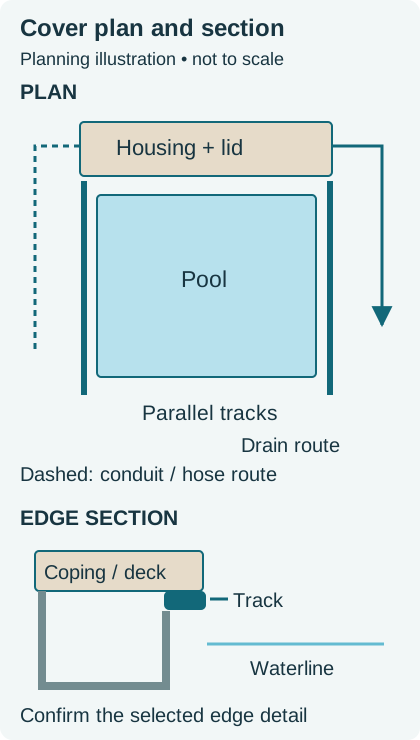
| Track family | Parallel envelope, deck or wall channel | Track plan and fixing section | Base, alignment, obstacles |
| Vault or bench | Roll, mechanism, lid and service zone | Housing plan and access section | End location and clear space |
| Electric or hydraulic drive | Conduit or hoses; unit access | Model layout and routing sheet | Route length and permitted duty |
| Drainage | Discharge route from housing | Drain / recess detail | Outlet and site acceptance |
| Coping / deck | Edge profile and track interface | Coping / channel section | Finish thickness and fixing |
A manufacturer’s public planning brochure shows deck-mounted, flush and underside-track layouts. The Hydramatic Undertrack/Top Recess manual (2007) supplies a specific housing/track example, not universal dimensions. Record the current selected model and drawing revision beside each choice.
For design detail, compare track types, drive layouts and vault drainage.
Takeaway: A choice is ready for coordination only when its space and unresolved details are recorded.
What a cover changes elsewhere in the plan
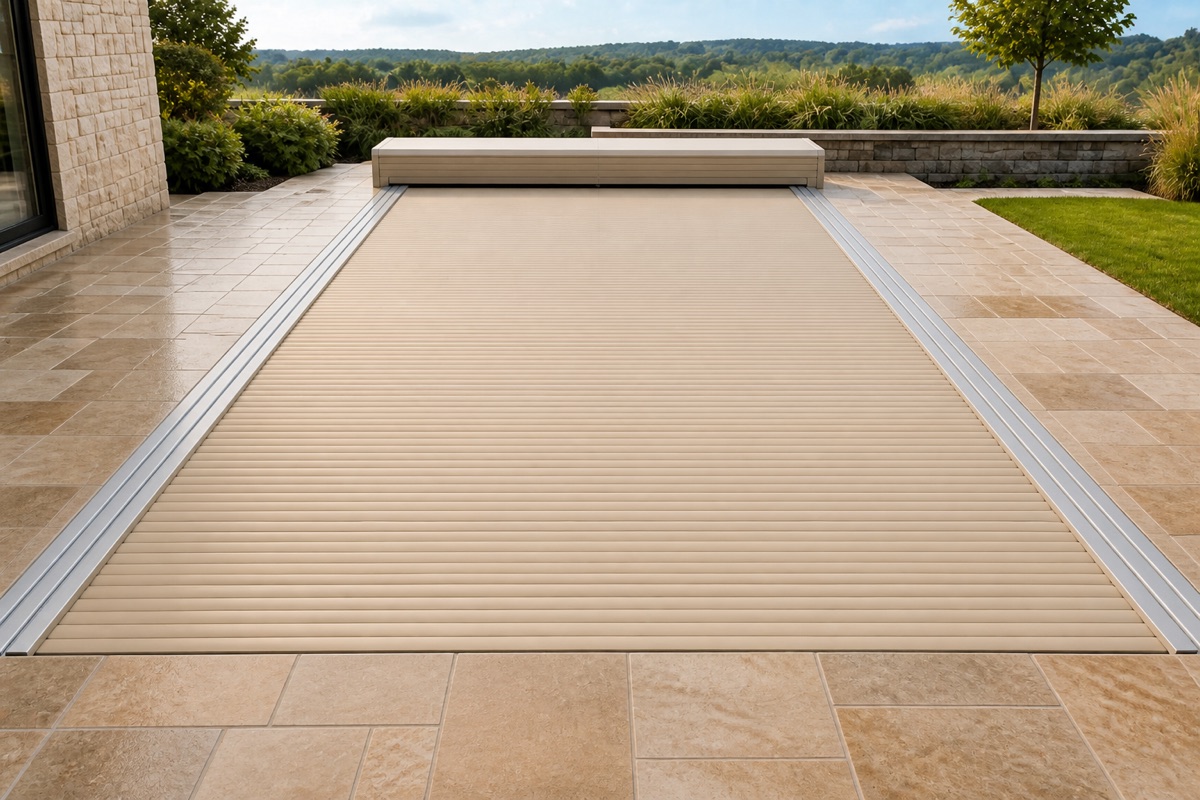
EPA public commercial-pool guidance describes evaporation control with covers. That can reduce operating demand; it does not by itself select a smaller heater. Have the designer check climate, uncovered use, target temperature and heat-up time. See pool design for hot climates. List the selected drive and any required cover-water pump on the equipment schedule, with pad space to match.
A cover also changes daily safety behavior, but a cover is a product with its own tested ratings. Check the specific model’s documentation rather than assuming any cover meets any standard.
Takeaway: Treat cover use as an operating input, then have the designer confirm heater selection.
Getting it onto the drawings
Every decision above has to appear on the construction documents. Use the construction sequence to place reviews before the work that would conceal each detail. The automatic pool cover coordination checklist walks the full list (dimensions, track, vault, drainage, power, coping, and the drawing sign-off points) in a form you can hand to the builder.
Takeaway: Carry the approved choices and unresolved items into the construction checklist.
What this page leaves out
Repair, fabric replacement, and troubleshooting are service topics for existing covers and are out of scope here. This site covers planning: getting the system into the structure on the first installation.
Frequently asked questions
When is the right time to decide on an automatic cover?
During design, at the same time as the pool's shape and equipment location. Track recesses, housing, drains and drive routes can affect structure or deck work. Confirm them before the trade that would conceal or obstruct them.
Does a rectangular pool make covers easier?
Yes. A true rectangle lets the cover track run parallel along both sides, in deck recesses or under coping. Freeform shapes need a track wider than the water at every point, which changes the proposed envelope and installation work. If a cover matters to you, let it influence the shape early.
What does a cover change about the rest of the project?
A cover can reduce evaporation and heating demand, but heater selection still needs the project heat-load calculation, target temperature and use schedule. The vault needs a drain that actually goes somewhere, the deck needs a coping profile matched to the track, and the equipment plan gains a drive unit and usually a cover pump.
Sources
- Cover-Pools Dealer Brochure (2017), track and housing planning diagrams — Cover-Pools
- Hydramatic Undertrack and Toptrack/Recess Installation Manual (2007), pre-site checks and track details — Aquamatic
- Hydramatic Toptrack Installation Manual (2007), bench, hose and control layout — Aquamatic
- WaterSense at Work 5.3: Commercial Pool and Spa Equipment (November 2023), evaporation and covers — U.S. Environmental Protection Agency