Key takeaways
- Track type is a structural decision that locks the coping profile before stone is ordered.
- Undertrack is the concealed, new-construction option; top track is the visible, retrofit-friendly option.
- Recessed deck tracks trade some concealment for retrofit flexibility.
- Track choice, vault position, and deck drainage are one coordinated detail, not three separate ones.
A track detail chosen after the coping can cause rework. For the tracked systems compared here, track position is a visible decision in cover planning. It is also one of the earliest. The track family fixes the coping profile, and coping is ordered long before anyone unrolls fabric.
Scroll horizontally to read all columns.
| Check | Undertrack | Recessed deck track | Top track |
|---|---|---|---|
| Position | Beneath coping / edge channel | Channel flush with deck | Deck surface |
| Selection condition | Edge accepts documented channel/fixing | Deck accepts channel and anchorage | Deck support, anchors and travel clearance verified |
| Work to confirm | Coping or edge construction; conversion may need rebuilding | Channel formation/cutting, drainage and substrate | Load support, fixing, unobstructed parallel paths and drainage |
| Geometry source | Selected edge section | Selected deck-channel section | Selected surface-track section |
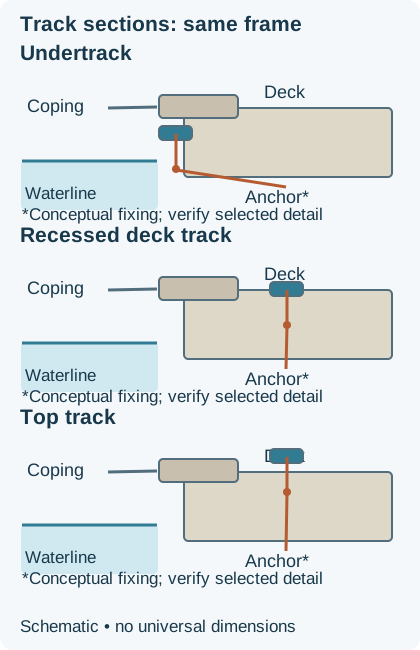
This comparison uses public installation documents, not our tests. A manufacturer’s Save-T 3 overview (2015), Track Options and Coping and Deck sections, illustrates these positions and fixing details; the Hydramatic manual (2007), Track Extrusions and Top/Recess Track Installation, gives system-specific fastening checks.
The three families
Undertrack. The track mounts under the coping overhang, inside the pool’s top edge. The hardware is concealed at the edge. The cost is coordination: the bond beam, coping profile, and track geometry are one detail, built during construction. Review it while the edge can still be detailed.
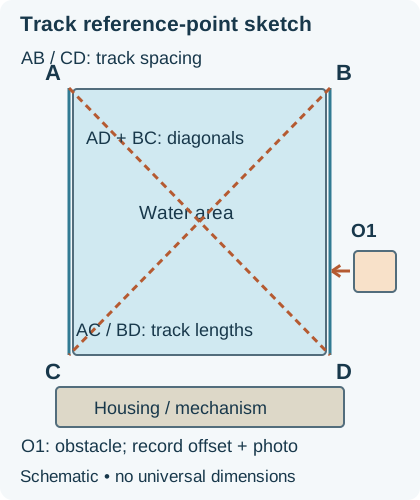
Top track. The track mounts on the deck surface, outside the waterline. Existing-deck installation needs verified substrate support, anchorage, travel clearance and drainage; edge work may still be necessary. Deck-mounted tracks also widen the system: the covered rectangle includes the track spacing, not just the water.
Recessed deck track. The track sits in a channel cut or formed into the deck, flush with the surface. Its flush appearance is a visual preference; forming or cutting the channel needs its own construction review. Consider it on remodels with deck work, the situation described in adding a cover to an existing pool.
Takeaway: Choose only after the existing or proposed edge passes the system-specific check.
What the choice commits you to
Three details follow the track decision immediately:
- Coping profile. Undertrack needs an overhang and fastening detail that match the specific system. Choose the track before you order stone.
- Deck drainage. Water must shed away from the track and the vault, whatever the family. A track channel that also collects runoff becomes a lasting maintenance problem. Drainage is covered in vaults, drainage and power.
- System width and the vault. Track spacing is an input to fabric, mechanism and housing selection. That is why the measurement guide starts from track lines rather than waterlines.
Takeaway: Review coping, drainage and measured geometry as one detail.
Choosing during design
On a new build, consider undertrack if the selected edge detail supports it. Decide it at the same time as the five structural choices in automatic pool cover planning. On an existing pool, the geometry you have decides more often than preference. Either way, record the choice, with the manufacturer’s actual track detail, in the cover coordination checklist so the builder, the stone supplier, and the cover installer are reading the same drawing.
Takeaway: Record the accepted track detail with the drawing revision.
What this comparison leaves to the product
Track materials, fastening specifics, and span limits are product engineering, and they vary by manufacturer and model. Use this page to pick the family during design. Use the chosen system’s documentation for every dimension after that.
Frequently asked questions
Which track type looks best?
Undertrack may suit a preference for concealed hardware. This is a visual preference, not a performance ranking. Check the chosen edge and track detail before deciding; recessed and top tracks have different visible profiles.
Can a top-track cover be converted to undertrack later?
Conversion may require rebuilding coping or the pool edge to provide the selected channel and fixing detail. Have the installer and structural designer assess the existing construction; it is not categorically impossible or a simple track swap.
Does track type change the cover's function?
Track position changes geometry, fixing and the deck interface. Operation, limits and maintenance depend on the complete selected system; do not infer equivalent performance from the track family alone.