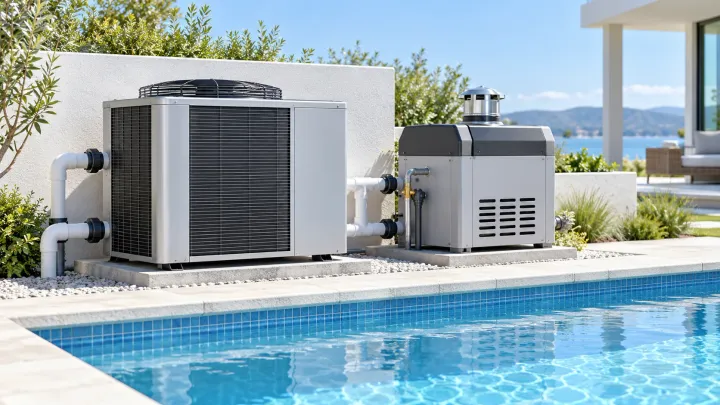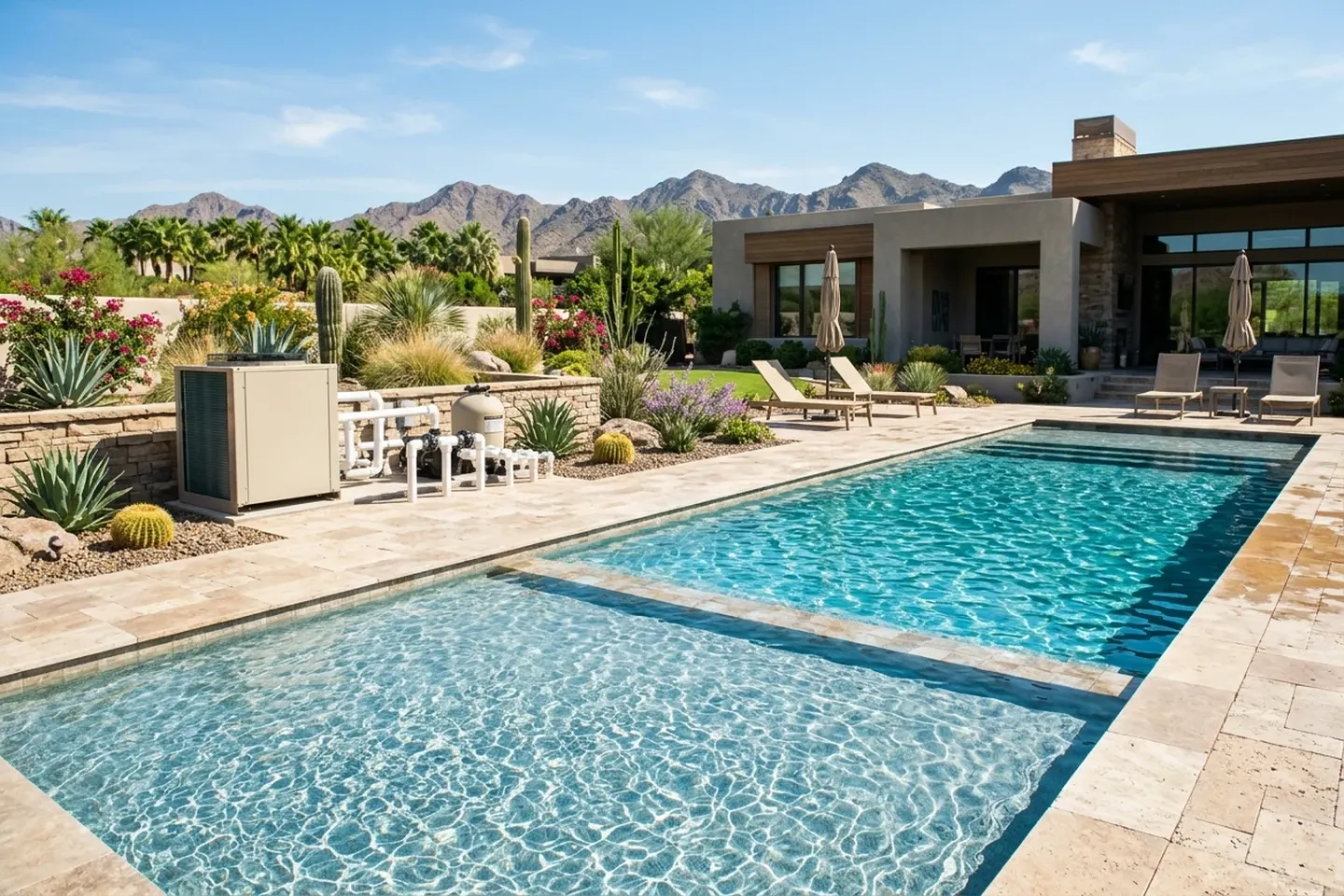
Selecting a pool chiller requires checking how water surface area, shallow zones, and sun exposure interact with the cooling unit’s rated capacity and circulation plumbing. Before choosing between an evaporative pool cooler and a reversible heat-cool heat pump, compare how surface heat transfer works, verify the unit’s dedicated cooling output, and match the plumbing layout to your circulation pump. For the broader equipment selection sequence, start with our pool equipment guide.
Scroll horizontally to read all columns.
| Verification area | Question to verify on site | Record to keep with the equipment schedule |
|---|---|---|
| Pool geometry | What are the measured water surface area, average depth, and total gallon volume? | Surface area calculation, depth profile, and volume worksheet |
| Solar and wind exposure | Is the pool unshaded all day, finished in a dark or pebble surface, or exposed to wind? | Sun exposure notes, interior finish specification, and wind exposure category |
| Cooling equipment type | Will the project use a reversible heat-cool heat pump or a fan-driven evaporative pool cooler? | Manufacturer, exact model number, and cooling rating or gallon capacity |
| Operating schedule | Which hours will the circulation pump and chiller run during the night and day? | Nighttime cool-down schedule and daytime maintenance window |
| Circulation and bypass plumbing | Does the selected unit require an external manual bypass valve, throttled inlet ball valves, or suction-side return routing? | Pump horsepower, flow rate range, bypass diagram, and pad run distance |
Why water surface area and solar gain drive pool chiller sizing
Begin by separating water surface area from total water volume, and review how radiation, convection, and evaporation act across the exposed pool surface. For site-level evaporation, shade, and climate planning, see our pool design for hot climates guide.
Pool thermal sizing is based on four considerations: conduction through the pool walls, convection from the pool surface, radiation from the pool surface, and evaporation from the pool surface.
During the daytime, an unshaded pool receives radiant energy often as much as 100,000 Btu/h.
At night on clear, cool nights, the sky temperature may be as much as 80°F below ambient air temperature, causing radiation heat losses from the pool surface.
Evaporative losses constitute 50 to 60% of heat loss from the pool in most cases.
Except in aboveground pools and rare cases where cold groundwater flows past the pool walls, conduction losses through the pool walls are small and can be ignored.
ASHRAE states that the desirable water temperature for swimming pools is 80°F.
A circulation rate that generates a change of water every 8 h for residential pools and every 6 h for commercial pools is acceptable.
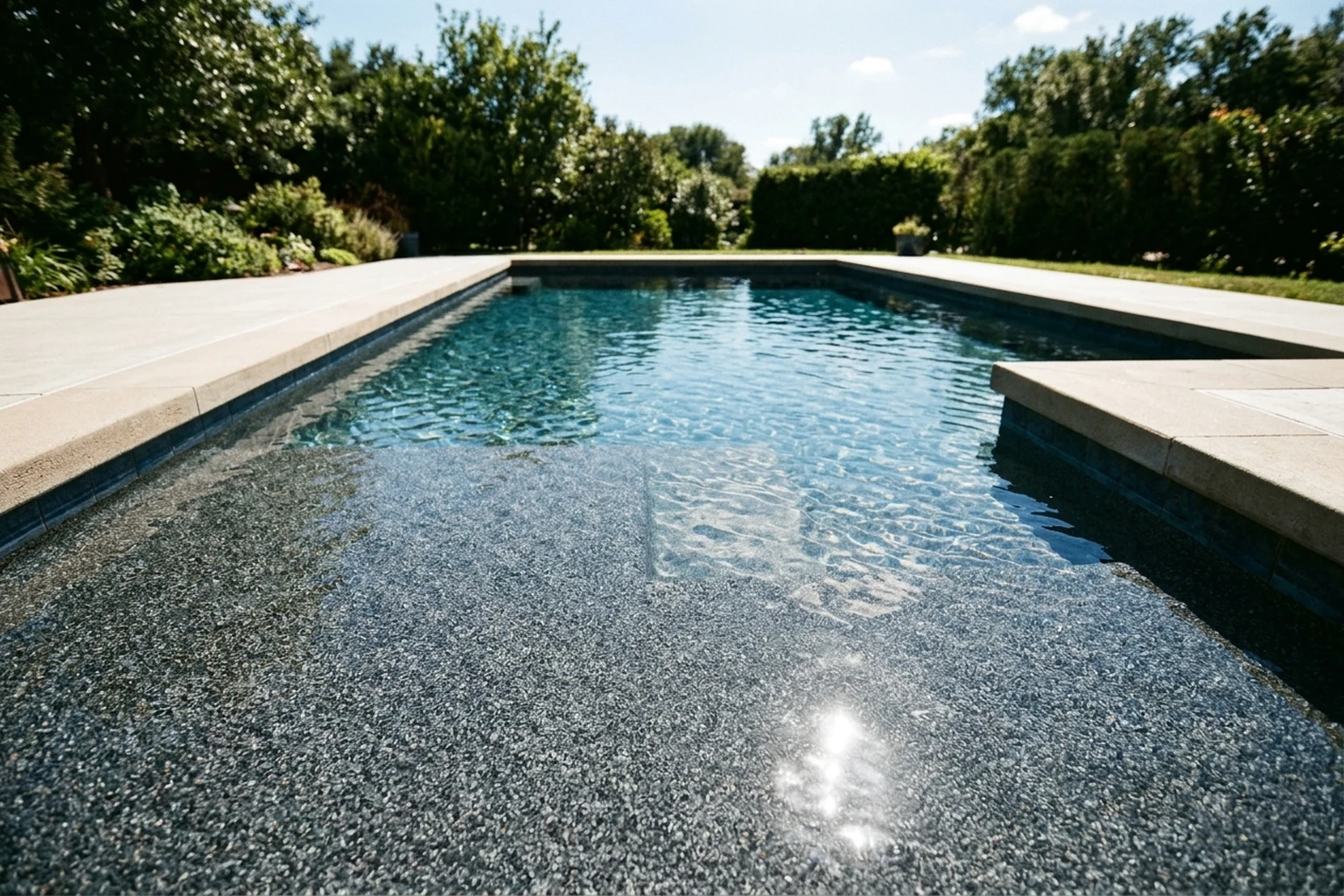
Surface area, volume, and surface heat transfer equations
Use the equations and table values below to keep water surface area, average depth, and wind velocity separated on your sizing worksheet.
Scroll horizontally to read all columns.
| Pool geometry & water constants | Surface heat transfer & wind exposure |
|---|---|
| For a rectangular pool, surface area equals Length times Width (Area = LW). | In the ASHRAE pool surface heat transfer equation, the surface heat transfer coefficient U is 10.5 Btu/h·ft2·°F. |
| For a kidney-shaped pool, surface area is approximately 0.45 times Length times the sum of widths at each end, Area = 0.45L(A+B). | The ASHRAE pool surface heat transfer equation assumes a wind velocity of 3 to 5 mph; sheltered pools under 3.5 mph use 75% of the calculated value. |
| Pool water volume in gallons equals 7.5 gal/ft3 times Surface Area times Average Depth. | For higher wind exposure in the ASHRAE surface heat transfer equation, a velocity of 5 mph multiplies surface heat transfer by 1.25, and 10 mph multiplies by 2.0. |
| In the ASHRAE outdoor pool thermal rate equation, the density of water is 8.33 lb/gal and the specific heat of water is 1.00 Btu/lb·°F. | Raypak's Heat Loss from Water Surface table reports heat loss in BTUH per square foot across air velocities from 0 to 34.09 miles per hour at 70% humidity. |
| Raypak's Residential Heater Sizing chart indexes required degree rise per hour by Pool Size - Surface Area in Square Feet (from 300 to 1000 sq. ft.) assuming an average pool depth of 5 ft. | In Raypak's surface heat loss table at 80°F air and 80°F water (70% humidity), heat loss is 17 BTUH per square foot at 0 miles per hour, 66 at 3.4, and 106 at 6.81 miles per hour. |
Reversible heat-cool heat pumps: heating BTU class vs cooling BTU output
When evaluating a reversible heat-cool pool heat pump, read the cooling capacity column separately from the heating capacity column. For cold-season heating derate and gas heater comparisons, see our pool heat pump ambient derate vs gas heater guide.
For heat-pump pool units, output capacity and thermal efficiency vary with ambient conditions, and measured COP depends upon the rating conditions at which the products were tested.
UltraTemp heat pumps are available with heat/cool functionality that can automatically heat or chill a pool to the desired temperature.
Pentair UltraTemp table ratings are in accordance with AHRI Standard 1160 and ordered as air temperature (°F), relative humidity (%), and water temperature (°F).
Compare the Pentair UltraTemp H/C and Raypak Crosswind V Deluxe heat/cool model specifications below by rating condition.
Scroll horizontally to read all columns.
| Heating capacity & COP | Cooling capacity, electrical & model details |
|---|---|
| UltraTemp 120 H/C (part numbers 460935 Almond, 460965 Black) has a listed heating BTU capacity of 125,000 and COP of 5.5 at 80/80/80. | UltraTemp 120 H/C has a listed cooling BTU capacity of 71,000 and cooling COP of 4.1 in the 80/80/80 column. |
| UltraTemp 120 H/C has a listed heating BTU capacity of 118,000 (COP 5.3) at 80/63/80 and 80,000 (COP 4.0) at 50/63/80, with a 50 Amp breaker and 230/60Hz/1 voltage. | UltraTemp 140 H/C has a listed cooling BTU capacity of 71,000 and cooling COP of 4.1 in the 80/80/80 column. |
| UltraTemp 140 H/C (part numbers 460958 Almond, 460959 Black) has a listed heating BTU capacity of 140,000 and COP of 5.6 at 80/80/80. | UltraTemp 140 H/C has a listed heating BTU capacity of 132,000 (COP 5.4) at 80/63/80 and 85,000 (COP 4.0) at 50/63/80, with a 50 Amp breaker and 39x31x44.5 in. dimensions. |
| UT140 H/C Active Defrost (part number 462032) has a listed heating BTU capacity of 138,000 (COP 5.6) and a listed cooling BTU capacity of 70,000 (COP 4.0) in the 80/80/80 column. | Raypak Crosswind V Deluxe heat/cool models TWPH-6550EHC08 and TWPH-8550EHC08 use R-410A refrigerant, are tested to AHRI 1160, and specify a maximum water flow of 30-60 gpm. |
| Raypak Crosswind V Deluxe heat/cool model TWPH-6550EHC08 is rated at 115,000 BTU/6.0 COP (80,80,80), 108,000 BTU/5.8 COP (80,63,80), and 72,000 BTU/4.2 COP (50,63,80) with 5.4 kW electrical input. | Raypak Crosswind V Deluxe heat/cool model TWPH-8550EHC08 is rated at 137,000 BTU/5.8 COP (80,80,80), 129,000 BTU/5.7 COP (80,63,80), and 85,000 BTU/4.1 COP (50,63,80) with 6.7 kW electrical input. |
Operating modes and cooling set-point limits
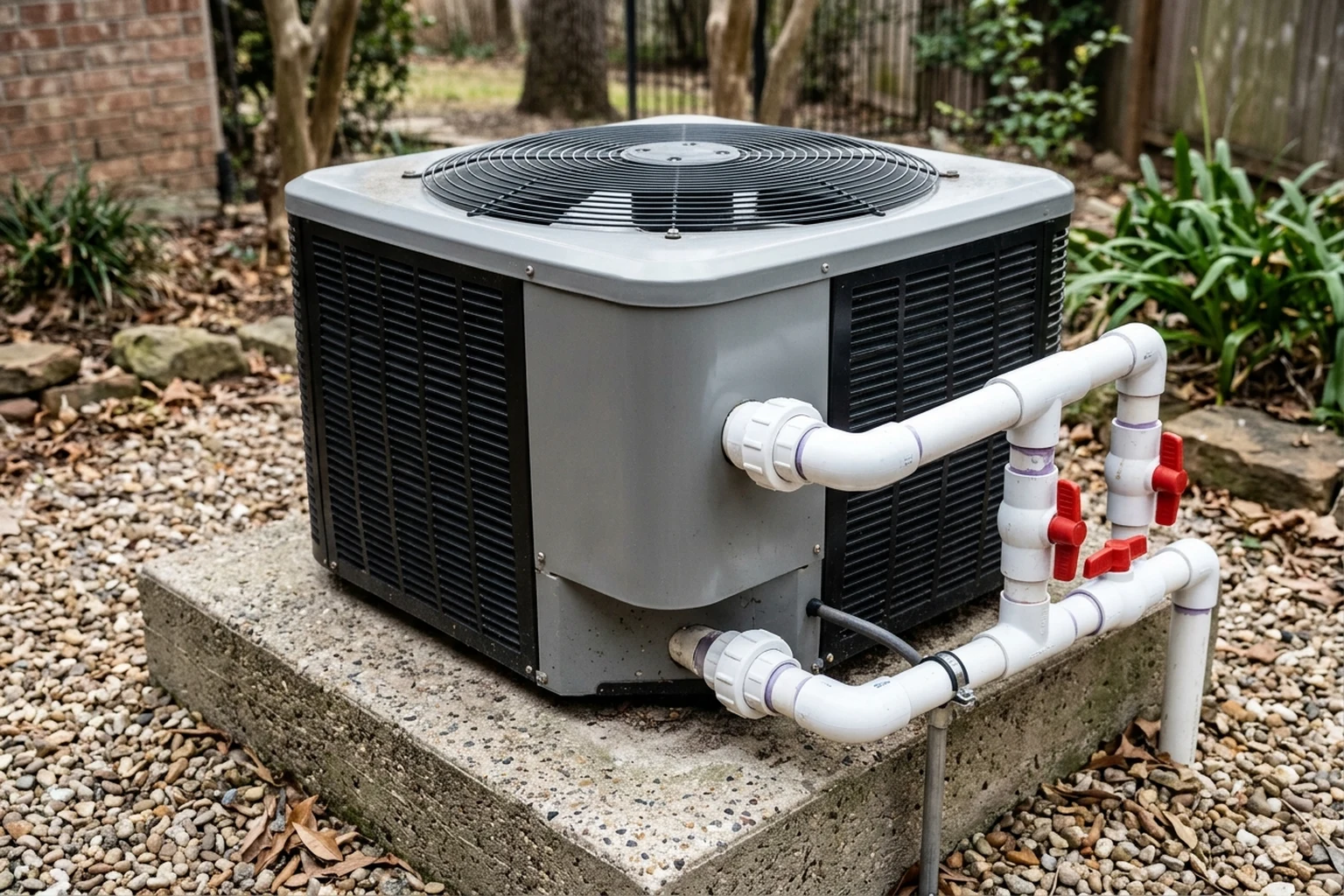
Check the control modes, temperature limits, and heat-exchanger features across candidate heat-cool product lines:
- UltraTemp models with heat and cool capability can be set up to operate in Heat Only, Cool Only, or Auto Heat and Cool mode.
- In Auto mode, the UltraTemp heat pump automatically switches between heat and cool based on whether the water temperature is below or above the active set point.
- The UltraTemp heat pump will not heat above 104°F or cool below 45°F (40°C - 7.2°C).
- UltraTemp heat pumps are listed by ETL as complying with UL 1995 and CSA C22.2 No. 236.
- Raypak Crosswind 50-I and 65-I inverter heat pumps feature Heat and Cool mode and a spiral titanium heat exchanger with 1-1/2 in. PVC union water connections.
- The Hayward HeatPro Series of Heat+Chill Heat Pumps includes six models (three heat-only models and three Heat+Chill models) with microchannel heat exchanger technology and AHRI certification.
- The Hayward HeatPro Heat+Chill chill feature can chill water as low as 40 degrees Fahrenheit for cold-plunge applications or lower pool temperatures during hot summer months.
Evaporative pool coolers: gallon ratings, nighttime runtime, and site heat load
Compare fan-driven evaporative pool coolers against refrigerant heat-cool units by reviewing climate suitability, water consumption, nighttime operating rules, and model gallon ratings.
The 27th IIR Informatory Note describes evaporative cooling as offering technical and economic advantage especially in hot dry climates, while noting its consequences on water consumption.
In evaporative heat rejection, each kilogram of water removed transfers 2.200 kilojoule evaporation per c.
Glacier Pool Coolers are electric fan cooling systems that require no Freon, heat exchange, or gas to operate.
Glacier Pool Coolers states that overnight temperature drops average 10-15 degrees, but are not exact, guaranteed degrees because all pools differ due to heat load from the sun, exposure, plaster color, and depth.
Glacier’s Operation Guide states that a pool will not drop degrees during daylight hours and instructs running the pool and cooler at night to drop water temperature, while during the day you may continue to maintain your preferred temperature.
Glacier’s Operations Manual notes that pool finish (such as dark bottom or pebble bottom), all-day sun exposure, and equipment run distance over 15 ft from the pool cause different cooling results.
Glacier residential coolers do not come with thermostat controls; cooling is determined by pool pump run time, and if the pool is automated, a temperature range can be set through the automated system.
Glacier residential and commercial model specifications
Use the table below to compare Glacier nominal pool gallon capacities, flow rates, dimensions, pad footprints, and electrical ratings.
Scroll horizontally to read all columns.
| Pool gallon capacity, flow rate & physical specs | Electrical rating & commercial comparison |
|---|---|
| Glacier residential model GPC25 is rated for pools under 20K gallons, with 30 gpm nominal flow, 1.5 in. inlet/outlet pipe diameter, 63 in. height by 34 in. width, a 2x2 ft pad size, and 125 lbs dry weight. | Glacier models GPC25 and GPC210 electrical specifications are 110/115v, 1-PH, 50/60H, 8.5Amps, and a 20 Fuse Size. |
| Glacier residential model GPC210 is rated for pools under 30K gallons, with 45 gpm nominal flow, 1.5 in. inlet/outlet pipe diameter, 65 in. height by 42 in. width, a 3x3 ft pad size, and 150 lbs dry weight. | Glacier model GPC215 electrical specifications are 110/115v, 1-PH, 50/60H, 12Amps, and a 20 Fuse Size. |
| Glacier residential model GPC215 is rated for pools under 45K gallons, with 45 gpm nominal flow, 2 in. inlet/outlet pipe diameter, 70 in. height by 42 in. width, a 3x3 ft pad size, and 200 lbs dry weight. | Glacier commercial model GPC220 is rated for pools under 80K gallons, with 60 gpm nominal flow, 2 in. inlet/outlet pipe diameter, a 4x4 ft pad size, 250 lbs dry weight, and 110/115v 1-PH 14 Amps electrical rating. |
Circulation flow rate and bypass plumbing verification
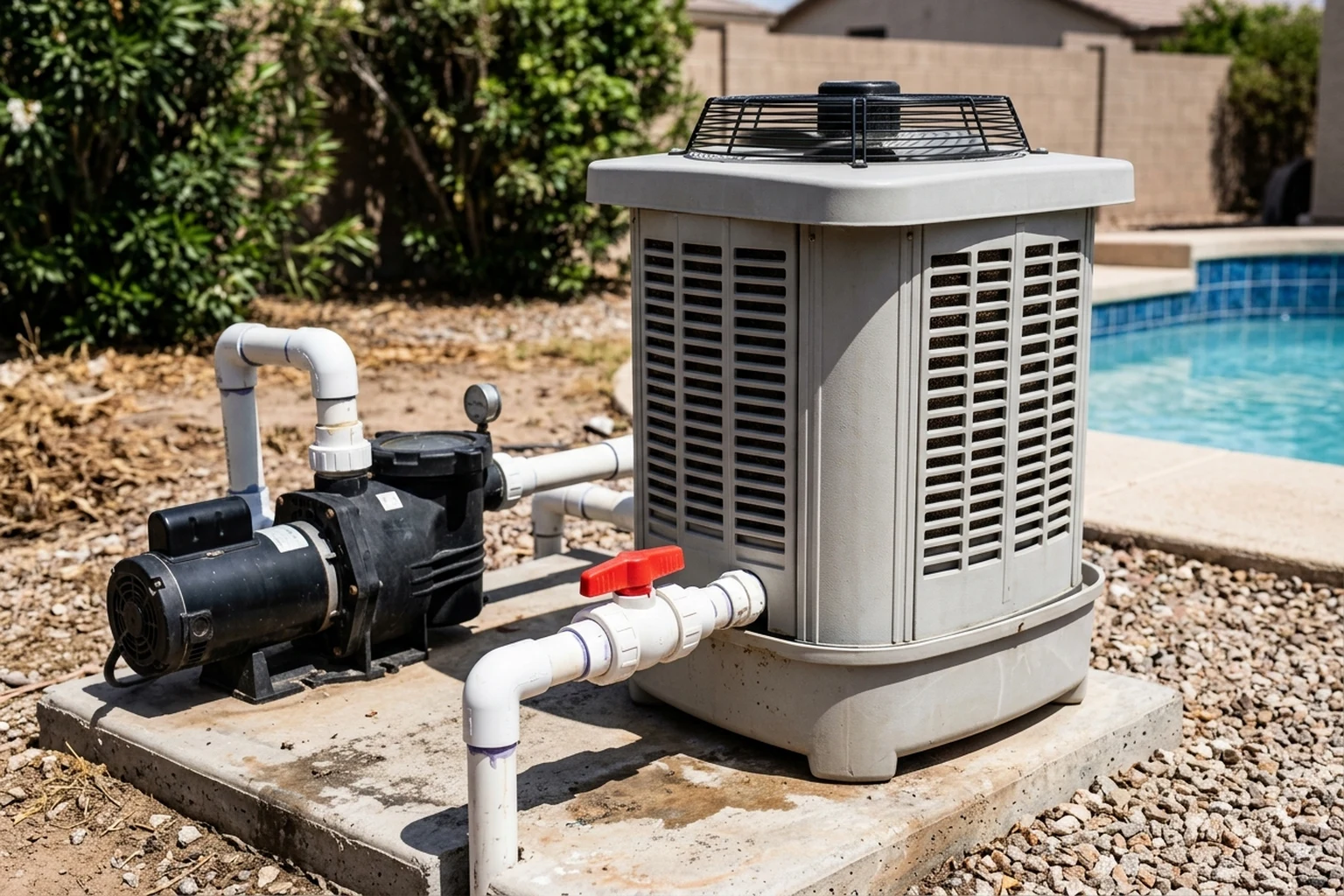
Coordinate the chiller’s water flow envelope, valve arrangement, and return routing with your pool equipment pad layout. Closed-loop heat pumps and open-basin evaporative coolers connect to the circulation system differently.
Scroll horizontally to read all columns.
| Heat-pump water flow & bypass rules | Evaporative cooler basin, valve & return rules |
|---|---|
| The UltraTemp water flow rate requirement is a minimum of 30 gpm (110 lpm) and a maximum of 120 gpm (456 lpm), with a maximum working water pressure of 50 psi (3.5 bar). | In a Glacier Pool Cooler, chilled water collects in the bottom basin and an internal float-switched sump pump pushes the water back into the pool line in cycles that can last 2-3 minutes in residential units. |
| The UltraTemp inlet/outlet header comes equipped with an internal automatic flow control valve that maintains proper flow through the heat pump at rates up to 120 gpm (456 lpm). | A Glacier Pool Cooler is not installed like a heater; the cold water leaving the outlet line should be plumbed into the suction side of the pool pump or into a designated line so chilled water does not headwall in the plumbing. |
| For UltraTemp, if the circulation pump is over 2 HP or if total flow exceeds 120 gpm (456 lpm), an external manual bypass valve must be added because excess water flow will damage the heat exchanger. | On automated Glacier installations, actuators open 100% while the ball valves at the cooler are set to 10–15% open for the flow rate into the cooler; the right setting is when water is not splattering out the top fan guard and the wands are still moving and not stopped. |
| Pentair's Ambient/Water Flow diagnostic table for UltraTemp 120 H/C and UltraTemp 140 H/C is specified at a water flow rate of 45-50 gpm. | Glacier's Operations Manual warns never to manually adjust the basin water level, because a dry basin prevents water from reaching the pool pump and can cause cavitation or pump damage. |
| Raypak Crosswind 50-I requires a water flow rate of 21.9-30.6 gpm (83-116 LPM), and Crosswind 65-I requires 28.5-37.5 gpm (108-142 LPM). | Glacier Pool Coolers must be installed at least 12 inches away from buildings, walls, or fences made from materials that could degrade from water exposure, with a minimum 5-foot overhead clearance to avoid condensation on the structure. |
Assemble your pool chiller sizing and plumbing record
Before ordering a pool chiller or finalizing equipment-pad piping, record these project inputs on one worksheet:
- The measured pool water surface area, average depth, and calculated water volume, noting any shallow sun shelves, dark or pebble interior finishes, and unshaded daytime exposure.
- The local daytime and nighttime air temperatures, relative humidity, and wind exposure category from our pool design for hot climates guide.
- The peak summer water temperature, target swimming water temperature, and planned nighttime and daytime circulation pump schedules.
- The selected cooling unit manufacturer, exact model number, and either the listed cooling BTU output or nominal gallon capacity.
- The circulation pump horsepower, operating flow rate, bypass valve configuration, equipment run distance, and wall and overhead clearances on the pool equipment list and pool equipment pad layout.
Review the completed worksheet alongside our pool equipment hub and pool heat pump ambient derate vs gas heater guide before installation begins.
Sources
- ASHRAE Handbook, Service Water Heating
- Pentair UltraTemp brochure
- Pentair Pool catalog, heaters and heat pumps
- Pentair UltraTemp Heat Pump Installation and User’s Guide
- Raypak Residential Pool Catalog
- Hayward HeatPro Series of Heat+Chill Heat Pumps Product Release
- Glacier Pool Coolers Residential Pool Coolers Technical Specs
- Glacier Pool Coolers Commercial Pool Coolers Technical Specs
- Glacier Pool Coolers Residential Operation Guide
- Glacier Pool Coolers Operations Manual
- U.S. Department of Energy, Consumer Pool Heaters Final Rule Technical Support Document
- International Institute of Refrigeration, IIR Informatory Note on Evaporative Cooling
- International Institute of Refrigeration, The Environmental Benefits of Evaporative Cooling