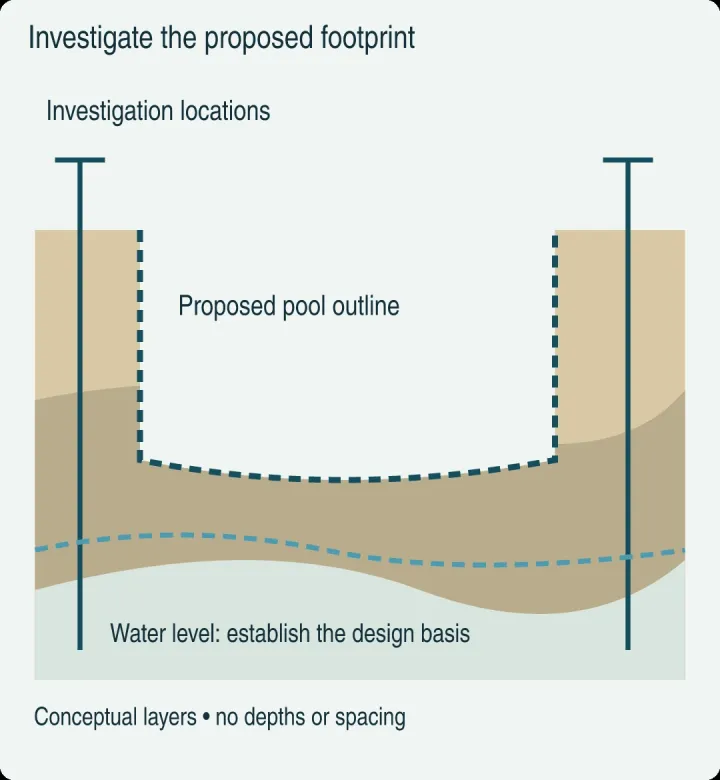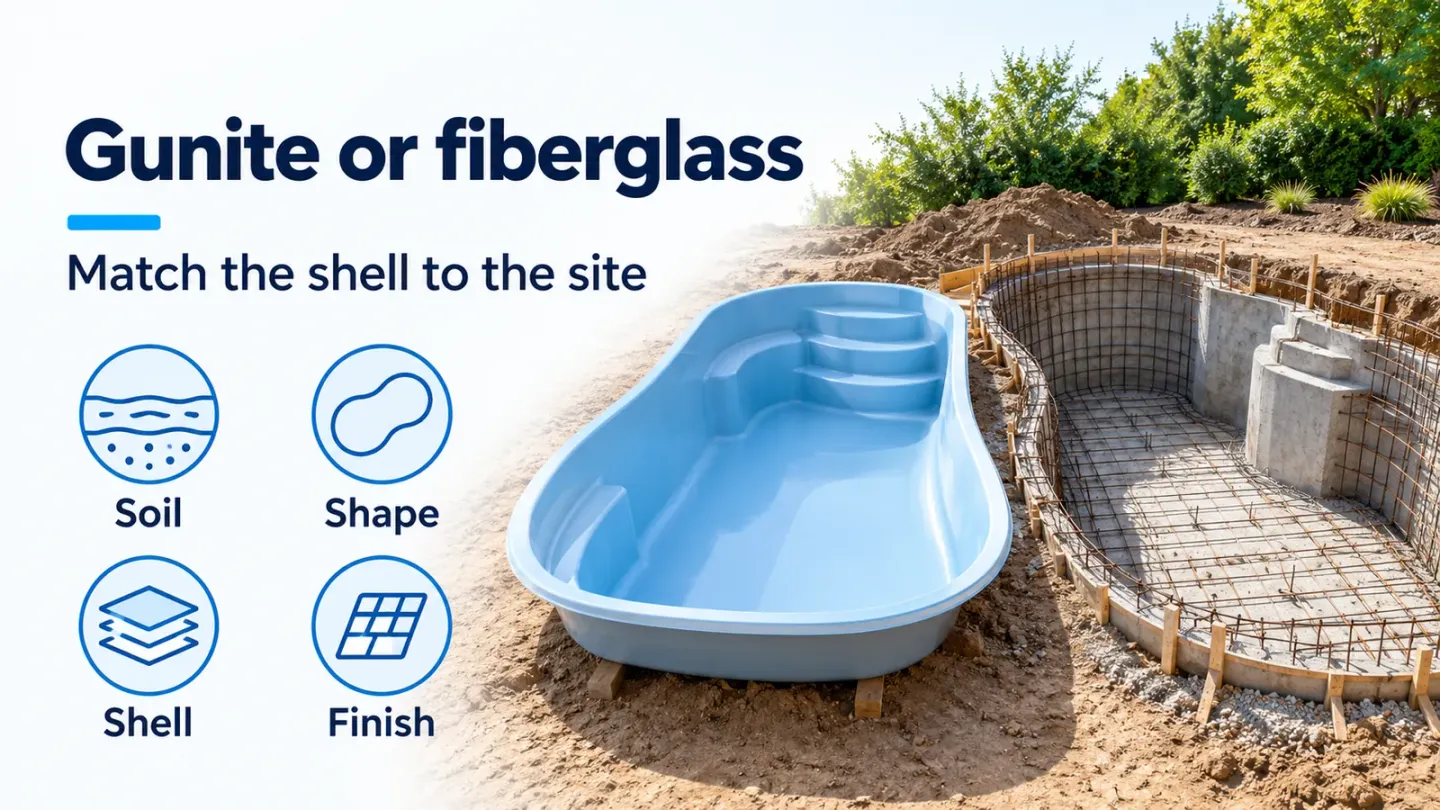
Choosing a shell before resolving its ground support can cause costly rework: gunite pool vs fiberglass is a structural comparison between a site-formed concrete shell and a factory-made vessel. Favor site-formed construction when the required geometry falls outside available molds; consider fiberglass when a model fits and its installation requirements can be met, with either choice subject to site engineering.
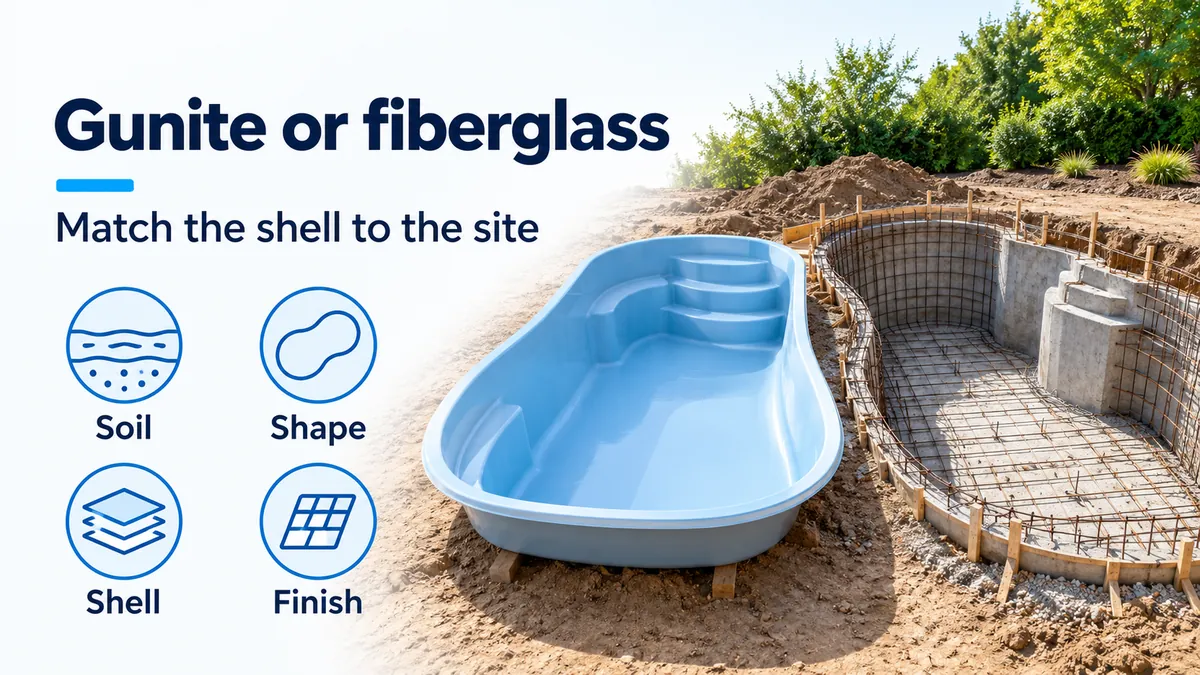
Expansive soil does not select the material for you. The useful comparison is between a concrete design that addresses the site’s movement and a fiberglass vessel whose specified support, backfill and water-management arrangement the project can provide. Shape freedom matters before construction; interior renewal matters during ownership. Treat those as separate decisions rather than collapsing them into a price or lifespan ranking.
Start with the pool design decisions, then compare the systems below. The failure column identifies mechanisms to examine, not measured failure rates.
Scroll horizontally to read all columns.
| Structural option | When to keep it in the design | Shape and interior commitment | Dominant Failure Mode & Prevention |
|---|---|---|---|
| Site-formed gunite/shotcrete shell | The engineer can resolve the ground conditions and the required geometry needs site forming | Perimeter and floor are designed for the project; a cementitious interior can later have its own renewal scope | Ground-related cracking or inadequate shell construction → engineered subgrade and reinforcement, with specified placement and curing controls |
| One-piece fiberglass vessel | A selected model fits and the site can meet its installation requirements | Mold fixes the vessel profile and built-in features; gelcoat care and repair follow the finish system | Uneven support or unbalanced external pressure causing wall movement → specified bedding/backfill, coordinated installation and groundwater management |
| Either, if the engineer and the vessel maker both accept the site | Both proposed systems have a documented path to acceptable support and water management | Choose between an available model and a project-specific shape after resolving the site | An unresolved ground or drainage condition carried into the build → reconcile the ground report, structural design and applicable manufacturer instructions before committing |
These are planning conclusions drawn from the ASA shell-practice statement, Latham installation overview and Thursday Pools damage guidance. Acceptance of a fiberglass option concerns the actual vessel maker; a concrete-only design still needs its own engineering review.
Soil movement: resolve support before choosing a shell
Obtain the site’s movement and water conditions before treating flexibility or rigidity as a benefit. Colorado Geological Survey explains that certain clay minerals expand as they take up water and may shrink when previously wet clay dries. Movement can act horizontally as well as vertically. Its hazard guidance also identifies changed drainage, ponding and irrigation as relevant influences; it is a mechanism explanation, not a prediction for your excavation. See the CGS expansive-soil explanation.
For concrete, ASA calls for professional structural evaluation and a design covering subgrade preparation, reinforcement and penetrations. For fiberglass, Latham describes the need for a stable, even foundation and coordinated water/backfill placement. Factory manufacture does not remove those site obligations.
Keep expansive-clay movement separate from groundwater pressure. The former concerns moisture-driven soil volume change; the latter can load a vessel from outside. Thursday Pools warns that soil movement or improper support can stress a fiberglass shell, and that draining without accounting for groundwater can allow movement or lifting. A claim that fiberglass “flexes” establishes no acceptable movement range for a particular model.
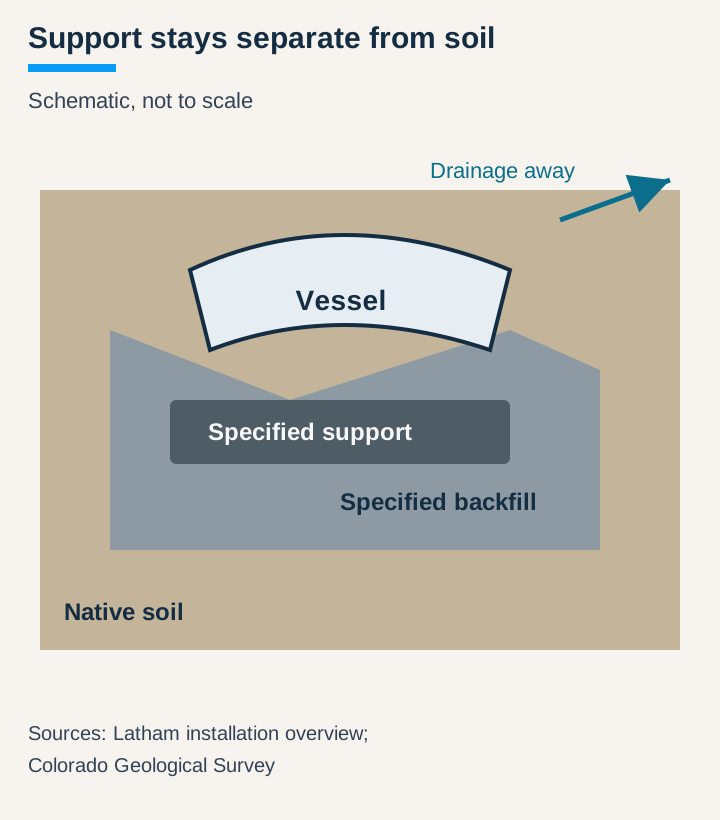
Rule of thumb: If the ground report identifies movement-prone soil and neither proposal shows how its support and water-management design addresses it, pause material selection and resolve that design gap. A process label or factory shell cannot supply the missing site solution.
Use the soil investigation and excavation guide to organize that handoff. Ask the responsible team to identify the ground conditions used in the design, the support arrangement, the water-management responsibilities and who accepts each detail.
Shape: compare the vessel envelope with the required perimeter
A site-formed shell can follow a designed non-mold shape; a catalog fiberglass choice starts with an existing vessel profile. ASA describes the geometric versatility of shotcrete pool construction. Latham’s manufacturing description explains that its fiberglass pools are built on molds, while its model range shows differing built-in seating, ledges and spa options.
The planning implication is to check the whole selected model: outside outline, floor profile, steps and ledges. A matching water length and width alone do not establish that the vessel fits the intended layout. If an essential corner, entry or floor transition is unavailable in a suitable model, a site-formed proposal is worth developing with the designer. That freedom remains subject to structure and site constraints.
For a simple width screen, define the vessel’s outside width and separately assigned side allowances, all at the same plan section:
Required planning width = outside vessel width + left allowance + right allowance.
Assumed arithmetic only: 4.0 m + 0.5 m + 0.5 m = 5.0 m required planning width.
These hypothetical inputs demonstrate addition, not a recommended excavation clearance or an actual model’s dimensions. Replace them with the selected vessel drawing and project-defined allowances. This width screen does not check depth, curved boundaries, setbacks, delivery turns or lifting access. A concrete proposal likewise needs its outside shell and working envelope drawn beyond the desired water edge.
Keep adjacent decisions distinct: the gunite-versus-shotcrete guide explains placement processes, and pool-and-spa planning addresses the connected layout and operating choices. Neither substitutes for matching a vessel to the site.
Interior renewal: identify the layer that needs work
Renewing a concrete pool’s plaster and repairing a fiberglass vessel’s gelcoat are different scopes. For a cementitious interior, SGM’s Diamond Brite resurfacing procedure includes finding and removing hollow or delaminated plaster, patching and preparing the bond. It demonstrates why a renewal scope includes substrate preparation rather than just new finish material.
A sound surface-renewal plan also distinguishes finish deterioration from a shell concern. ASA’s position is that properly designed and constructed shotcrete should be functionally watertight; the planning implication is that fresh plaster cannot be assumed to resolve an inadequate structural shell. The shell-strength records guide covers the separate construction evidence.
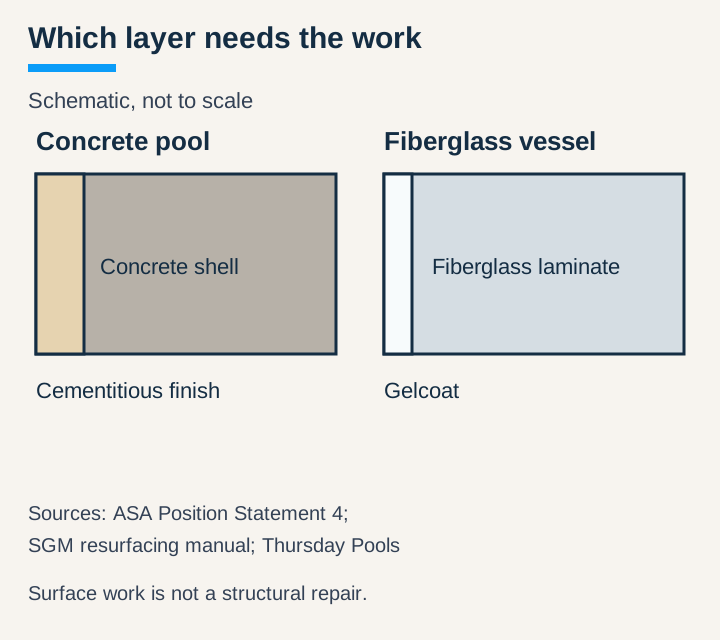
For fiberglass, Thursday Pools distinguishes cosmetic gelcoat concerns from damage extending into the laminate. Its guidance describes localized gelcoat repairs and notes that some minor cosmetic cracks may be better left alone after professional assessment, because the repair can be more visible. Wall movement calls for evaluation of the shell and surrounding conditions. See its finish and structural-damage guidance.
Before assigning a renewal allowance, ask what condition would trigger work, which layer is affected, what preparation is included and how any required draining will be managed. No fixed replastering interval or gelcoat replacement schedule follows from these sources.
TCO: carry access, committed geometry and finish work forward
Compare ownership obligations using the actual support and finish scope, rather than a universal cost winner. The ledger below is an editorial planning deduction from the construction dependencies above; it assigns no dollar amount or savings rate.
Scroll horizontally to read all columns.
| TCO factor | Site-formed concrete scope to clarify | Factory fiberglass scope to clarify |
|---|---|---|
| Shell access and support | Equipment/material access, excavation support and the engineered subgrade arrangement | Delivery and lifting access, specified bedding/backfill and site water management |
| Shape changes after commitment | Drawing revisions and affected work once forms, steel and penetrations are fixed | Consequences of changing the selected mold/model after ordering or delivery; any proposed vessel alteration needs maker review |
| Interior renewal | Inspection, removal of unsound finish, preparation, application and return-to-service requirements | Finish diagnosis, compatible cosmetic repair where appropriate, appearance expectations and deeper assessment if needed |
For each proposed change, record the affected work, who reviews it and what must be repeated or replaced. Neither molded geometry nor fixed reinforcement should be treated as freely adjustable during installation. Carry these decisions into the pool construction plan before approving the shell package.
Method and sources
This is public-document editorial synthesis, not a structural design or a bid. The conditional selection table and TCO questions are planning deductions from the cited practices. The width calculation uses explicitly assumed inputs and supplies no installation requirement. Source documents were checked on October 19, 2026; site engineering and the selected system’s current instructions establish project details.
The primary references are ASA’s pool-shell practice statement, Latham’s installation overview and mold-manufacturing description, Colorado Geological Survey’s expansive-soil explanation, Thursday Pools’ damage guide and SGM’s resurfacing manual. Their sections and limits are recorded in the source list. Manufacturer guidance is used for the identified system or procedure, without extending it into a market-wide price, lifespan or movement-tolerance claim.
Sources
- Watertight Shotcrete for Swimming Pools — Position Statement 4 — American Shotcrete Association
- Inground Fiberglass Pool Installation — Latham Pool
- Expansive Soil and Rock — Colorado Geological Survey
- Latham Group Annual Report 2024 — Latham Group
- Fiberglass Pool Shapes & Sizes — Latham Pool
- Fiberglass Pool Damage: What You Need to Know — Thursday Pools
- Diamond Brite Installation Manual — SGM