Missing strength evidence can delay a pool-shell handoff. Compare gunite and wet-mix shotcrete using the project’s specified strength, water-control records, shotcrete sampling plan and rebound-removal procedure, rather than the placement label.
For an owner checking gunite versus shotcrete pool strength in PSI, the useful question is whether the specified material and the placed shell have the evidence the project requires. Gunite commonly means dry-mix shotcrete; both dry- and wet-mix are placement processes. ASA’s Summer 2018 pool article supports a minimum 4,000 psi at a 28-day test age, but that published industry position does not replace your project design or local requirements. This guide helps you connect a quoted number to its source, specimen, curing conditions and review responsibility.
Use the pool construction hub for the wider build decisions. The general gunite and shotcrete comparison covers method terminology; this page concentrates on the records behind a strength claim.
| Input or item | Value or source to obtain | Why it matters |
|---|---|---|
| Specified compressive strength | Current project drawings or specification, with units | Establishes the design requirement being checked |
| Test age | Project’s specified age, recorded on the report | Makes results comparable to that requirement |
| Specimen source | Approved sampling plan and specimen identifiers | Distinguishes a shot panel, delivery sample and in-place sample |
| Water control | Mix information, batch records and permitted adjustments | Shows how the material was controlled before placement |
| Rebound removal | Placement procedure and observation record | Keeps rejected material out of the structural shell |
| Curing responsibilities | Shell specification and laboratory records | Separates shell care from specimen conditioning |
Read the strength specification before comparing process names
Start with the strength written for your pool, its test age and its acceptance procedure. A marketing statement about achievable strength is different from a project requirement, and both are different from a result on a laboratory report. Put each claim in the appropriate column before comparing two proposals.
The National Ready Mixed Concrete Association (NRMCA) explains that compressive strength is derived from failure load divided by the resisting cross-sectional area. PSI means pound-force per square inch; it is a stress measurement, rather than a measure of shell thickness or reinforcement. Its CIP 35 distinguishes specified strength, often written as f′c, from test results and the higher average strength targeted when designing a mixture.
| Statement you receive | What it establishes | What to request next |
|---|---|---|
| “Our mix can achieve this strength” | A claimed material capability | The applicable mixture information and supporting test conditions |
| Strength and test age on project drawings | A project design requirement | The approved sampling and acceptance procedure |
| A delivery or batch ticket | Information about supplied material | Its connection to the placement date and test specimens |
| A laboratory strength report | Results for identified specimens | Sample origin, age, conditioning and the responsible reviewer’s interpretation |
In Gunite Versus Shotcrete in Swimming Pool Construction, published in ASA’s Summer 2018 magazine, Mason Guarino and Ryan Oakes discuss ASA’s minimum-strength position. The same issue’s Overview of ASA Position Statements explicitly states ASA’s recommendation of at least 4,000 psi at 28 days for pool shotcrete. This is attributed industry guidance from that publication, not a finding that every pool must meet a nationwide rule or that a particular shell has passed. Get the actual design value from the project documents.
Even an accurately reported strength does not answer all structural questions. The same ASA article discusses ground conditions, reinforcement and curing among the factors relevant to cracking. The soil investigation and excavation guide explains the ground-report handoff; a larger PSI number cannot substitute for that work.
Common mistake: Comparing a builder’s advertised strength with another builder’s specified design strength as though both were test results.
Takeaway: Identify whether a PSI claim is a capability, a requirement or a measured result before using it to compare proposals.
Dry-mix and wet-mix: where water enters the process
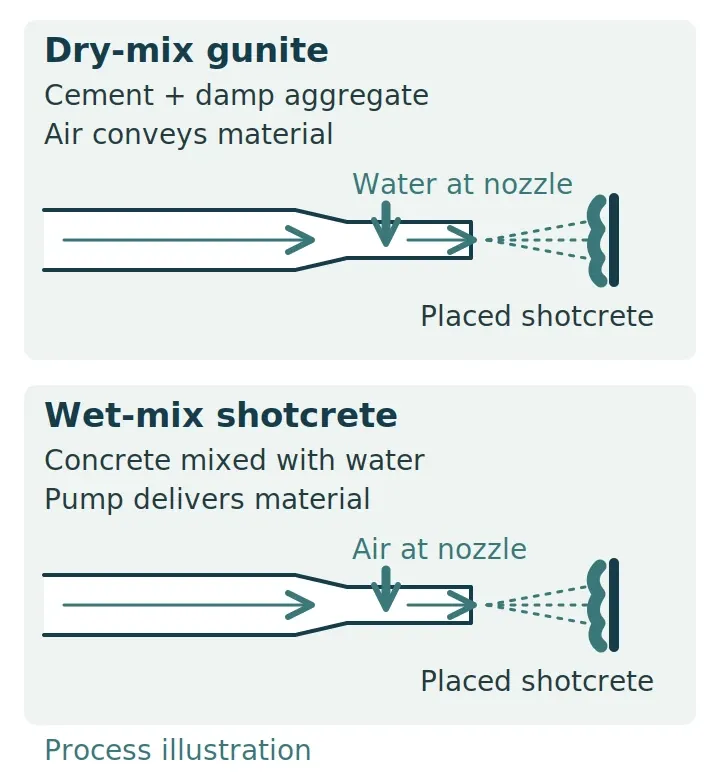
Dry-mix adds water at the nozzle; wet-mix contains its mixing water before it reaches the nozzle. That distinction changes where control records and operator responsibilities sit. It does not remove the need to control the mixture, place it correctly or document permitted adjustments for either process.
The USDA Natural Resources Conservation Service (NRCS) describes dry-mix as cement and predampened aggregate conveyed to a nozzle where water is added. Wet-mix delivers already mixed concrete to the nozzle, with compressed air used to project it. The diagram at the top shows these paths without prescribing nozzle dimensions or equipment settings.
| Control question | Dry-mix gunite | Wet-mix shotcrete |
|---|---|---|
| Where is mixing water introduced? | Primarily at the nozzle; aggregate may already contain moisture | During mixing before pumping |
| What should the owner ask to see? | Material proportions and the procedure for nozzle water control | Mix identification, batch records and the procedure for water adjustments |
| Which activity needs skilled supervision? | Consistency control and placement at the nozzle | Delivery and adjustment control, plus nozzle placement |
| Does the name prove achieved strength? | No; use the specified testing evidence | No; use the specified testing evidence |
Ask the mix supplier or designer to identify the water-ratio term used in the project records, explain what its calculation includes and state how aggregate moisture and subsequent water adjustments are accounted for. Keep that explanation with the mixture information so the team can compare records on the same basis.
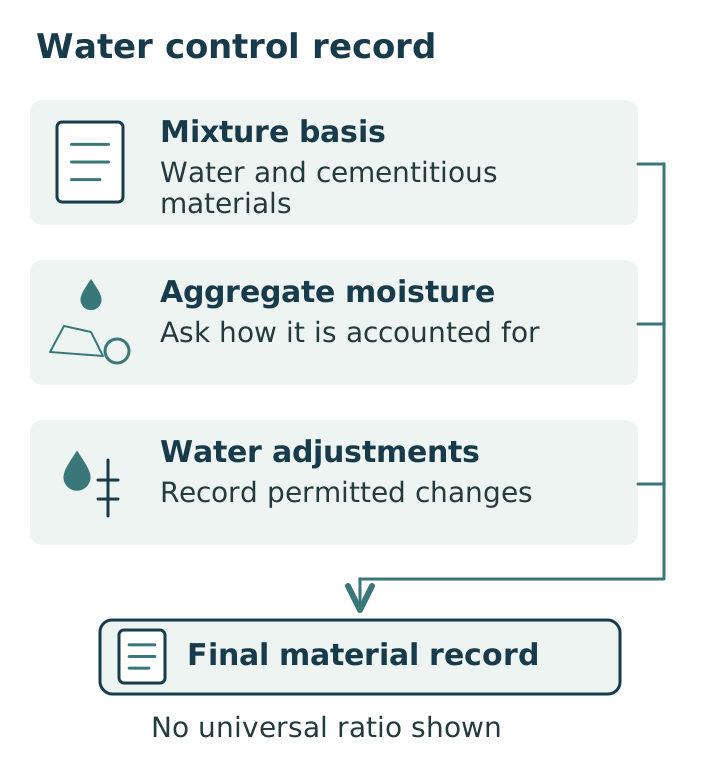
ASA’s article explains why additional water matters: excessive water content can reduce strength and increase permeability and shrinkage potential. The practical response is to require the project’s control procedure, rather than to tell an owner to regulate the nozzle or invent a water ratio from a general guide.
If you are comparing quotations, put the requested mixture and water-control records in the new-pool project checklist. A nominal recipe is useful background; the team also needs to explain how changes during delivery or shooting are controlled and recorded.
Takeaway: Compare documented water-control responsibilities for both processes, with the mixture’s ratio definition kept consistent.
A 28-day report needs a traceable specimen
A strength result needs an identifiable sample, an age and documented conditioning before it can answer a project acceptance question. NRMCA says concrete strength requirements are commonly stated at 28 days. That convention tells you when the specimen is tested; it does not tell you that a pool is ready for finishing or use.
Sampling deserves particular attention with shotcrete. NRCS describes production test panels made during construction to document the strength of the production shotcrete. Cores are taken from these panels for testing. The panel is intended to reproduce the placement situation as closely as possible, including the same orientation for vertical or overhead applications. The handbook references ASTM C1140 for preparing shotcrete panels.
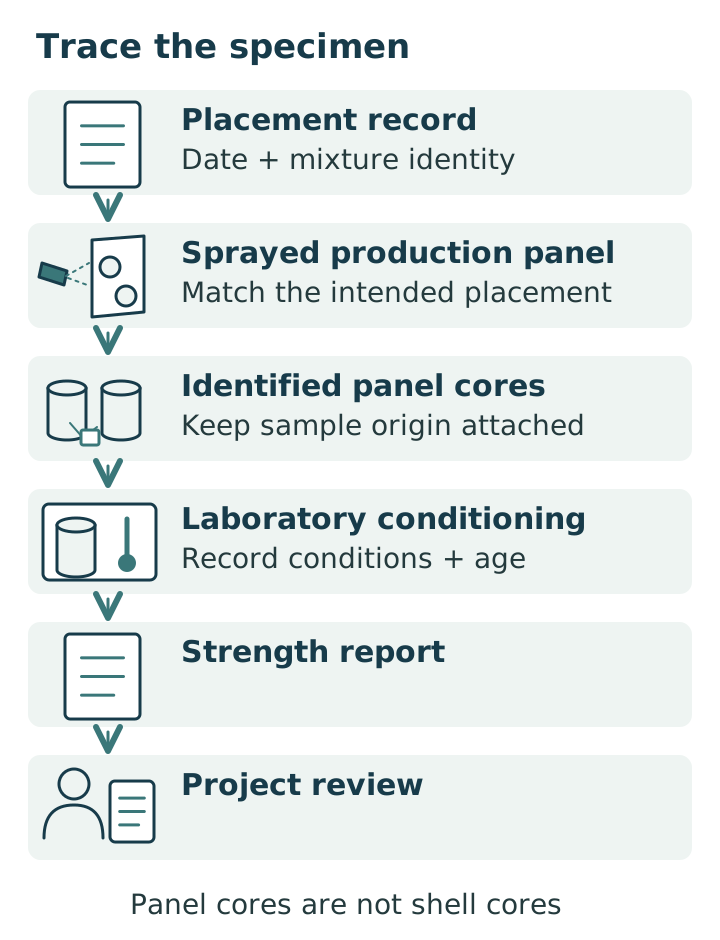
A conventional cast-cylinder result from supplied wet-mix material can describe that sample. It does not, by itself, document all the effects of spraying and placement. Similarly, a panel core is a specimen from a panel; it is not automatically a core from the pool wall. Keep these origins visible rather than filing every result under “pool concrete test.”
| Report detail | Question for the testing team |
|---|---|
| Sample or panel identifier | Which placement date, mixture and represented work does it refer to? |
| Sample origin | Was this a delivery sample, sprayed panel or approved in-place sample? |
| Sampling and test method | Which procedures does the project require for this specimen? |
| Test age and units | Does the reported age match the specified requirement? |
| Conditioning history | Was the specimen standard-cured, field-cured or otherwise conditioned under the plan? |
| Review and disposition | Who compares the results with the project’s acceptance criteria? |
NRMCA distinguishes standard-cured specimens used for acceptance and quality control from field-cured specimens used to estimate in-place strength. Its CIP 35 discusses conventional concrete cylinders; it is useful for understanding this distinction, but does not supply the entire sampling plan for a shotcrete pool. The lab and designer should identify the required shotcrete procedure.
Place sampling responsibilities next to shell placement in the complete pool construction stages guide. If the first discussion of specimens happens after shooting, ask the responsible team to resolve the missing evidence before assuming a later report can reconstruct it.
Common mistake: Calling a standard-cured specimen result proof that every part of the shell received the same placement and curing.
Takeaway: Keep the specimen’s source, conditioning, test age and project reviewer attached to every strength result.
Rebound belongs outside the structural shell
Rebound is material that bounces away during spraying; it is not structural fill to sweep beneath reinforcement or pack into steps. NRCS’s shotcrete inspection handbook states that rebound is not reused and that accumulated rebound is removed from the work area. Treat removal as an explicit placement responsibility for either process.
The handbook also warns against shooting onto rebound. ASA’s pool article highlights the difficulty of clearing rebound, shavings and excess material from beneath reinforcement at the floor-to-wall cove. It emphasizes properly placing concrete at high velocity for compaction in both dry- and wet-mix work. Material piled into a corner does not receive that same placement merely because concrete is later sprayed over it.
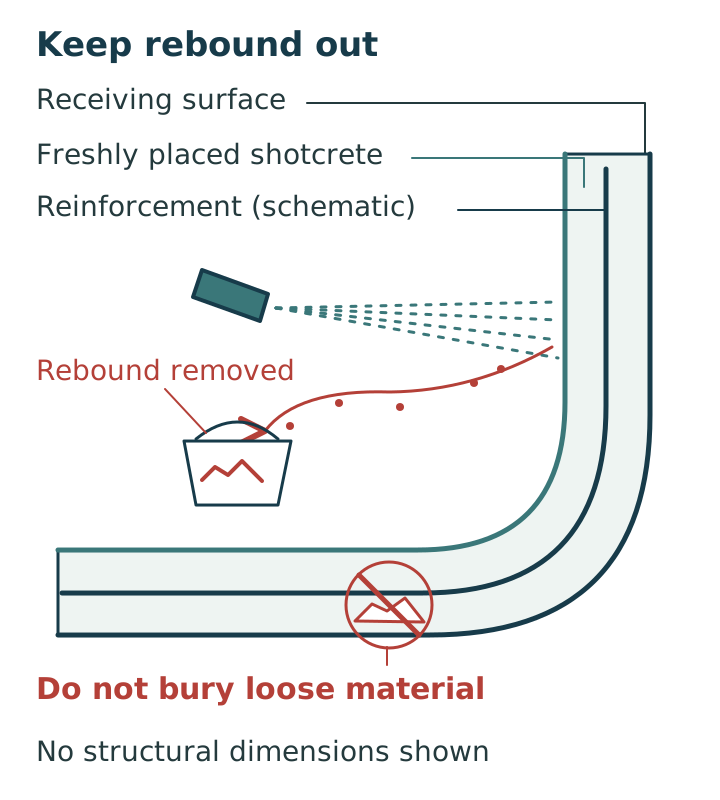
For an owner, the useful observation record answers these questions:
- Who removes accumulated material while the nozzle operator continues placing concrete?
- How are coves, steps, benches and congested areas kept clear before being covered?
- Where is removed material taken so it cannot return to the receiving surface?
- Who records a concern if material appears to have been buried, and who decides the response?
An attached spa can add congested geometry and penetrations. Use the pool-and-spa planning guide to locate those coordination decisions, then ask the placement team how it will manage access and clearing at those details. Where a cover vault affects the shell, the vault, drainage and power guide helps identify drawings to bring to the discussion.
Do not enter active shooting areas or try to excavate a finished shell to check material yourself. If burial is suspected, preserve the available placement records and refer the concern to the project’s responsible design and inspection team. A satisfactory test from a separate panel does not erase a location-specific placement concern.
Common mistake: Treating rebound as usable concrete because it contains sand and cement, or covering it and relying on a good panel result afterward.
Takeaway: Require rebound removal during placement, with a documented route for reporting material that may have been covered.
Keep shell curing separate from laboratory curing
Shell curing and specimen conditioning are related records with different purposes. The shell needs the curing specified for the work; the lab prepares and conditions specimens under the testing plan. A standard-cured result does not document how the pool shell was protected at the site.
NRCS’s handbook describes curing as maintaining moisture and temperature conditions that allow the placed material to develop its properties. Ask for the shell’s approved method, who performs it and how interruptions or weather concerns are reported. Ask the lab separately for specimen conditioning and test dates. Neither record should be substituted for the other.
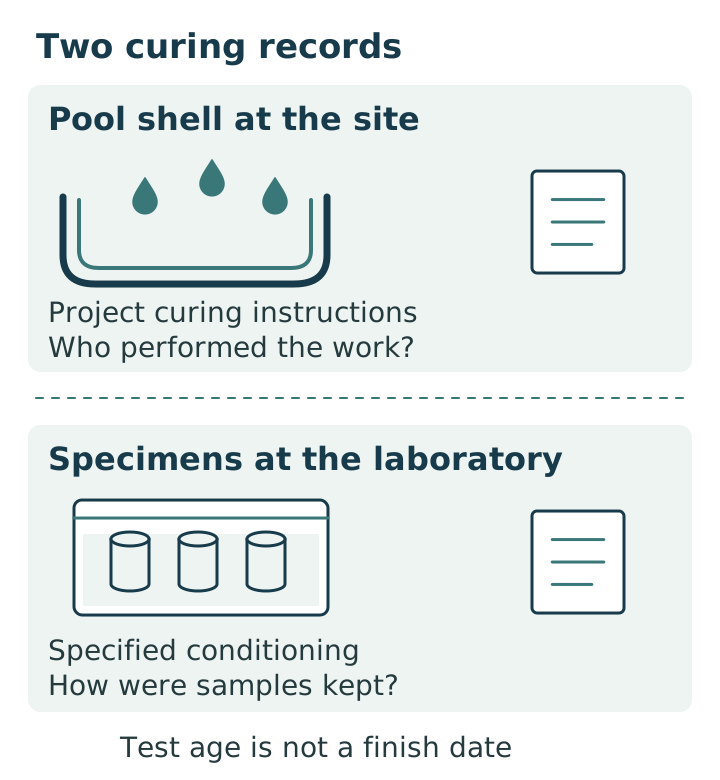
For scheduling, keep three entries apart: placement date, shell-curing instructions and specimen test age. The construction process guide places curing in the build sequence, but the project’s specification controls when subsequent work can proceed. The 28-day strength convention is not a universal watering schedule or a blanket instruction to apply the interior finish on that day.
Takeaway: Obtain a shell-curing record and a specimen-conditioning record, then use the project’s instructions for the next trade.
What to do with missing or low test results
Ask the project’s designated reviewer to interpret the result against its acceptance procedure. NRMCA notes that low results can involve specimen fabrication, handling, curing or testing problems as well as the concrete. A single number without its record chain cannot distinguish those possibilities.
First, check whether the report actually belongs to this placement and required test age. Then collect the laboratory record, mixture and placement information, specimen conditioning and site-curing records. Request a written explanation of the result and the next authorized action. The responsible designer and testing team decide whether further investigation is appropriate and what it entails.
NRMCA also explains that an early-age result is not, by itself, a basis for rejecting concrete specified at a later age. It can prompt investigation. Do not use an early number to declare failure against a 28-day requirement, or assume that a later result will certainly solve the concern.
If records are missing entirely, label the gap rather than inventing a passed test. Carry the open item into the automatic-cover coordination checklist where shell readiness affects subsequent cover work. Approval to proceed should come from the team responsible for the work and its specification.
Takeaway: Escalate incomplete or concerning results with their supporting records; do not self-design a retest, repair or acceptance decision.
When this does not apply
This guide explains evidence for site-built concrete pool shells placed by dry- or wet-mix shotcrete. It does not specify fiberglass or vinyl-liner pools, structural thickness, reinforcement, exposure requirements, mix adjustments, test frequencies, laboratory acceptance thresholds or repair details. It also does not determine compliance with a jurisdiction’s adopted code.
The ASA article and NRCS handbook are dated technical references. Their process explanations help identify questions; their published values and construction procedures are not a substitute for the project’s current design and approved testing plan. A PSI result alone does not establish watertightness, crack resistance or uniform placement throughout a shell.
Takeaway: Use this guide to organize the questions and records, and use the project documents for design and acceptance.
Records to carry into the next construction stage
Close the shell-stage discussion with named record owners and a written disposition of open questions. This editorial checklist gathers the variables discussed above; it is not a new industry standard or an inspection certificate. Keep the documents with the project plan so later trades can find the decision on which they rely.
| Record | Question to close | Person or team to identify |
|---|---|---|
| Current shell specification | What strength, age and acceptance procedure apply? | Project designer and designated reviewer |
| Mixture and water-control records | How was the material identified and any adjustment controlled? | Material supplier and placement contractor |
| Sampling plan and reports | What was sampled, conditioned and tested? | Testing agency and project reviewer |
| Placement and rebound record | Were receiving areas cleared, and were concerns recorded? | Placement contractor and inspection team |
| Shell-curing record | What was done under the project’s instructions? | Named curing responsible party |
| Written disposition | What remains open before the next operation? | Responsible project decision-maker |
Use the project checklist to assign those responsibilities. Return to the construction stages guide to connect the shell-stage decision with later work. Bring unresolved records to the actual project team, rather than treating an article as authorization to proceed.
Takeaway: A useful handoff identifies the requirement, evidence, unresolved items and person responsible for the decision.
Method and sources
This guide is an editorial synthesis of public references, checked on October 8, 2026. The ASA pool article supplies the process comparison and its attributed strength position; NRCS supplies inspection explanations for shotcrete placement, rebound and test panels; NRMCA supplies strength-test terminology and interpretation cautions. Their links and access dates appear in the template’s source list.
The illustrations and record tables are original explanatory work. They show no measured water ratio, rebound percentage, nozzle dimensions or project test data. The article does not assert that current code editions or a particular local authority adopt every procedure in these dated references, and it reports no testing by Fielder Pools.
For related reading:
- Gunite and shotcrete methods — Clarify the terminology before reading a shell proposal.
- Complete construction stages — Put shell placement, curing and later trades in sequence.
- New-pool project checklist — Assign responsibility for the documents and decisions.
Takeaway: Trace numerical claims to their stated source and scope, and keep this explanation separate from project approval.
Frequently asked questions
Is gunite stronger than shotcrete?
Gunite generally means dry-mix shotcrete, so the terms overlap. Compare the same specified strength, test age and specimen conditions. Neither a process name nor a higher quoted PSI demonstrates the quality of placement throughout a particular pool shell.
How many psi is shotcrete?
There is no single strength for all shotcrete. ASA's Summer 2018 pool article supports at least 4,000 psi at 28 days for pool shotcrete. Treat that as attributed industry guidance; obtain the strength and acceptance requirements for your project from its design documents.
Can you pour gunite in the rain?
Gunite is sprayed, rather than poured. A strength specification alone cannot decide whether work should proceed in rain. Ask the responsible construction team how the weather affects receiving surfaces, placement and protection under the project's specification, and who authorizes continuing or rescheduling.
Is shotcrete stronger than concrete?
Shotcrete describes a way of placing mortar or concrete, rather than a separate strength class. A comparison needs identified mixtures and comparable test conditions. Do not infer greater strength, watertightness or crack resistance merely because a proposal uses the word shotcrete.
What are the disadvantages of shotcrete?
For this decision, scrutinize the reliance on correct nozzle work, access around reinforcement, rebound removal and traceable sampling. Those are quality-control tasks to document, not evidence that every shotcrete shell has defects. Site logistics belong in the builder's project plan.
Is shotcrete more expensive than gunite?
The labels alone do not establish a price difference, and gunite is a shotcrete process. Compare quotations with the same shell design and stated scope for testing, rebound removal and curing. A lower headline price may simply leave responsibility for those items undefined.
Sources
- Shotcrete Summer 2018: Pool process comparison, pages 12–15; ASA position overview, pages 28–31 — American Shotcrete Association Accessed October 8, 2026.
- National Engineering Handbook, Part 645, Chapter 14: Shotcrete, April 2017 — USDA Natural Resources Conservation Service Accessed October 8, 2026.
- CIP 35: Testing Compressive Strength of Concrete — National Ready Mixed Concrete Association Accessed October 8, 2026.