Residential pool fence requirements center on continuous perimeter isolation: a barrier at least 48 inches high on the outside face—or 60 inches in stricter jurisdictions—with no openings passing a 4-inch sphere, tight bottom clearance, zero external climbable footholds, and outward-opening self-closing, self-latching gates. Confirm the local code edition before ordering fencing or scheduling plaster.
Use these checkpoints alongside the swimming pool planning hub and the pool permit, HOA approval, and utility register so barrier linework, gate swing arcs, and equipment-pad setbacks appear on the permitted site plan before excavation.
What height do pool fence codes commonly require?
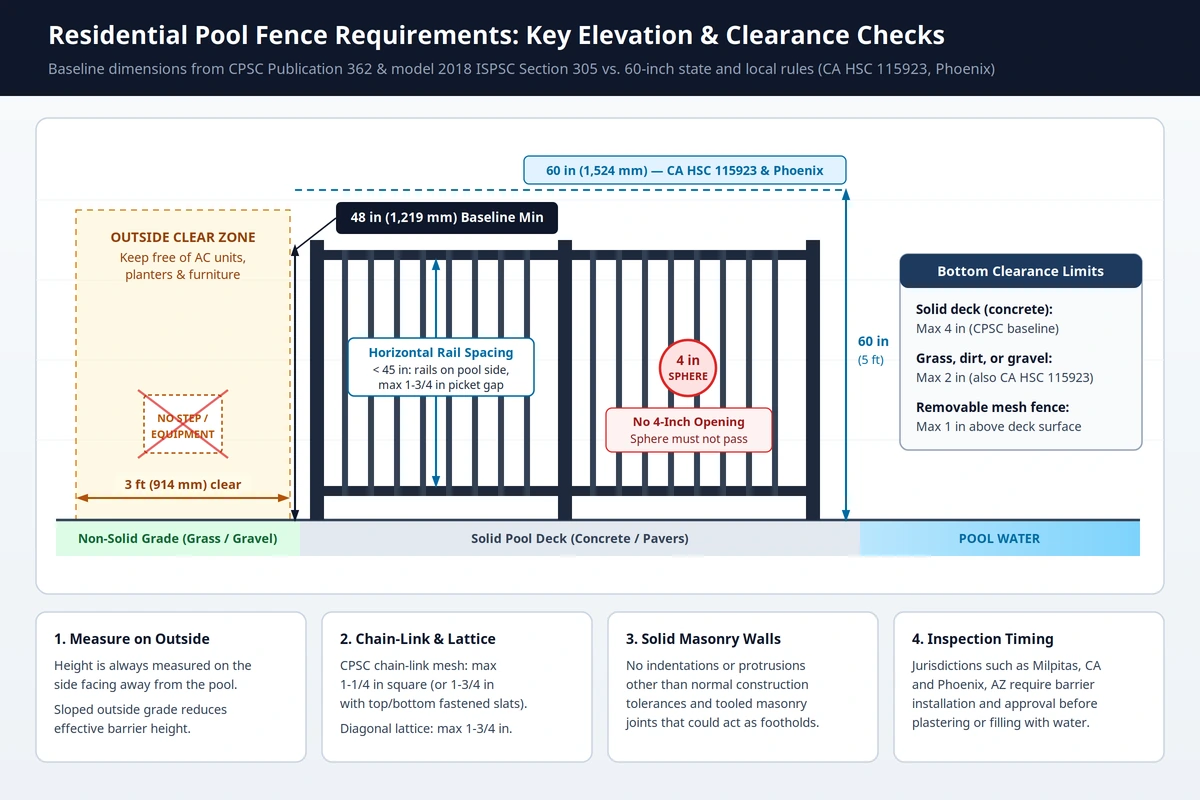
Most residential pool codes set a 48-inch (4-foot, or 1,219 mm) minimum barrier height measured on the exterior side facing away from the swimming pool, matching U.S. Consumer Product Safety Commission (CPSC) Publication 362 and model 2018 International Swimming Pool and Spa Code (ISPSC) Section 305.2.1.
CPSC also notes that fences 5 feet or higher are preferable and that a four-sided fence completely surrounding the pool is better than using a house wall as the fourth side. Measuring on the outside face matters whenever a backyard slopes up toward the fence line or sits beside retaining walls, raised planter beds, or decorative boulders. Under Phoenix’s 2018 ISPSC amendments, the required exterior barrier height shall exist around the entire perimeter and for a distance of 3 feet (914 mm) measured horizontally from the outside of the required barrier.
Is a four-foot fence tall enough in every jurisdiction?
No—a 48-inch barrier fails inspection in every state or municipality that adopts a 60-inch (5-foot) minimum, and no single federal statute sets a universal residential pool fence height. CPSC explicitly states that its swimming pool barrier guidelines are not a mandatory federal CPSC standard, though many states and localities incorporate them into building codes. Similarly, CPSC notes that the federal Virginia Graeme Baker Pool & Spa Safety Act mandates anti-entrapment drain covers for public pools and spas and does not require residential pools to install them, even though CPSC recommends doing so.
Two published government examples show how local code raises the baseline above 48 inches and locks in pre-plaster inspection timing:
- California residential enclosures: Under California Health and Safety Code (HSC) Section 115923, as published on the City of Milpitas residential pool safety certificate, a qualifying pool enclosure must have a minimum height of 60 inches, a maximum vertical ground clearance of 2 inches, and a gate self-latching device placed no lower than 60 inches above ground.
- City of Phoenix ISPSC amendment: Phoenix amends model 2018 ISPSC Section 305.2.1(1) from 48 inches (1,219 mm) to 60 inches (1,524 mm) in accordance with Arizona Revised Statutes (A.R.S.) Section 36-1681, and amends Chapter 2 to trigger barrier rules at water depths over 18 inches (457.2 mm) rather than the model 24-inch (610 mm) threshold.
- Inspection before plaster or water: Both Milpitas and Phoenix require safety barriers to be installed, inspected, and approved before plastering occurs for in-ground pools—and before water fill in Phoenix or installation of above-ground pools in Milpitas—so coordinate barrier installation early in the in-ground pool construction stages guide.
What opening, bottom-clearance, and anti-climb rules apply to fence panels?
Inspectors check fence panels against three paths—getting under, through, or over the barrier—using bottom clearance caps, the 4-inch diameter sphere test, rail and mesh spacing limits, and outside climbable-object clearances. Under CPSC Publication 362, no barrier opening may pass a 4-inch diameter sphere, reflecting a young child’s head breadth and chest depth.
Bottom clearance depends on the surface directly beneath the fence measured on the outside face. CPSC caps bottom vertical clearance at 4 inches above a solid surface, reduces that limit to 2 inches over non-solid surfaces such as grass or pebbles, and tightens it further to 1 inch for removable mesh fences. California HSC Section 115923 applies a 2-inch maximum vertical ground clearance to qualifying enclosures regardless of surface type.
Scroll horizontally to read all columns.
| Barrier component or material | CPSC Publication 362 baseline specification | Named local or statutory variation | Why inspectors check it |
|---|---|---|---|
| General barrier openings | Must not allow passage of a 4-inch diameter sphere | California HSC 115923 blocks any sphere 4 inches or greater; Florida 515.29 prohibits squeeze-through gaps | Prevents a young child’s head or torso from passing through |
| Bottom vertical clearance | Max 4 inches over solid deck; max 2 inches over grass or pebbles; max 1 inch for removable mesh | California HSC 115923 caps vertical ground clearance at 2 inches | Prevents a young child from crawling under the bottom rail |
| Horizontal rails under 45 inches apart | Horizontal rails on pool side; vertical picket spacing and decorative cutouts max 1-3/4 inches | Verify local picket and cutout tolerances on permitted plans | Limits foot width so a child cannot use rails or gaps as footholds |
| Horizontal rails more than 45 inches apart | Horizontal rails may sit on outside face; vertical spacing max 4 inches; cutouts still max 1-3/4 inches | Keep decorative cutouts under 1-3/4 inches even on tall rails | Eliminates ladder-like climb geometry between lower and upper rails |
| Chain-link fencing | Max 1-1/4 inch square mesh, or max 1-3/4 inches when slats are fastened at top or bottom | Phoenix ISPSC 305.2.7 sets max 1-3/4 inch (44 mm) openings and minimum 11 wire gauge | Prevents small shoes from finding toe-holds in wide diamond links |
| Diagonal latticework fencing | Maximum opening formed by diagonal members no more than 1-3/4 inches | Verify whether local building or HOA rules restrict lattice | Eliminates climbable diamond cavities along the outer face |
| Solid masonry or stone wall | No indentations or protrusions except normal construction tolerances and tooled masonry joints | California HSC 115923 bars outside protrusions or cavities serving as handholds or footholds for children under five | Prevents climbing via stepped stone ledges, decorative pilasters, or wall niches |
Barrier placement around backyard equipment is a frequent source of final-inspection failures. Both CPSC Publication 362 and Florida Statutes Section 515.29 state that a barrier may not be located where permanent structures, equipment, or similar objects can be used to climb over it. Keep pool filter pads, air-conditioning condensers, utility meter boxes, raised planters, and deck benches well outside the fence perimeter—and outside Phoenix’s 3-foot (914 mm) horizontal clear zone—when laying out the site on your new pool project checklist.
What gate and latch rules do inspectors check?
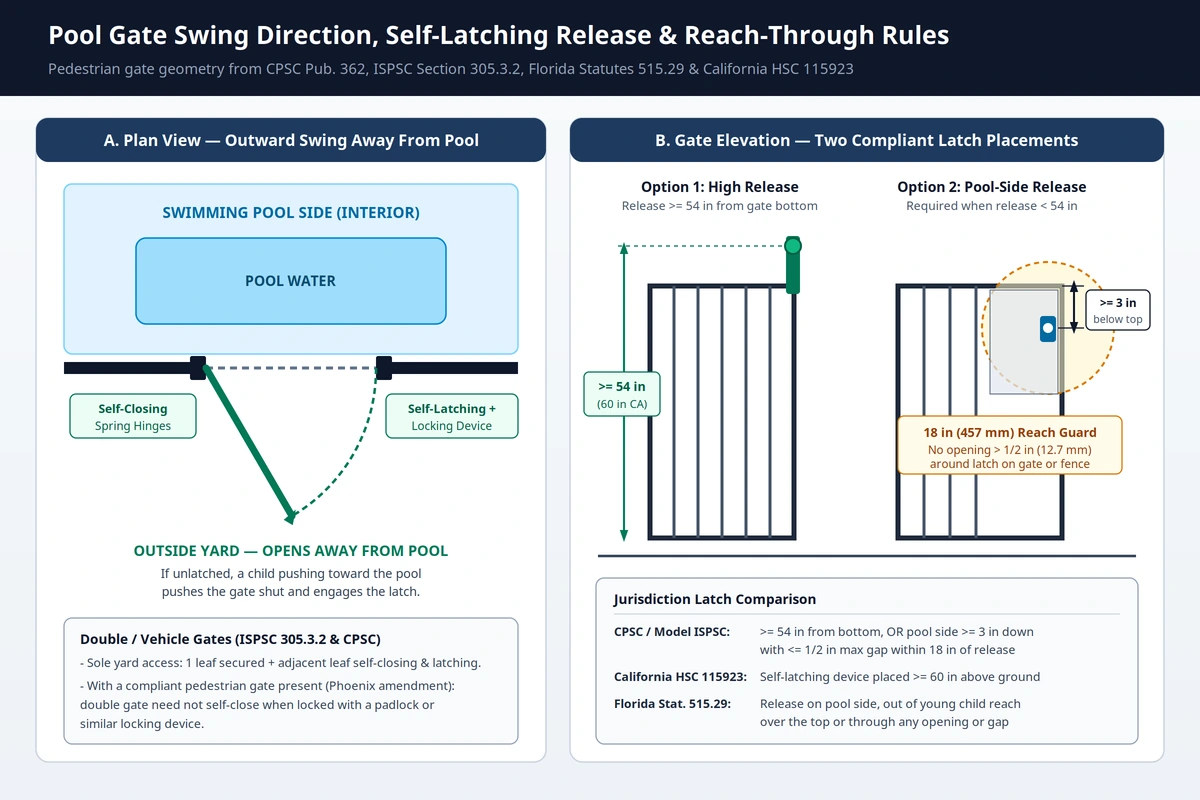
Pedestrian pool gates must open outward away from the pool, self-close, self-latch, and carry a locking device. CPSC explains why outward swing is essential: if an outward-opening gate stays slightly unlatched, a young child pushing toward the pool pushes the gate shut and may engage the latch instead of entering the water area.
Latch height and reach-through shielding are checked closely during final walkthroughs because rules diverge across model codes and state statutes:
- CPSC and model ISPSC latch geometry: Under CPSC Publication 362 and ISPSC Section 305.3.2, when the self-latching release mechanism sits less than 54 inches (1,372 mm) from the bottom of the gate, it shall be located on the pool side of the gate at least 3 inches (76 mm) below the top of the gate, and neither the gate nor the adjacent barrier may have an opening greater than 1/2 inch (12.7 mm) within 18 inches (457 mm) of the release mechanism.
- California enclosure latch height: California HSC Section 115923 specifies that any access gate through a qualifying enclosure must open away from the pool, be self-closing, and place its self-latching device no lower than 60 inches above the ground.
- Florida pool-side release: Florida Statutes Section 515.29 mandates outward-opening, self-closing gates with a self-latching locking device whose release mechanism sits on the pool side of the gate where a young child cannot reach it over the top or through any opening or gap.
- Double gates and vehicle entrances: CPSC states that gates other than pedestrian access gates should also carry a self-latching device and locking device. Under Phoenix’s amended 2018 ISPSC Section 305.3.2, if double or multiple gates provide the only access to the pool yard, at least one leaf shall be secured in place while the adjacent leaf is self-closing and self-latching; if a separate compliant pedestrian gate is also present, the double gate need not self-close when equipped with a padlock or similar locking device.
How do state rules in California or Florida raise or structure the baseline?
California and Florida both codify residential pool barriers through multi-option state statutes rather than fence height alone, yet their counts and dimensions differ sharply. California’s Swimming Pool Safety Act requires at least two of seven drowning prevention features for permitted residential pools, while Florida requires at least one of five options for pools over 24 inches deep.
Under California Health and Safety Code Sections 115920–115929, referenced in the 2025 California Building Code Section 3109.2, new or remodeled residential pools and spas at private single-family homes must install two qualifying features from the seven-item menu. By contrast, Florida Statutes Section 515.27 requires a new residential pool over 24 inches deep—defined in Florida Statutes Section 515.25 for detached one- or two-family dwellings and townhouses up to three stories—to meet at least one of five safety options to pass final inspection.
Scroll horizontally to read all columns.
| Requirement area | CPSC Pub. 362 / Model 2018 ISPSC | California (HSC 115920–115929 / Milpitas) | Florida (Statutes Chapter 515) | Phoenix 2018 ISPSC Amendments |
|---|---|---|---|---|
| Water depth trigger | Over 24 inches (610 mm) in model ISPSC Chapter 2 | Residential pool or spa permit (new or remodel) | Over 24 inches deep | Over 18 inches (457.2 mm) per Arizona Section 36-1681 |
| Required safety features | Continuous barrier (or ASTM F1346 powered cover exemption in ISPSC 305.1) | At least two of seven features (excluding prohibited pairings) | At least one of five options (Section 515.27) | Continuous barrier or keyed ASTM F1346 powered cover |
| Minimum barrier height | 48 inches (1,219 mm) measured on outside face | 60 inches minimum for HSC 115923 enclosures | At least 4 feet high on the outside (Section 515.29) | 60 inches (1,524 mm) across 3-foot (914 mm) outside zone |
| Yard perimeter fence rule | Four-sided isolation fence preferred over house wall | Isolation enclosure separates pool from the home | Separate from yard fence unless yard fence sits on pool perimeter and meets Section 515.29 | Entire pool perimeter maintained continuously |
| Gate latch placement | 54 inches from bottom, or pool side 3 inches below top with 1/2-inch max gap within 18 inches | No lower than 60 inches above ground (HSC 115923) | Pool side, unreachable over top or through any gap | 54 inches (1,372 mm) or pool side 3 inches (76 mm) below top |
| Pre-plaster / fill hold | Verify locally with building department | Must pass inspection before plastering (Milpitas) | Required to pass final inspection for certificate of completion | Installed, inspected, and approved before plastering or filling |
California also enforces explicit prohibited combinations so two overlapping devices cannot double-count toward the two-feature minimum. As listed on the City of Milpitas certificate, California’s two-feature rule is not satisfied by combining an exit alarm and a self-closing, self-latching device on the same door, combining an exit alarm and a door latch on separate doors, or pairing a safety pool cover with an ASTM F2208 water-entry pool alarm. Both California and Florida exclude personal wearable child alarms from qualifying as an ASTM F2208 swimming pool alarm, and California allows hot tubs and spas to use locking ASTM F1346 safety covers as an alternative to the seven-feature menu.
What extra safeguards apply when a house wall forms the fourth side?
Whenever a dwelling wall forms one side of the barrier and contains doors or operable windows leading directly to the pool area, codes require dedicated opening protection because unlatched house doors are a primary access gap. Under Florida Statutes Section 515.29, a dwelling wall may serve as part of a compliant barrier only if it contains no door or window opening to the pool—otherwise the home relies on Florida Section 515.27 options such as exit alarms rated at least 85 dBA at 10 feet on all direct-access doors and windows, or self-closing, self-latching door devices with releases at least 54 inches above the floor.
Model codes and municipal amendments spell out exact performance specs for house-wall alarms, doors, windows, covers, and pet openings:
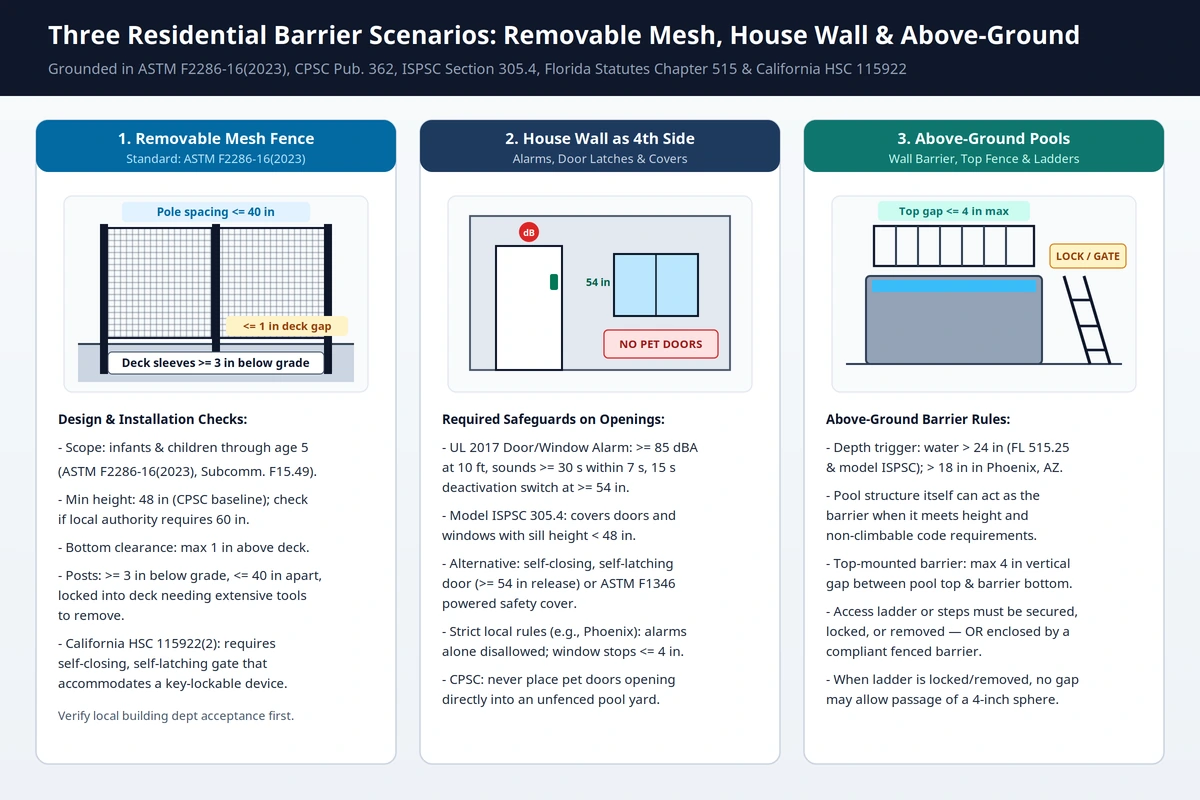
- UL 2017 door and window alarms: CPSC Publication 362 specifies UL 2017 Section 77 alarms that sound for 30 seconds or more within 7 seconds after a door or screen opens, produce at least 85 dBA measured 10 feet away with a tone distinct from household phones, doorbells, and smoke alarms, and include an automatic-reset temporary deactivation switch lasting up to 15 seconds mounted at least 54 inches above the threshold. Model 2018 ISPSC Section 305.4 applies UL 2017 water hazard entrance alarms to direct-access doors and operable windows with sill heights under 48 inches (1,219 mm), placing deactivation switches at 54 inches (1,372 mm) or more—or between 48 inches (1,219 mm) and 54 inches (1,372 mm) in Accessible, Type A, or Type B units.
- Safety covers as a barrier layer: Model 2018 ISPSC Section 305.1 exempts spas with lockable ASTM F1346 covers and pools with powered ASTM F1346 safety covers from Sections 305.2 through 305.7, CPSC and Florida reference ASTM F1346-91 covers, and California’s 2025 certificate cites ASTM F1346-23 labeled covers. If you plan to integrate an automatic cover into your compliance strategy, coordinate track, vault, and switch layout early in automatic pool cover planning.
- Stricter local house-wall amendments: Phoenix amends 2018 ISPSC Section 305.4 to remove audible alarms as a standalone house-wall compliance path, requiring instead either a key-operated ASTM F1346 powered safety cover (with its keyed switch at least 54 inches / 1,372 mm high where the entire cover is visible) or outward-swinging, self-closing, self-latching doors with 54-inch latches paired with window latches at 54 inches (1,372 mm) or keyed locks preventing non-egress windows from opening more than 4 inches (102 mm).
- Pet or doggy doors: CPSC advises never installing a pet or doggy door that opens directly to a pool or backyard water, noting that locking a pet door is not sufficient and that an isolation fence is the best defense when a home has pet doors.
What mesh safety fence standard applies to removable barriers?
Removable mesh pool safety fences are governed by ASTM F2286-16(2023), the active ASTM International specification developed by Subcommittee F15.49 (Book of Standards Volume 15.11) outlining design and performance requirements for removable mesh barriers around swimming pools, hot tubs, and spas to reduce injuries or death for infants and children up to and including five years of age.
Product labeling to ASTM F2286 is only half of compliance—installation geometry and local code acceptance determine whether an inspector signs off. CPSC Publication 362 details four layout benchmarks for removable mesh pool barriers:
- Height and climb resistance: At least 48 inches tall under CPSC guidelines (verify whether your municipality enforces 60 inches), with pole-to-mesh attachment designed to hinder climbing.
- Deck sleeve depth and pole spacing: Removable vertical support posts should extend at least 3 inches below grade and sit no more than 40 inches apart.
- Tight bottom clearance: The bottom of the mesh barrier should sit no more than 1 inch above the deck or installed surface.
- Tool-locked installation and compliant gate: CPSC notes that the safest removable mesh fences lock into the deck so they cannot be removed without extensive use of tools. Under California’s seven-feature menu, ASTM F2286 removable mesh fencing counts only when paired with a self-closing, self-latching gate that accommodates a key-lockable device.
ASTM F2286-16(2023) itself notes that inch-pound units are the standard and that users remain responsible for confirming local regulatory limitations prior to installation. Always ask the local building department whether removable mesh fencing is accepted for final permit sign-off and what documentation the inspector requires on site.
Do above-ground pools also have pool fence requirements?
Yes—above-ground and on-ground pools are regulated under residential pool barrier rules once water depth crosses the local code threshold, which is over 24 inches in Florida Statutes Section 515.25 and model 2018 ISPSC Chapter 2, and over 18 inches (457.2 mm) in Phoenix. Treating an above-ground pool as exempt is one of the most common permitting oversights.
Both CPSC Publication 362 and Florida Statutes Section 515.29(2) allow two structural approaches for above-ground pool barriers:
- Pool wall or top-mounted barrier: The above-ground pool structure itself may serve as the barrier if its exterior meets local height and non-climbable requirements, or a separate barrier may be mounted on top of the pool structure. When a barrier is mounted on top of the pool structure, CPSC caps the maximum vertical clearance between the top of the pool structure and the bottom of the barrier at 4 inches.
- Secured ladders, steps, or enclosed access: Where the pool structure or a top-mounted fence acts as the barrier, any access ladder or steps must be capable of being secured, locked, or removed to prevent access, or surrounded by a compliant fenced barrier. CPSC further specifies that when a ladder or steps are secured, locked, or removed, any opening left behind must not allow passage of a 4-inch diameter sphere.
Pre-inspection residential pool barrier checklist
Walk the entire pool perimeter with a tape measure and a 4-inch gauge before calling for pre-plaster or final barrier inspection:
- Confirm local code edition and height: Verify with your building department whether the parcel follows a 48-inch baseline or a 60-inch state or local rule, and measure height on the outside face along every grade change.
- Audit outside climb clearance: Remove or relocate air-conditioning condensers, pool equipment pads, planters, retaining steps, and patio furniture away from the outside fence face, maintaining a 3-foot (914 mm) clear zone where locally required.
- Check bottom gaps and panel openings: Confirm bottom clearance stays within 4 inches on solid decks, 2 inches on grass or gravel (or all California HSC 115923 enclosures), and 1 inch on removable mesh fences, and verify no opening passes a 4-inch sphere.
- Verify rail, chain-link, and masonry geometry: Confirm horizontal rails spaced under 45 inches apart sit on the pool side with 1-3/4 inch maximum vertical spacing and cutouts, chain-link mesh stays within 1-1/4 inches square (or 1-3/4 inches with fastened slats), lattice openings stay within 1-3/4 inches, and solid walls have no exterior footholds.
- Test every gate under real swing: Release each pedestrian gate from barely ajar and fully open to confirm outward swing away from the pool, reliable self-closing, and positive self-latching, and verify latch height (54 inches or pool-side 3-inch drop with 1/2-inch max gap within 18 inches, or 60 inches in California) plus double-gate locking rules.
- Inspect house-wall openings and covers: Where a dwelling wall forms one side of the barrier, verify UL 2017 door and window alarm sound (85 dBA at 10 feet), timing (30 seconds within 7 seconds), and 54-inch deactivation switch—or confirm compliant self-closing doors, window stops, or ASTM F1346 safety cover labeling—and eliminate any direct pet-door path to the pool.
- Verify mesh and above-ground hardware: For ASTM F2286 mesh barriers, check 3-inch sleeve depth, 40-inch maximum pole spacing, 1-inch deck clearance, and tool-locked sleeves; for above-ground pools, verify top-mounted gap limits (4 inches maximum) and locked, removable, or fenced ladders.
Frequently asked questions
Is a 4-foot pool fence tall enough in every state and city?
No. While CPSC guidelines, Florida Statutes 515.29, and model 2018 ISPSC Section 305.2.1 set a 48-inch (4-foot) baseline height, California HSC 115923 and local ISPSC amendments such as Phoenix Ordinance G-6463 require a 60-inch (5-foot) minimum barrier measured on the outside face.
Does federal law set a mandatory residential pool fence height?
No. U.S. CPSC Publication 362 states that its swimming pool barrier guidelines are not a mandatory CPSC standard, and the federal Virginia Graeme Baker Pool & Spa Safety Act mandates anti-entrapment drain covers for public pools and spas rather than residential pool fences; state and local building codes govern residential barriers.
Which way must a pool fence gate swing, and where does the latch go?
Pedestrian pool gates must open outward away from the pool and be self-closing and self-latching with a locking device. Under CPSC guidelines and ISPSC Section 305.3.2, a release mechanism lower than 54 inches from the gate bottom must sit on the pool side at least 3 inches below the top with no opening over 1/2 inch within 18 inches, while California HSC 115923 places enclosure gate latches at least 60 inches above ground.
What standard governs removable mesh pool safety fences?
Removable mesh safety fencing is covered by ASTM F2286-16(2023), developed by ASTM Subcommittee F15.49 for children up to and including five years of age. CPSC recommends a minimum 48-inch height, posts extending at least 3 inches below grade spaced no more than 40 inches apart, a maximum 1-inch gap above the deck, and deck locking that requires extensive tools to remove.
Do above-ground pools need a fence or barrier around them?
Yes, once water depth exceeds the local trigger—over 24 inches in Florida and model 2018 ISPSC, or over 18 inches in Phoenix. The pool wall itself or a top-mounted barrier with at most a 4-inch gap above the pool top may act as the barrier only if ladders or steps can be secured, locked, or removed, or are enclosed by a compliant barrier leaving no 4-inch sphere opening.
Sources
- Safety Barrier Guidelines for Residential Pools (Publication 362) — U.S. Consumer Product Safety Commission (CPSC)
- Pool/Spa Safety Requirements Certificate (Residential) & HSC § 115923 Enclosures — City of Milpitas, California — Office of Building Safety (2025 California Building Code, Section 3109.2)
- 2024 Florida Statutes, Chapter 515, Section 515.25 — Definitions — The Florida Senate
- 2024 Florida Statutes, Chapter 515, Section 515.27 — Residential Swimming Pool Safety Feature Options — The Florida Senate
- 2024 Florida Statutes, Chapter 515, Section 515.29 — Residential Swimming Pool Barrier Requirements — The Florida Senate
- 2018 International Swimming Pool and Spa Code (ISPSC) Phoenix Amendments (Ordinance G-6463) — City of Phoenix, Arizona — Planning & Development Department
- ASTM F2286-16(2023): Standard Design and Performance Specification for Removable Mesh Fencing for Swimming Pools, Hot Tubs, and Spas — ASTM International (Subcommittee F15.49) (F2286-16(2023))