Selecting an inground winter pool cover requires coordinating the cover fabric’s drainage method with the deck assembly that holds the perimeter anchors. Before ordering a custom cover or drilling into the deck, compare how standard mesh, high-shade mesh, and solid vinyl safety covers handle rain and snowmelt, then match the anchor hardware to your poured concrete, paver, wood, composite, or raised-wall perimeter. For the broader cover planning sequence, start with our pool covers guide.
What to verify before ordering a winter pool cover
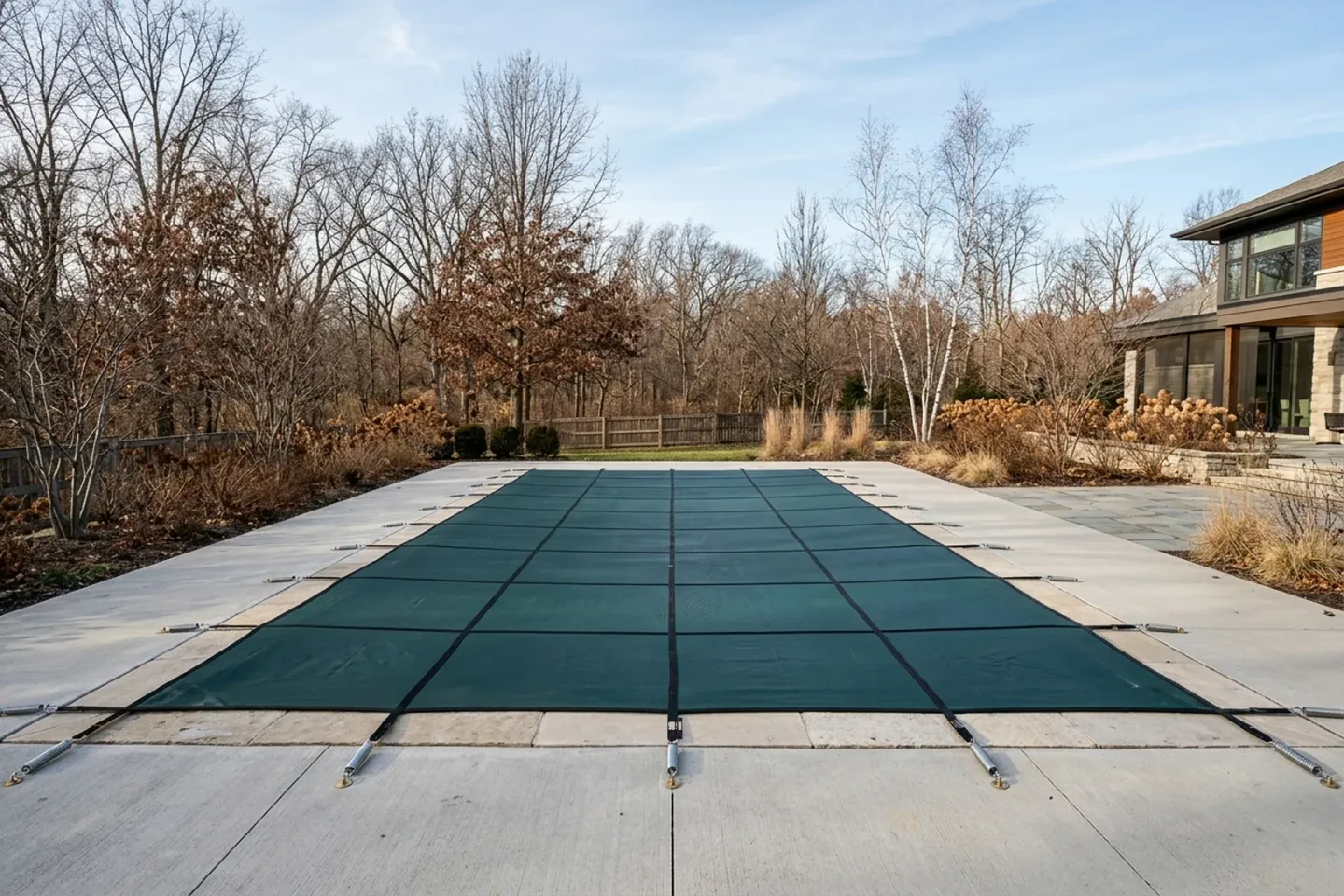
Begin by distinguishing an anchored safety cover from an unanchored floating cover, and check the applicable safety and water-removal criteria for your project.
Floating pool covers are designed to float on top of the water without anchoring or securing to the pool and are not safety covers.
Tests cited by the Riverside County Department of Environmental Health show that floating pool covers return to their original position within 10 to 20 seconds after a person falls underneath them, concealing a potential drowning victim.
According to ASTM F 1346-91 guidelines cited by Meyco, a safety cover installed on a pool with a width or diameter greater than 8 ft. from the periphery must be able to hold a weight of 485 lbs. (2 adults and 1 child).
The ASTM Performance Specification states that no pool cover can call itself a safety cover if it does not provide for water removal.
Under the 2024 International Swimming Pool and Spa Code Section 305.4 Item 5, where a wall of a dwelling or structure serves as part of the barrier and where doors, gates or windows provide direct access to the pool or spa through that wall, one compliance option is installing a safety cover that is listed and labeled in accordance with ASTM F1346.
Use the verification table below alongside your site layout to record the fabric, drainage, deck clearance, and hardware choices before requesting a cover quote.
Scroll horizontally to read all columns.
| Selection area | Question to verify on site | Record to keep with the order |
|---|---|---|
| Cover fabric | Will the pool use pass-through mesh drainage, a solid cover with drain panels, or an all-solid cover with a pump? | Selected manufacturer, model family, and fabric specification sheet |
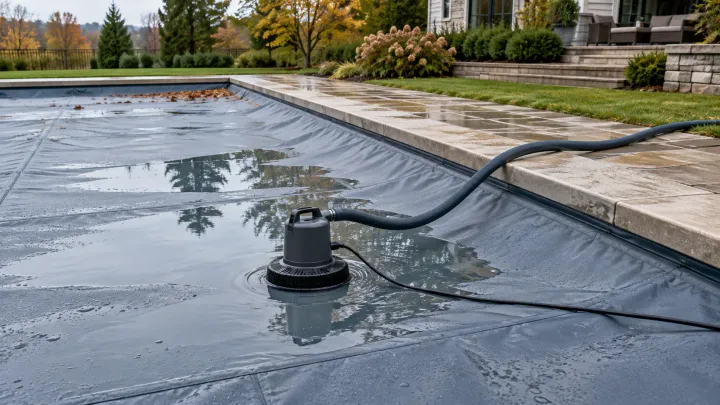
| Surface water removal | If choosing an all-solid cover, where will the automatic cover pump sit and discharge? | Pump rating, power cord route, and discharge path |
| Perimeter setback | How much unobstructed deck width exists around the water edge for cover overlap, straps, and springs? | Measured deck width at every side, step, and corner |
| Deck substrate | Is each anchor zone monolithic concrete, pavers, loose brick, wood, composite boards, lawn, or a raised wall? | Anchor hardware schedule by perimeter zone |
| Winter water level | What water-level window does the cover manufacturer require to support winter snow and ice loads? | Closing water-level target and mid-winter inspection plan |
Mesh vs solid winter safety cover specifications
Compare winter safety cover fabrics across three functional tiers: standard mesh, high-shade mesh, and coated vinyl solid covers. Keep each fabric weight, sunlight blockage figure, and drainage specification tied to its exact manufacturer and product line.
Scroll horizontally to read all columns.
| Cover fabric & sunlight blockage | Construction, weight & drainage specification |
|---|---|
| LOOP-LOC Super Dense Mesh safety covers are designed to block approximately 97% of sunlight while allowing rain and melting snow to drain through, eliminating the need for a cover pump. | LOOP-LOC Super Dense Mesh uses polypropylene-extruded monofilament yarn rated at 525 denier in the warp. |
| LOOP-LOC Super Dense Mesh has a 41 x 20 construction with 80% black yarn and 20% green yarn at a fabric weight of 4.7 ounces per sq. yard. | Meyco RuggedMesh pool covers weigh 50% less than a typical solid safety cover and use a tighter weave to filter out finer particles while allowing surface water to drain. |
| The patented weave material of LOOP-LOC AQUA-XTREME Virtually Solid Mesh blocks 99% of sunlight from reaching the pool. | LOOP-LOC AQUA-XTREME Virtually Solid Mesh drains up to 80 gallons of water per minute without clogging. |
| LOOP-LOC AQUA-XTREME Virtually Solid Mesh is 50% lighter than traditional solid covers. | LOOP-LOC Aqua-Xtreme Mesh uses 86% black yarn and 14% colored yarns at a fabric weight of 6.7 ounces per sq. yard. |
| LOOP-LOC ULTRA-LOC III solid safety covers block 100% of sunlight and offer optional mesh drainage panels or an all-solid configuration with an automatic cover pump. | LOOP-LOC ULTRA-LOC III uses high adhesion coated vinyl with a woven rip-stop scrim at a weight of 14 ounces per sq. yard. |
When an all-solid safety cover relies on surface pumping rather than mesh drainage, include the pump specification and placement in the closing plan.
On Anchor Industries solid safety covers, the cover pump must be placed at the geographical center of the cover and have a rating of 1200 gph or more to meet safety cover criteria.
For automatic pump starting depth, discharge head, and debris screen checks on solid covers, see our pool cover pump selection guide.
Webbing straps and coping chafing strips
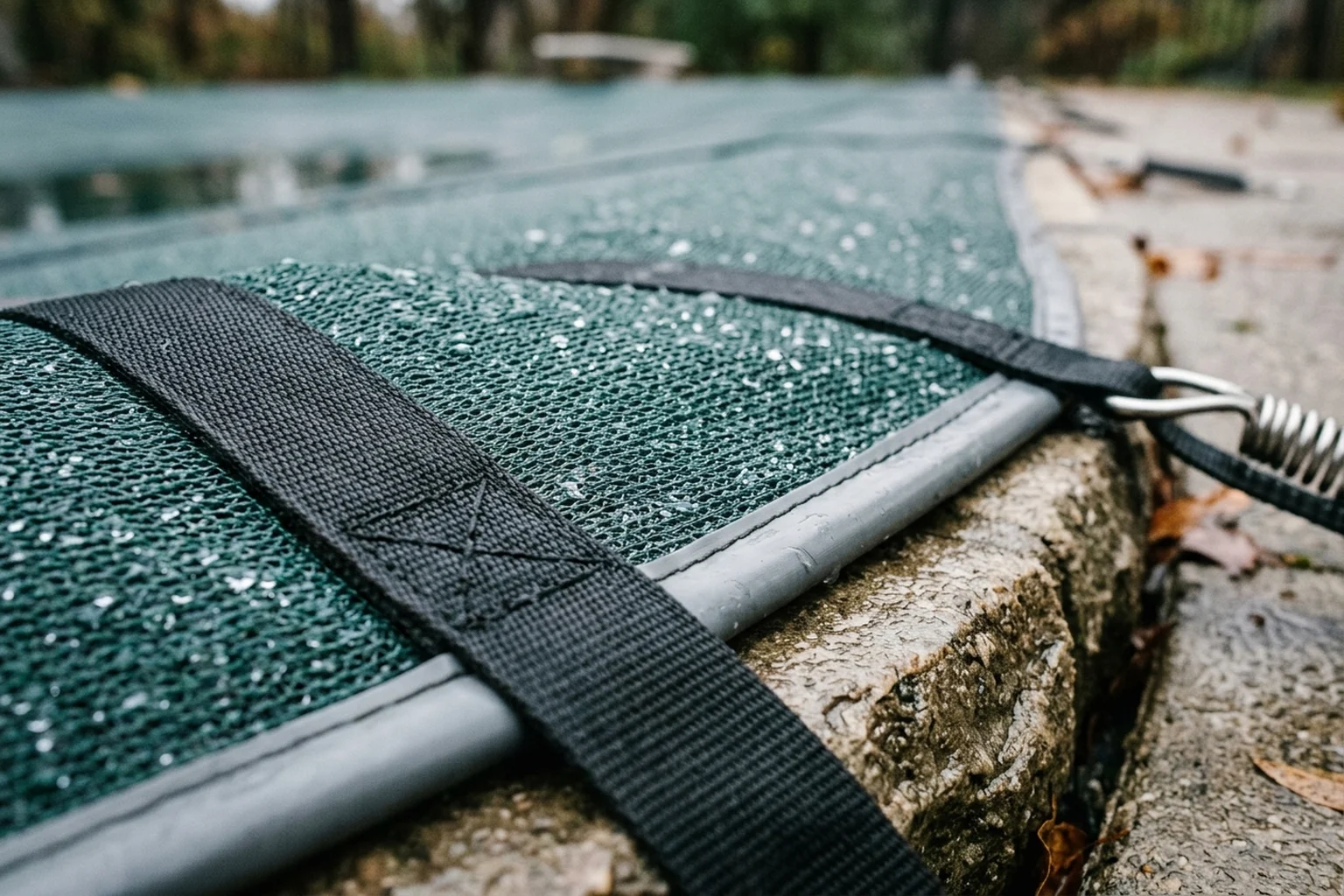
Check the reinforcement webbing and coping wear strips alongside the fabric specification.
LOOP-LOC 1” wide polypropylene webbing has a minimum single break strength of 2,100 pounds and is used double-thick for a minimum strap break-strength of 4,200 pounds.
LOOP-LOC under-cover chafing strips are a minimum of 1” wide, 20” to 36” long depending on cover overlap, and made of 3/16” thick extruded solid virgin vinyl.
Deck width, anchor setback, and concrete drilling specifications
Before drilling into a concrete pool deck, confirm that the available deck width accommodates both the cover’s deck overlap and the strap-and-spring extension from the cover edge to the anchor point. Record the water outline and non-removable deck obstructions using our pool cover measurement guide.
Scroll horizontally to read all columns.
| Deck clearance & anchor setback | Concrete anchor specification & drill depth |
|---|---|
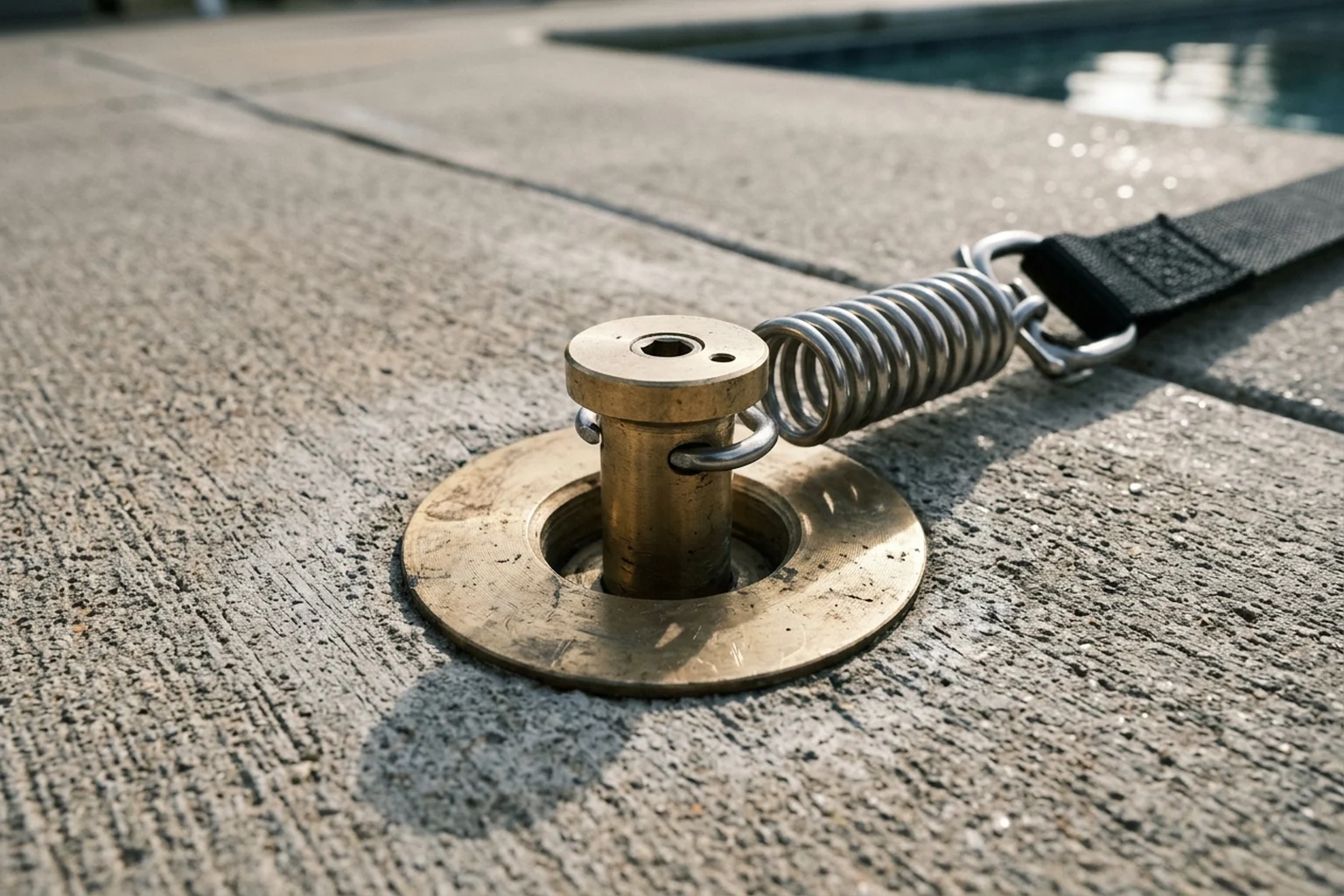
| Robelle safety cover installation requires the deck width around the pool to be a minimum of 3 feet. | LOOP-LOC flush-mounted brass deck anchors with a screw-type insert have a 4,000 pound break strength at the neck. |
| On Robelle safety covers, the cover overlaps the pool from the water's edge approximately 9” to 18” onto the deck surface, and the spring and strapping extend another 17” from the cover's edge. | Robelle brass anchor installation uses a hammer drill and a 3/4” drill bit held perpendicular to the deck surface to drill down 1 7/8” into the deck. |
| On Meyco safety pool covers, anchors should be located 20” back from the cover's edge, and typically the anchors are about 32” to 38” back from the pool edge. | Meyco concrete anchor installation requires drilling a hole with a 3/4” drill bit to a depth of 1 3/4” for screw-type anchors or 2” for pop-up type anchors, plus the drill bit beveled depth. |
| On GLI safety covers, the anchor setback from the edge of the pool equals the cover overlap plus 22”, which produces a 34” setback for a 12” overlap and a 40” setback for an 18” overlap. | GLI standard brass anchor installation requires drilling 3/4” diameter holes to a depth of 2” and beveling or reaming the top of the hole for a flush fit. |
| On Anchor Industries solid safety covers, brass anchors with rubber ties are placed approximately 11” from the pool cover edge and over 1” from a 90º corner. | Anchor Industries brass anchor installation uses a 3/4” masonry bit to drill holes no more than the depth of the brass anchor (1 5/8”). |
Paver tubes, wood countersinks, composite brackets, and wall anchors
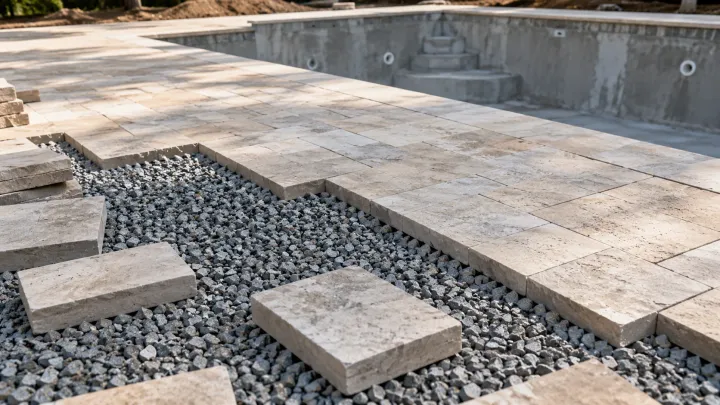
Coordinate deck slope, board spacing, and subbase construction with the hardware specified for each surface. For stone bedding and subbase design under pavers, see our pool deck pavers and drainage base guide.
Under the 2024 International Swimming Pool and Spa Code Section 306.5 and Section 306.6, the maximum deck slope is 1/2 inch per foot; under Section 306.5 Exception 1, the minimum slope is not required where an alternative drainage method prevents water pooling deeper than 1/8 inch (3.2 mm) 20 minutes after water addition stops; and wood deck board drainage gaps are 1/8 inch to 1/2 inch.
Paver decks, loose brick, and lawn edges
Dry-laid pavers, patio stones, and adjacent lawn or garden zones require deep pipe tubes or lawn stakes as specified by the cover manufacturer:
- For unstable surfaces such as loose bricks, patio stones, and landscape areas, Meyco pipe anchors are 18” long aluminum tubes with a brass screw-type anchor permanently embedded into one end, installed by pre-drilling a 7/8” hole.
- Meyco offers a 9” Pipe Anchor for pools with paver decks or irregular surfaces and an 18” Pipe Anchor for paver decks, loose brick, or garden/lawn areas.
- When anchoring into brick, stone, or pavers, GLI specifies using a GLI 9” Paver Tube installed in a 1” hole drilled 9-1/4” deep.
- For brick, stone, pavers, or lawn surfaces, Robelle specifies drilling a 7/8” hole 18” deep through the brick, stone, or pavers and hammering an anchor tube with a brass anchor flush with the surface.
- Meyco lawn stakes are 1/2” round, 18” long aluminum pins that should not be used for more than 20% of the anchoring points around a pool and should never be placed at opposite ends of the same strap.
Wood and composite decking
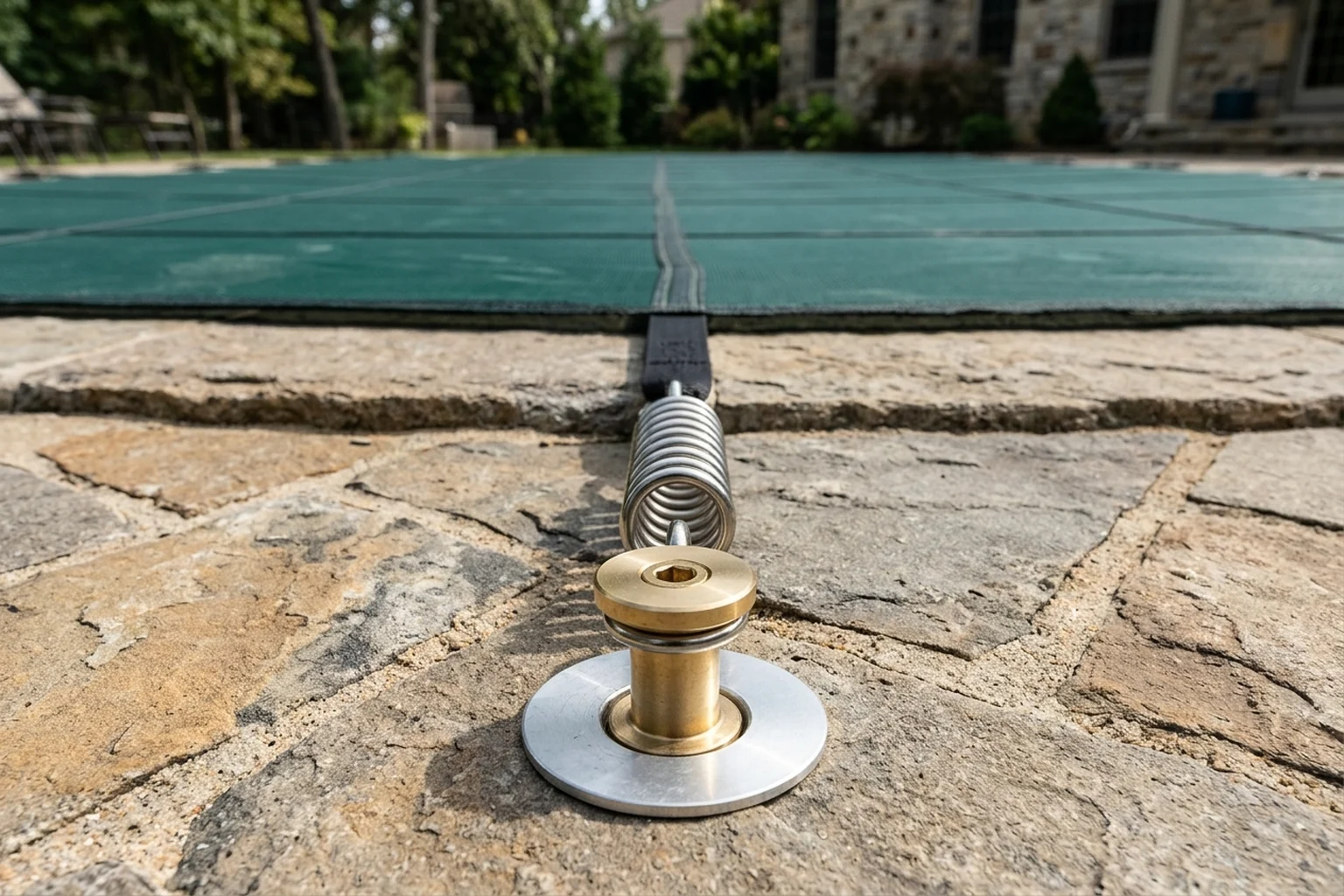
Wood and composite decks use either countersunk flange anchors screwed into the decking or no-drill brackets matched to the board gap:
- Meyco wood deck anchors are countersunk into wood decking by drilling a 2” x 1/8” countersink for the top flange and a 3/4” hole for the anchor body.
- GLI wood deck anchor installation drills a 1-1/2” diameter hole to a depth of 1/8” with a wing bit, followed by a 3/4” diameter center hole to a final depth of 1-1/4”, secured with 4 brass screws.
- LOOP-LOC DECK-LOC is a marine-grade stainless steel no-drill anchoring system made for composite decks with 3/8” board spacing.
- Meyco Wood Deck Brackets are snap-in-place no-drill anchors compatible with composite or wood decking that has 1/8″ to 1/4″ spacing.
Raised bond beams and wall applications
Where a raised bond beam, spa wall, or retaining wall interrupts the flat deck perimeter, review the manufacturer’s wall-anchor and cable spacing limits:
- On raised walls, GLI Cable Mate Wall Anchors are installed every 3’ on straight walls and every 18” on tight radius walls in 3/8” holes drilled 2-1/2” deep, and the gap between the cover and wall must not exceed 4”.
- LOOP-LOC CABLE-LOC raised wall treatment uses aircraft-quality stainless steel cable with a 5,000 lb. break strength and a maximum 18” anchor spacing.
Spring tension, winter water levels, and snow-load mechanics
Perimeter springs and the pool water below the cover work together to carry winter precipitation, snow, and ice loads. Match the spring hardware to the available deck clearance and set the initial and ongoing compression targets according to the cover manual.
- Meyco standard 7.5” stainless steel springs and heavy duty 8” stainless steel springs have a load-bearing strength of 1,500 lbs, while short 5.5” stainless steel springs are made for areas with short decking.
- Upon original installation, adjustable springs on a LOOP-LOC mesh cover should be compressed about 90% for in-ground pools and about 50% for on-ground pools, then adjusted over time to maintain 75% compression for in-ground and 50% for on-ground.
- On LOOP-LOC ULTRA-LOC solid covers, the adjustable springs should be compressed about 60% at all times; after running a garden hose over the entire cover for at least 5 minutes, further adjust the springs if water still accumulates until it drains completely.
- On GLI safety covers, springs should be compressed about 60% to 70% for a taut fit.
- On Meyco safety covers, straps are tightened so that the springs are compressed about halfway, with coils compressed approximately 2 1/2” apart.
Maintaining the winter water-level window
Keeping pool water within the manufacturer’s specified winter range supports the cover when heavy snow or ice accumulates and prevents excessive downward deflection on straps, springs, anchors, and coping.
During the winter months, LOOP-LOC specifies maintaining pool water levels at 15” to 18” below the top of the pool for mesh covers and 12” to 16” below the top of the pool for solid covers to support snow and ice loads.
On GLI solid safety covers, the cover must remain suspended above the pool’s water level in order to drain, and the pool’s water level must not drop more than 18” from the top of the pool during winter months.
On LOOP-LOC solid covers without drain panels, water seeping up through material seams under snow and ice loads can be pumped out by the automatic cover pump; once the cover exceeds a depressed level of 16” below the deck, excess stress is placed on the cover, hardware, pool, coping, and deck, making cover or hardware failure possible.
Assemble your winter safety cover specification packet
Before placing a custom cover order or scheduling deck drilling, record these project details on one sheet:
- The selected cover manufacturer, model family, and fabric category (standard mesh, high-shade mesh, solid with mesh drain panels, or all-solid with an automatic pump).
- The water-outline measurements, diagonal checks, and locations of all non-removable rails, ladders, steps, and raised walls from the pool cover measurement guide.
- The measured deck width around every side of the pool, identifying any narrow-deck zones that require short-deck springs.
- A perimeter hardware schedule mapping each zone to its substrate anchor type (flush concrete brass anchors, paver pipe tubes, wood countersink anchors, composite board-gap brackets, lawn stakes, or raised-wall cable anchors).
- The surface-water discharge plan for solid covers from the pool cover pump selection guide and the closing water-level check schedule.
Review the completed specification packet alongside our pool covers hub and pool deck pavers and drainage base guide before installation begins.
Sources
- LOOP-LOC — Super Dense Mesh, ULTRA-LOC Solid, or AQUA-XTREME Virtually Solid Mesh Comparison
- LOOP-LOC — All Product Brochure
- LOOP-LOC — Safety Pool Covers & Hardware FAQs
- LOOP-LOC — Mesh & Solid Safety Pool Cover Care and Maintenance Information
- LOOP-LOC — DECK-LOC No-Drill Anchoring System for Composite Decks
- Meyco Pool Covers — Official FAQ
- Meyco Pool Covers — Safety Pool Cover Installation and Maintenance Instructions
- Meyco Pool Covers — Safety Cover Accessories & Anchors
- GLI Pool Products — Safety Cover Installation and Maintenance Instructions
- Anchor Industries — Solid Classic Safety Pool Cover Installation Manual
- Robelle Industries — Safety Cover Installation Guide
- Riverside County Department of Environmental Health — Guidelines for Pool Covers
- International Code Council — International Swimming Pool and Spa Code (Sample Excerpt)