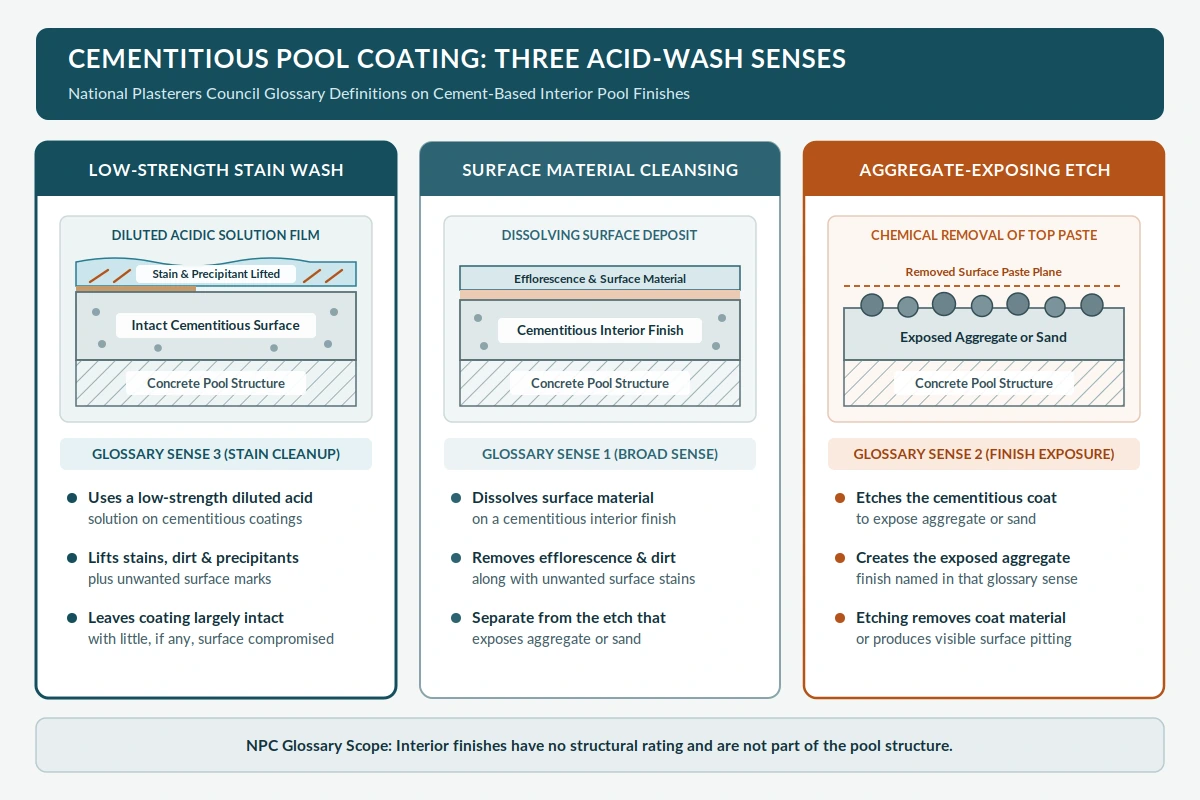
An acid wash on a concrete pool applies only to a cementitious interior coating, meaning a finish with the properties of cement, and the National Plasterers Council consumer glossary separates three distinct meanings under that term. In its general sense, an acid wash cleanses the interior finish surface by dissolving material on a cementitious coating to remove efflorescence, dirt, or other unwanted stains. In its stain-cleanup sense, a low-strength diluted acidic solution removes certain cementitious stains, dirt, precipitants, or marks while leaving little, if any, of the cementitious surface compromised.
A separate glossary sense uses acid to etch a cementitious coating in order to expose the aggregate or sand and create an exposed aggregate finish. Etching is the physical or chemical removal of material from within the interior finish surface, or visible pitting of that surface, and where continued leaching has caused complete dissolution of the cement paste, or the plaster has separated from itself or from the substrate, hollow and delaminated plaster is sounded out and removed before a new finish.
In the National Plasterers Council glossary, interior finishes plaster the substrate with a cement-based product, carry no structural rating, and are not considered part of the swimming pool structure. As noted in our exposed pebble vs quartz interior finishes comparison, a later acid treatment for scale or stains is not routine owner maintenance, and the installer should assess the cause first. For plaster, aggregate, or tile systems, consult the selected system’s documentation and confirm application and start-up conditions with the finish maker through our pool materials hub.
What chemical solution is used in a pool acid wash?
In the National Plasterers Council glossary, acid is a liquid or dry chemical used to lower the pH or alkalinity of pool or spa water, and muriatic acid is a commercial name for hydrochloric acid used both to lower pH and alkalinity and to acid wash swimming pools. The Agency for Toxic Substances and Disease Registry gives synonyms for an aqueous solution of hydrogen chloride that include chlorohydric acid, hydrochloric acid, and muriatic acid, while the Occupational Safety and Health Administration occupational chemical database lists CAS 7647-01-0 with formula HCl and synonyms that include aqueous hydrogen chloride, hydrochloric acid, and muriatic acid, and one commercial muriatic acid safety data sheet also lists the synonym spirits of salt. According to ATSDR, hydrochloric acid is a component of commercial chemicals used to clean and disinfect swimming pools.
Shelf labels that say pool acid do not all refer to hydrochloric acid. Under the CDC Model Aquatic Health Code, approved substances for pH adjustment include muriatic (hydrochloric) acid, sodium bisulfate, carbon dioxide, sulfuric acid, sodium bicarbonate, and soda ash, and chemicals used for pH adjustment shall be certified, listed, and labeled to either NSF/ANSI 50 or NSF/ANSI 60 by an ANSI-accredited certification organization. Sodium bisulfate is a dry acid substance separate from hydrochloric acid, and the National Plasterers Council chemical etching bulletin warns that direct physical contact with compounds including sodium chloride, cyanuric acid, granular chlorine products, and sodium bisulfate can cause discoloration, water entrapment, or pigment alteration on cementitious finishes.
Published technical documents also record different hydrochloric acid concentrations and dilutions for distinct tasks, so each figure stays tied to its specific source and use:
Scroll horizontally to read all columns.
| Published document | Stated chemical & concentration | Documented task scope |
|---|---|---|
| National Plasterers Council Pool Start-Up Card (March 2023) | Muriatic acid identified as 31% to 33% hydrochloric acid, always pre-diluted by adding it to a five-gallon (19 L) bucket of water | Day-one in-water start-up adjustment to bring high alkalinity down to 80 ppm to 100 ppm, followed by pH reduction to 7.2 to 7.6 |
| Commercial muriatic acid safety data sheet | Hydrochloric acid (CAS 7647-01-0) at 31.45% by weight | Recommended uses listed as household cleaning, swimming pool water pH control, and neutralization |
| ATSDR Medical Management Guidelines | Concentrated commercial hydrochloric acid containing 36% to 38% hydrogen chloride in water | Federal toxicology profile for concentrated commercial grade solution and vapor hazard thresholds |
| Quartz-aggregate finish installation manual | Optional 25% solution of muriatic acid and water after brush exposure | New-finish installation step to remove thin residual film on a newly exposed coat, not a maintenance mix for aged stained plaster |
| CDC 2024 MAHC Annex (filter maintenance) | 1:20 solution of clean water and muriatic acid | Cleaning excessive calcium or mineral deposits on cartridge-filter media after degreasing, not for interior pool plaster |
For cartridge-filter media specifically, the Model Aquatic Health Code Annex notes that very few filters require that 1:20 acid wash and states never to use muriatic acid or products containing acid prior to degreasing because acid can set grease and ruin the cartridge.
How does stain washing differ from plaster etching and leaching?
Surface deposits that sit on top of a cementitious finish form through different chemical pathways than structural paste loss inside the coating. In the National Plasterers Council glossary, efflorescence consists of soluble compounds, predominantly calcium hydroxide, that migrate in the presence of moisture from within a cementitious product to the surface and then precipitate and carbonate onto the surface. When a pool is filled with water after a new interior finish has been installed, soluble white crystalline calcium hydroxide is apparent as plaster dust, while calcium carbonate is a calcium compound that forms a major component of scale.
According to the National Plasterers Council technical bulletin on swimming pool interior finishes and chemical etching, aggressive water that falls chemically outside established balanced ranges is capable of removing, dissolving, or reacting with surface materials and causing accelerated deterioration. That bulletin identifies aggressive water as water with low calcium hardness, low pH, low carbonate alkalinity, or a combination of those conditions, and notes that higher salt levels can make water more aggressive. When water is not maintained in the ideal ranges, which that bulletin treats as balanced, it can deteriorate a cementitious surface coating by dissolving components of the cement/aggregate matrix, resulting in the leaching of cement compounds, and the glossary defines leaching as the extraction of a mineral or metal from the interior finish.
Within that cement matrix, the etching bulletin notes that calcium hydroxide is the most soluble cement compound and the first compound to dissolve, and continued leaching can cause complete dissolution of the cement paste over time in affected regions of the coating. Its deterioration table lists low pH as causing general dissolving of materials. The Model Aquatic Health Code Annex likewise explains that low pH can lead water to dissolve calcium carbonate from plaster surfaces and increase metal corrosion, high pH can lead to calcium carbonate scaling, and too little calcium combined with low pH or low total alkalinity can make water aggressive enough to dissolve calcium carbonate from plaster. If total alkalinity is too low, the annex notes that pH may drop rapidly when net acidic chlorine sources or acidic chemicals such as trichlor, dichlor, or potassium monopersulfate enter the water, causing etching and corrosion.
The National Plasterers Council etching bulletin calls maintaining proper water balance the most critical care item to prevent etching deterioration and treats balanced water as water maintained to prevent etching and scaling, while the Model Aquatic Health Code Annex says maintaining properly balanced water is important for preventing plaster degradation in pools. Under the Model Aquatic Health Code, pool water pH shall be maintained at 7.0 to 7.8. To track calcium carbonate saturation, the Langelier Saturation Index predicts whether water has a tendency to precipitate calcium scale onto the finish or dissolve and leach calcium from the finish:
- On the National Plasterers Council Pool Start-Up Card (March 2023), a negative Langelier Saturation Index will cause leaching, etching, or discoloration of the surface, while a positive index will cause mineral scaling, metal staining, or discoloration.
- That start-up card states that the Langelier Saturation Index must be maintained between 0.0 and +0.3 for ongoing maintenance, especially within the first six months after initial start-up, to avoid potentially serious damage to the interior finish surface.
- The National Plasterers Council etching bulletin records that APSP acknowledges an acceptable Saturation Index range of -0.3 to +0.5 and an ideal range of 0.0 to +0.5, while the National Plasterers Council refines the ideal range to 0.0 to +0.3.
Can you run a no-drain acid treatment with water in place?
On the National Plasterers Council start-up card, chemicals added to pool water are pre-diluted when possible and added while the pumps are running, whereas one quartz-aggregate installation manual’s wet acid wash, also called an acid start-up or a no-drain acid wash, is sometimes used after water washing and is also used where fill water is high in alkalinity or hardness. On the National Plasterers Council start-up card, when chemicals are added to pool water, they should be pre-diluted prior to addition when possible, added while the pumps are running in the deep end away from benches, steps, and suction lines when possible, and followed by brushing of the area to disperse the chemicals.
In the Model Aquatic Health Code Annex, adding acid to filled pool water lowers total alkalinity because the acid reacts with bicarbonates in the water: adding 1.6 pounds of dry acid (sodium bisulfate) or 1.3 quarts of muriatic acid per 10,000 gallons of water decreases total alkalinity by 10 ppm, followed by retesting and adjusting pH. That annex dose is an incremental alkalinity adjustment within operating water balance, not a stain-removal wash.
By contrast, one published quartz-aggregate finish installation manual describes a wet acid wash, which it also calls an acid start-up or no-drain acid wash, strictly as a new-finish aggregate exposure technique used after water washing or where fill water is high in alkalinity or hardness. In that new-finish procedure, after filling the pool, the installer tests alkalinity to determine the muriatic acid needed to lower total alkalinity to zero and brushes the entire surface twice daily for 3 days. Even for a newly troweled finish, that manual states that when used alone without water washing, the no-drain technique produces the least desirable results, will not remove all cement paste evenly, and results in a streaked appearance.
When should stained or hollow plaster be resurfaced instead?
Continued leaching can cause complete dissolution of the cement paste over time in those regions of the coating. In the National Plasterers Council glossary, delamination is the separation of a material from itself or from the substrate. Where plaster is hollow or delaminated, the quartz-aggregate installation manual says to sound out and remove all hollow and delaminated plaster before a replacement finish.
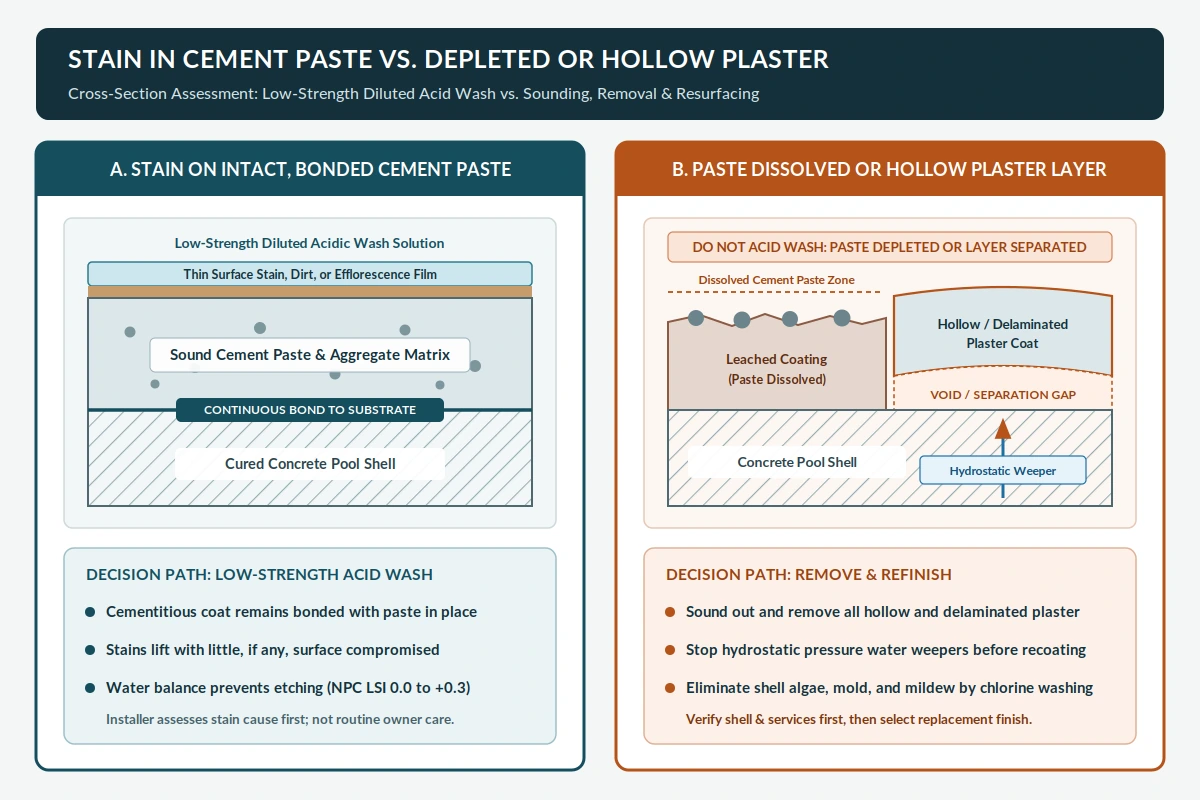
A published quartz-aggregate finish installation manual says, in its resurfacing section, to sound out and remove all hollow and delaminated plaster, and the same manual says all water penetration due to hydrostatic pressure must be stopped before the new finish, algae, mold, and mildew must be eliminated by chlorine washing, and the shell must be fully cured at least 28 days before that finish is applied.
Scroll horizontally to read all columns.
| Observed interior condition | Documented technical action |
|---|---|
| Surface stain, dirt, or efflorescence on sound cementitious paste | Evaluate stain cause first; where appropriate, use the glossary's low-strength diluted acidic solution so stains lift with little, if any, surface compromised |
| Hollow or delaminated plaster zones | Sound out and remove all hollow and delaminated plaster before applying a replacement finish |
| Groundwater seepage through the shell (weepers) | Stop all water penetration due to hydrostatic pressure before applying a new interior finish |
| Algae, mold, or mildew on the shell before that finish | Eliminate algae, mold, and mildew by chlorine washing before the new finish, or discoloration and bond failure (delamination) will result |
| Concrete shell before that finish coat | The shell must be fully cured at least 28 days before that finish is applied |
During installation of a new quartz-aggregate coat in that manual, the finish coat is worked to 3/8” to 1/2” thick, and aggregate exposure may begin only when the surface cream washes away without losing aggregate, because washing too soon causes washouts that must be re-troweled immediately.
When surface inspection points to plaster removal rather than a stain wash, follow the retain-or-refurbish sequence on our pool renovation hub: check the existing shell, services, and proposed changes first to establish that the structure and services are suitable before defining the finish scope. Once the substrate is verified, compare replacement cementitious systems in our pool plaster types: marcite, quartz, and pebble guide, and review warranty terms and sample checks on our exposed pebble vs quartz interior finishes page. While the Model Aquatic Health Code Annex lists paint, marcite plaster, quartz plaster, aggregate plaster, and vinyl or PVC liner systems among acceptable pool finishes, acid washing in the National Plasterers Council glossary applies specifically to cementitious coatings.
What drain, wastewater, and SDS controls apply before washing?
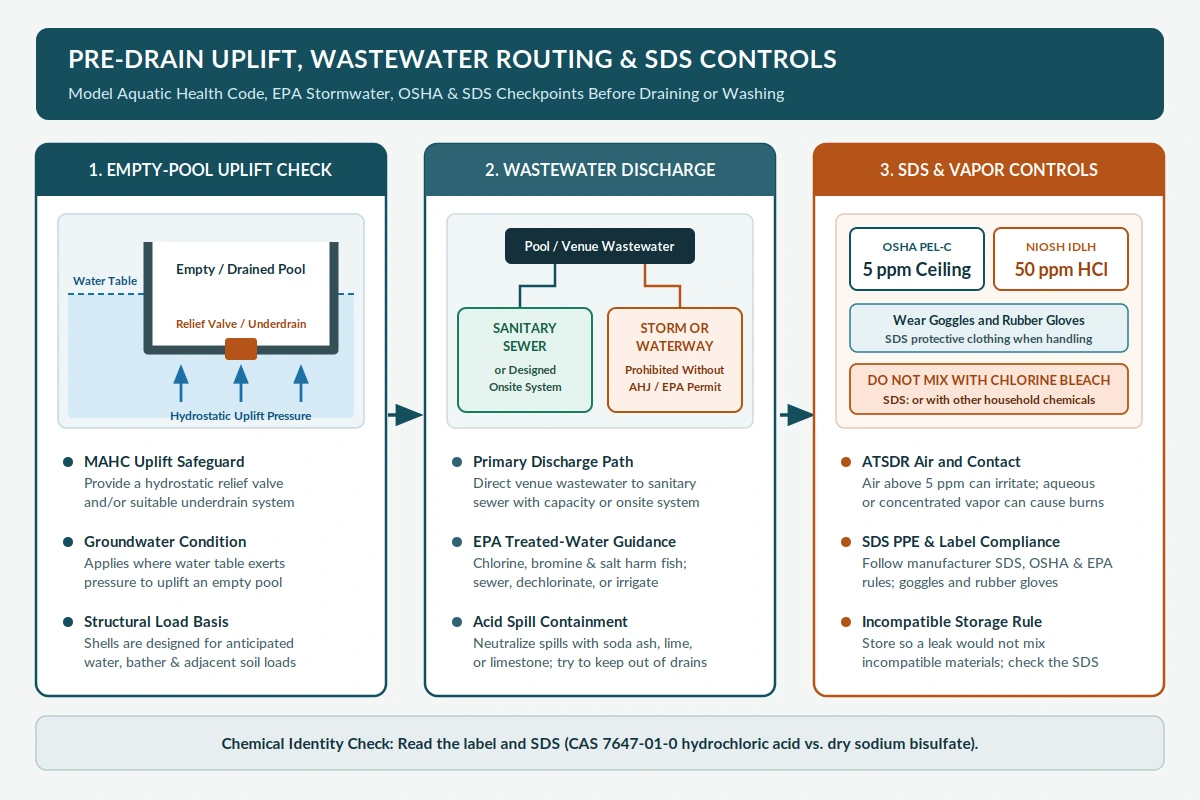
Load design, empty-pool uplift, wastewater routing, and chemical handling are separate checks below. Under the Model Aquatic Health Code, pools shall be designed to withstand reasonably anticipated loads imposed by pool water, bathers, and adjacent soils or structures, and a hydrostatic relief valve and/or suitable underdrain system shall be provided where the water table exerts hydrostatic pressure to uplift the pool when empty or drained.
Both the initial pool drain water and any neutralized wash runoff require planned disposal before pumping begins:
- Under the Model Aquatic Health Code, wastewater from an aquatic venue, including filter backwash water, shall be discharged to a sanitary sewer system having sufficient capacity to collect and treat wastewater or to an onsite sewage disposal system designed for that purpose, and wastewater shall not be directed to stormwater systems or surface waters without appropriate permits from the authority having jurisdiction or the EPA.
- According to the EPA stormwater best management practice sheet on discharging chemically treated water, most chemically treated water reaching storm sewers and water bodies comes from residential swimming pools, and water treated with chemicals such as chlorine, bromine, and salt harms surface-water quality and is toxic to wildlife and fish. The EPA sheet’s alternatives to storm-sewer or waterway discharge are draining to a sanitary sewer, dechlorinating water before discharging to storm sewers, or dechlorinating water and using it for irrigation.
- Dechlorinating pool water for sanitizer removal is separate from neutralizing acidic wash runoff. During a new-finish exposure wash, the quartz-aggregate installation manual states not to allow acid wash solution to puddle in the bowl area, to use a sump pump to constantly discard run-off after it is diluted and neutralized according to local requirements, and to neutralize acid remaining on the finish with soda ash and water to avoid discoloration.
- For accidental releases of concentrated product, a commercial muriatic acid safety data sheet states that spills should be handled immediately by neutralization and dilution using soda ash (sodium carbonate), lime (calcium hydroxide), or limestone (calcium carbonate) with large amounts of water, that an interior spill should try to prevent the materials from entering drains, waterways, or sewers, and that soda ash, lime, and limestone on an interior spill evolve heat and carbon dioxide so ample ventilation must be provided.
Exposure ceilings, safety-data-sheet handling, and chemical separation are stated in the sentences that follow. ATSDR lists the OSHA permissible exposure limit for hydrogen chloride as a 5 ppm ceiling and the NIOSH immediately dangerous value as 50 ppm; the OSHA occupational chemical database lists a PEL-C of 5 ppm (7 mg/m³) and an IDLH of 50 ppm and points its notes to 29 CFR 1910.1000 Table Z-1; and the commercial muriatic acid safety data sheet lists an OSHA permissible-exposure ceiling of 5 ppm (7 mg/m3) and a NIOSH immediately dangerous value of 50 ppm (75 mg/m3). According to ATSDR, hydrogen chloride air concentrations above 5 ppm can cause irritation, direct contact with aqueous solutions or concentrated vapor can cause severe chemical burns, and ingestion of concentrated hydrochloric acid can cause severe corrosive injury to the lips, mouth, throat, esophagus, and stomach.
Under the Model Aquatic Health Code, chemical handling shall comply with OSHA and EPA regulations, storage, handling, and use of each chemical shall comply with the manufacturer’s safety data sheet and labels, personal protective equipment shall be available as indicated on the chemical safety data sheet, and an emergency eyewash station shall be provided in chemical storage spaces under the code. The commercial muriatic acid safety data sheet specifies wearing protective clothing including goggles and rubber gloves whenever handling muriatic acid and warns not to mix the product with chlorine-type bleaches or other household chemicals. In addition, the Model Aquatic Health Code requires storing chemicals so that no mixing of incompatible materials would occur in a leak and consulting safety data sheets for incompatibilities, while CDC mini-MAHC guidance on chlorine-gas events warns that if recirculation flow is absent or low while chemical feeders keep running, concentrated chlorine and acid mix and generate toxic chlorine gas within the recirculation system.
Pre-drain inspection and post-finish start-up checklist
Use this technical checklist to verify interior coating condition, empty-pool uplift safeguards, wastewater routing, chemical handling, and new-finish start-up chemistry before scheduling work:
- Confirm that the existing interior surface is a cementitious coating, meaning a finish with the properties of cement, use the selected system’s documentation, and confirm application and start-up conditions with the finish maker through our pool materials hub, and verify with the installer what caused the stain or scale, since a later acid treatment for scale or stains is not routine owner maintenance.
- Sound the interior coating for hollow or delaminated plaster and inspect for regions where continued leaching has dissolved the cement paste, routing separated or depleted finishes to removal and resurfacing rather than an acid wash.
- Verify that a working hydrostatic relief valve and/or suitable underdrain system is in place where the water table exerts hydrostatic pressure to uplift an empty or drained pool, and stop any hydrostatic weepers before recoating.
- Confirm the approved wastewater path to a sanitary sewer with sufficient capacity or a designed onsite sewage system, and verify that wastewater is not directed to stormwater systems or surface waters without a permit from the authority having jurisdiction or the EPA; for a new-finish exposure wash, do not let the acid-wash solution puddle, use a sump pump to discard run-off after it is diluted and neutralized, and neutralize acid remaining on the finish with soda ash and water; for a concentrated-product spill, neutralize and dilute with soda ash, lime, or limestone and try to prevent the material from entering drains.
- Review the product label and safety data sheet to confirm chemical identity (hydrochloric acid, CAS 7647-01-0, versus dry sodium bisulfate), keep the OSHA 5 ppm ceiling and the NIOSH 50 ppm IDLH in mind, stage protective clothing that includes goggles and rubber gloves, and do not mix the product with chlorine-type bleaches or other household chemicals.
- If the inspection leads to a new cementitious finish rather than a wash, follow the National Plasterers Council Pool Start-Up Card (March 2023) and the selected finish maker’s documentation: adjust high day-one alkalinity downward to 80 ppm to 100 ppm using muriatic acid identified as 31% to 33% hydrochloric acid, always pre-diluted by adding it to a five-gallon (19 L) bucket of water, then reduce pH to 7.2 to 7.6, maintain the Langelier Saturation Index between 0.0 and +0.3, run pumps and filtration continuously for seven days or until plaster dust is brushed away and filtered out and water is no longer cloudy (minimum of 72 hours), do not add chlorine for 48 hours, do not turn on the pool heater until plaster dust is gone, do not add salt within the first 30 days on a salt-water chlorine-generator pool, brush the entire pool surface thoroughly at least twice daily to remove plaster dust, and keep the cleaner waits on their own documents: the start-up card says wheeled vacuums or wheeled pool cleaners should not be used until after 28 days, and the quartz-aggregate installation manual says not to vacuum with a wheeled vacuum for 14 days and not to install automatic pool cleaners for 28 days.
Sources
- CDC 2024 Model Aquatic Health Code (5th Edition, Code Language)
- CDC 2024 Model Aquatic Health Code Annex (5th Edition)
- CDC Mini-MAHC: Preventing In-Line Generation of Toxic Chlorine Gas
- ATSDR Medical Management Guidelines for Hydrogen Chloride
- OSHA Occupational Chemical Database: Hydrogen Chloride (CAS 7647-01-0)
- EPA Stormwater Best Management Practice: Educating Residents on Safely Discharging Chemically Treated Water
- National Plasterers Council Consumer Glossary (entries for Acid, Acid Wash, Calcium Carbonate, Calcium Hydroxide, Cementitious, Delamination, Efflorescence, Etching, Interior Finish, Langelier Saturation Index, Leaching, and Muriatic Acid)
- National Plasterers Council Pool Start-Up Card, March 2023 (English, two-sided start-up procedure and Langelier Saturation Index maintenance guidance)
- National Plasterers Council Technical Bulletin: Swimming Pool Interior Finishes and Chemical Etching
- Published quartz-aggregate swimming pool interior finish installation manual (April 2025 revision, resurfacing preparation and new-finish exposure sections)
- Commercial muriatic acid safety data sheet (August 2026 revision, CAS 7647-01-0 hazard identification, spill neutralization, and exposure controls)