Direct answer
No independent test we found shows a pebble finish outlasting quartz by a fixed number of years. Maker life estimates favor pebble, but they assume proper chemistry and care and are not warranties. The documents we read give PebbleTec material coverage of at least 5 years and Diamond Brite 1 year, extendable to 10 years residential for repair materials only. Choose from a wet sample, the issued warranty and the start-up plan, then keep chemistry records from the first fill.
Key takeaways
- Both finish families set aggregate in a cementitious binder and both are exposed at installation; neither is chemistry-proof.
- Texture depends on the product line: PTI describes PebbleTec as natural-textured, PebbleSheen as refined and PebbleFina as smooth.
- Treat maker lifespan figures as conditional estimates; they are a different kind of number from a warranty term.
- Read the issued warranty for the exact product and color, including registration deadline, claim records, remedy and exclusions.
- Both PTI's PebbleSheen packet and SGM's terms treat mottling as inherent; scale and chemistry damage are excluded.
- Record the product, sample, exposure method, start-up plan and warranty for each quote before choosing.
Choosing an interior finish on the wrong assumption — that a quoted lifespan is a warranty, or that “pebble” always means rough and “quartz” smooth — can leave you with a surface you dislike and coverage that does not apply to the problem. Pick by the exact product line, a wet sample and the issued warranty terms.
For owners comparing a PebbleTec-family pebble finish with a quartz finish such as SGM’s Diamond Brite, the decision turns on four documents and one sample: each product’s data, its start-up instructions, its issued warranty, your chemistry records and a wet sample. Maker lifespan figures favor pebble but are conditional estimates. This is a comparison based on public manufacturer documents accessed October 11, 2026, not our testing, and it ranks neither brand.
Scroll horizontally to read all columns.
| Decision factor | What decides it | Where to confirm |
|---|---|---|
| Material | Aggregate type and size in a cementitious binder; both families are exposed finishes | Data sheet for the exact product line |
| Feel underfoot | Product line and exposure workmanship more than the pebble-or-quartz label | Wet sample; steps and benches of an installed pool |
| Water color | Finish color plus depth, sun, shade, lighting and surroundings | Wet sample on site; makers say samples are not exact matches |
| Expected life | Water chemistry, use, maintenance and environment | Maker’s care and start-up documents; your test records |
| Warranty | Issuer, exact product and color, registration deadline, records, remedy, exclusions | Issued warranty and registration confirmation |
| Mottling or white haze | Inherent shade variation versus scale, etching or staining | Dated photos, chemistry records, installer assessment |
Use the pool materials hub for the wider material schedule and the construction stages guide to see where the finish and start-up fall in a new build.
What is the real difference between a pebble and a quartz finish?
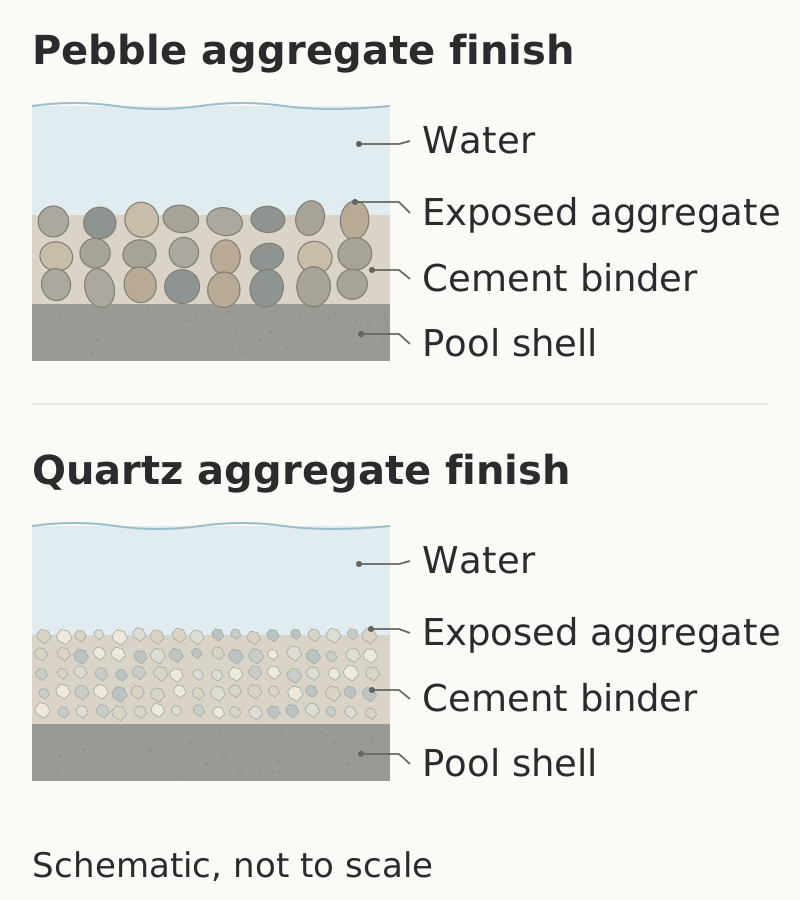
Both are cement-based aggregate finishes. PTI says its aggregate finishes consist of pebbles and cement; SGM describes Diamond Brite as quartz and other aggregates blended with polymer-modified Portland cement. Both are exposed at installation by removing surface cement. The practical differences are aggregate type and size, the exposure method and each product’s documents.
A common framing, “exposed pebble versus a smooth quartz coating”, does not match the makers’ own descriptions. SGM’s Diamond Brite data sheet is titled “Exposed Aggregate Pool Finish”. PTI’s care instructions say all aggregate finishes “consist of pebbles and cement” and vary in color, shade and exposure. Both contain a cementitious binder, so both respond to water chemistry in similar ways.
Exposure is an installation step for both. PTI’s PebbleSheen submittal packet describes scraping off loose pebbles the day after application, then using an acid solution to remove cement residue; power washing and buffing are other common methods. It adds that the process varies with finish, location, weather and applicator. SGM’s Diamond Brite instructions recommend brush water-washing for standard Diamond Brite but not for its Quartz Series, which is acid-washed instead. These are applicator instructions, not owner maintenance.
Scroll horizontally to read all columns.
| Product (maker) | Aggregate and binder as described | Maker’s texture wording | Exposure in documents read |
|---|---|---|---|
| PebbleTec (PTI) | Natural pebbles and cement | “More natural texture” | Ask for this line’s current instructions |
| PebbleSheen (PTI) | Slightly smaller pebbles | “Refined texture”, “slightly softer touch” | Next-day scrape and acid solution; power washing or buffing as alternatives |
| PebbleFina (PTI) | Smallest natural pebbles, with additives | “Smooth texture” | Ask for this line’s current instructions |
| PebbleQuartz (PTI) | Silica-based quartz aggregate | “Smooth texture”, plaster/quartz look | Ask for this line’s current instructions |
| Diamond Brite (SGM) | Quartz and select aggregates, polymer-modified Portland cement | “Variety of colors and textures” | Standard: brush water-washing; Quartz Series: acid washing |
Note that PTI also sells a quartz finish. “PebbleTec vs quartz” can therefore be a choice between product lines from one maker, not only between brands. The finish is also separate from the structure beneath it; shell placement and strength are covered in the gunite vs shotcrete guide.
Common mistake: Assuming a quartz finish is a resin coating or that a pebble finish has no cement. Both are cementitious.
Takeaway: Ask each bidder for the exact product line, its data sheet and the exposure method the applicator will use.
How do texture and water color compare?
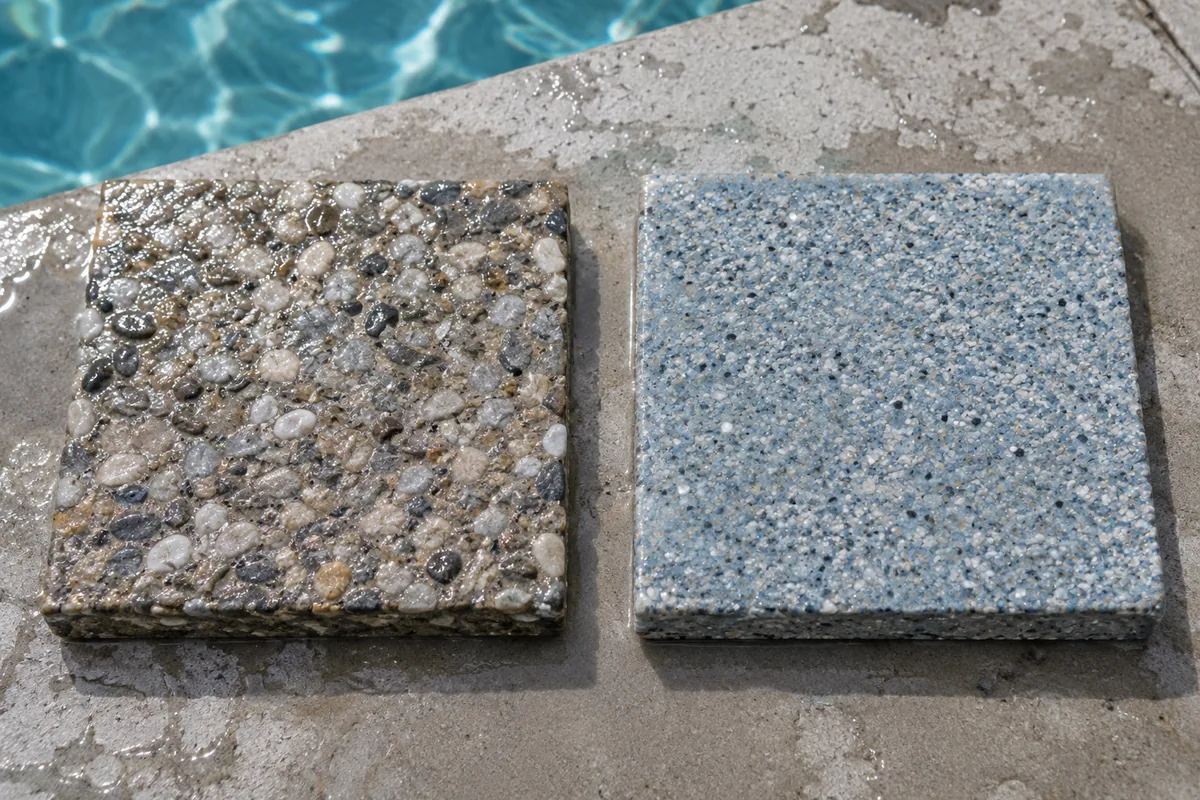
Texture follows the product line more than the pebble-or-quartz label: PTI calls original PebbleTec natural-textured, PebbleSheen refined and PebbleFina smooth. Water color follows the finish color plus depth, sun, shade, lighting and surroundings. Judge both on a wet sample and, where possible, an installed pool rather than a brochure photo.
The makers’ product pages describe texture in qualitative terms, but their technical sheets do carry some numbers. The PebbleSheen submittal packet reports coefficient-of-friction readings, and the Diamond Brite data sheet lists dry slip-resistance readings for its rougher and smoother color groups. These are readings for particular products and test samples, not a side-by-side test under the same conditions, and we found no published barefoot-comfort comparison across lines. They cannot be used to rank one finish as more comfortable or safer than another. “Slightly softer touch” is PTI’s marketing description of PebbleSheen, not a safety rating. Owners often ask whether textured finishes scrape knees or toes; that question is best answered with your own hand and foot on a sample and on the steps of a finished pool.
View samples wet, outdoors and in daylight. A dry sample under shop lighting shows neither the wet color nor how the aggregate stands out under water. PTI’s support FAQ says it cannot guarantee that a sample or image will exactly match the finished pool, and SGM’s warranty terms say pigmented finishes are not warranted for color.
Check texture where people actually touch the finish:
- Entry steps and treads, where bare feet bear full weight.
- Benches, spa seats and sun ledges, where skin rests for long periods; the pool and spa combinations guide covers how these features are laid out.
- Shallow play areas, where children kneel and push off the floor.
- Wall surfaces near swim lanes, if swimmers touch walls when turning.
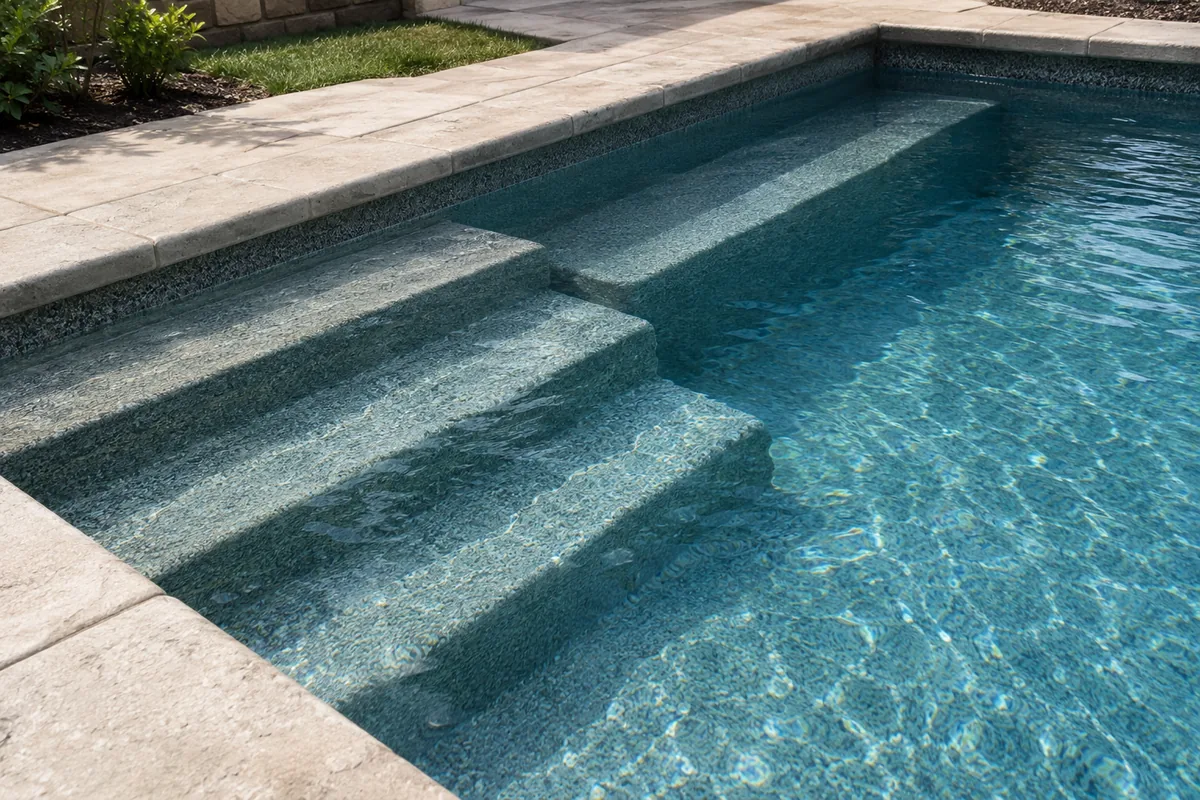
For water color, PTI lists depth, daytime sun, night lighting placement, trees and landscaping, decking, water features, chemistry and filtration as influences. SGM’s terms add pool size and shape, application technique and batch differences. PTI also advises allowing about 30 days of initial curing before judging the finish or color. Strong sun and shade patterns are part of that judgment; the hot-climate pool design guide and the pool design hub cover site exposure and layout decisions.
Common mistake: Choosing a color from a brochure photo or a dry indoor sample.
Takeaway: Compare wet samples in daylight and check the steps and benches of an installed pool before choosing a line.
Which lasts longer, pebble or quartz?
No independent, matched study we found settles it. PTI says a properly installed pebble finish lasts over 20 years with proper maintenance and chemistry; SGM says Diamond Brite typically lasts 10–15 years under proper chemistry and maintenance. Both are maker estimates, so chemistry, use and workmanship are the variables that decide your result.
PTI’s lifespan article also puts quartz finishes at “around 7 to 15 years”. That is a pebble maker describing a competing category, not a test result. The same article says any resurfacing schedule depends on usage, maintenance and environmental factors. SGM’s figure appears in its own Diamond Brite FAQ. Neither source reports a side-by-side test in the same water and climate.
What the documents do agree on is what shortens a cementitious finish’s life:
- Scale. PTI calls a white haze from poor water chemistry the most common maintenance issue, says scale can trap dirt and discolor the surface, and says scale removal is not covered by warranty.
- Aggressive water. PTI’s support page, citing the National Plasterers Council, says acidic or soft water can etch or leach cementitious finishes, and that unbalanced water can weaken the cement so pebbles come loose in larger amounts.
- Neglected routine care. SGM’s data sheet links Diamond Brite’s life to weekly testing, recording and brushing.
Some aggregate loss is expected. PTI says pebbles normally come loose during initial curing and a small loss over time is normal; SGM’s terms say some aggregate loss is expected, especially in a new installation. Larger or continuing loss is a reason to have the installer look at the finish and your water records.
Keep test records from the first fill. PTI recommends at least weekly testing and printed reports for warranty requests, and says its product-specific procedures take precedence over generic advice. If the pool will have an automatic fill, settle who checks fill water and chemistry using the automatic fill planning guide; the pool care hub covers the wider maintenance routine. When a finish does wear out, resurfacing is decided by condition rather than a calendar; the pool renovation hub covers that assessment.
Common mistake: Setting PTI’s “over 20 years” against SGM’s 10-year extended warranty as if they were the same kind of number. One is a life estimate; the other is a limited material warranty.
Takeaway: Treat lifespan claims as conditional, and keep the chemistry records that both the finish and its warranty depend on.
What do PebbleTec and Diamond Brite warranties cover?
The warranties are shorter and narrower than the lifespan claims. In the documents we read, PTI covers defective pool-finish material for a minimum of 5 years and installers cover workmanship for at least 5 years. SGM covers Diamond Brite material for 1 year, extendable to 10 years residential by registration, as prorated repair materials only. None offers a 20-year or lifetime term.
Scroll horizontally to read all columns.
| Item | PTI pebble finishes (warranty page) | PTI PebbleQuartz (product page) | SGM Diamond Brite, standard colors (terms) |
|---|---|---|---|
| Material term as stated | Minimum 5 years from installation | 1 year; 5 years if registered | 1 year; extended 10 years residential or 5 years commercial if registered |
| Workmanship | Authorized Installer, minimum 5 years | Applicator, 2 years if registered | Not covered by SGM; claims go to the contractor or applicator |
| Conditions | PTI Authorized Installer; original homeowner; non-transferable | Registration within 30 days of installation | Online registration within 30 days; applicator paid in full; Continental US; original owner |
| Remedy | PTI evaluates, then repairs or replaces defective material at its discretion | Not stated on the product page; ask for the terms | Materials to repair the failed area only, prorated; no labor |
| Records for a claim | Written claim with water chemistry documentation | Ask for the issued terms | Monthly printed computerized water chemistry reports |
| Selected exclusions | PebbleSheen packet: labor, mottling and color variation, scale, chemistry-related etching or staining, cracking, freeze–thaw damage | Ask for the issued terms | Workmanship, labor, chemistry damage or fading, mottling and staining, cracks and crazing, draining, freeze–thaw, out-of-water features |
Details change by product and color. SGM’s terms give Diamond Brite Atlantic Blue a 5-year residential extended term only, and Commercial White 10 years for both residential and commercial use. PTI’s PebbleSheen packet defines covered material as pebble, glass bead and pigment, and its footnote says some applicators or builders provide a different term depending on region. The packet carries no publication date, so ask for the document actually issued for your pool.
Document check: SGM’s data sheet says its one-year product warranty runs from the date of manufacture, while SGM’s current online terms say the date of installation. We have not resolved that difference. Ask SGM or the applicator which document governs your installation, and keep the registration confirmation.
A search for a “20-year warranty pool interior finish” will turn up lifespan claims, not warranties, in these makers’ documents. Keep the issued warranty, registration confirmation and test records together with the comparison record below.
Note the 30-day registration window on the day of installation: missing it drops PebbleQuartz to one year and leaves Diamond Brite without its extended term.
Takeaway: Register on time and file the warranty for the exact product and color, with its claim-record requirements.
Is mottling or white haze a defect, and how is it fixed?
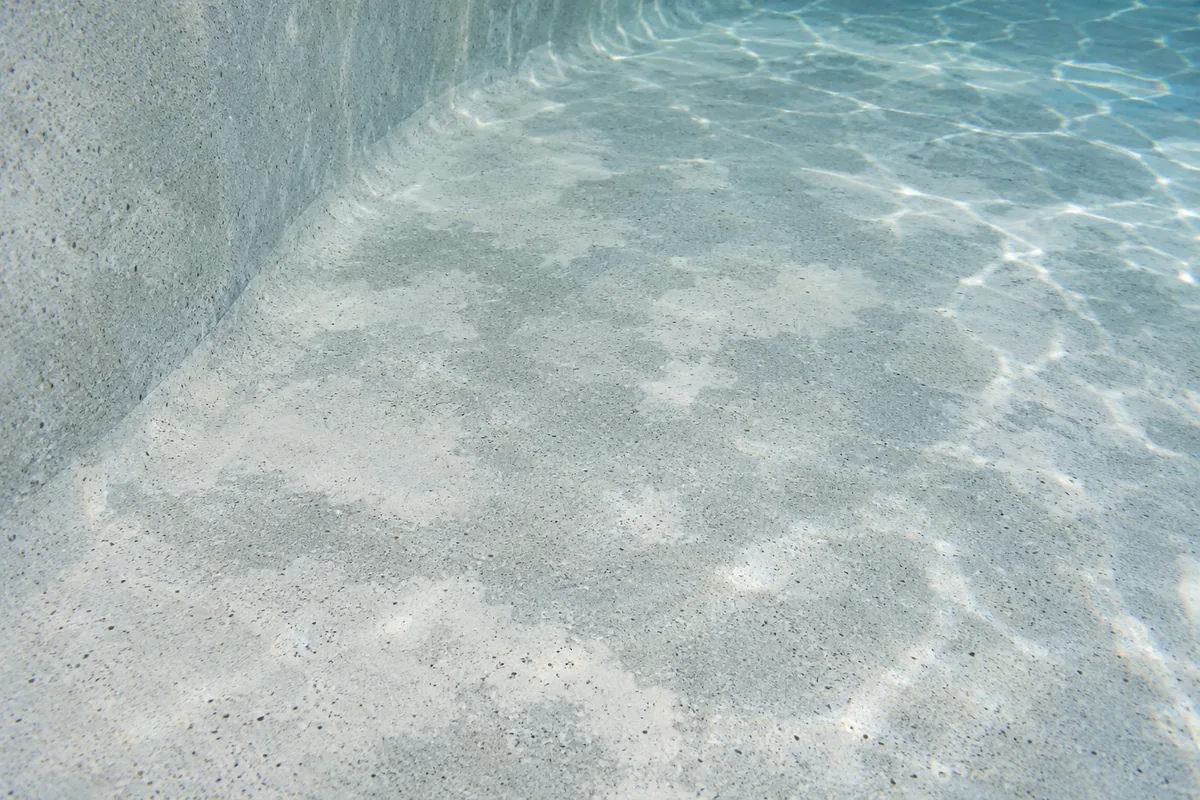
Soft shade variation, often called mottling, is listed as inherent in both PTI’s PebbleSheen packet and SGM’s warranty terms, not as a defect. PTI describes scaling as a white haze from poor water chemistry, and scale removal is not covered, but appearance alone does not confirm the cause. Record what changed and have the installer assess it before any acid treatment or draining.
Both makers stress that hand-applied cementitious finishes vary. SGM’s terms describe variations in color, shade, tone and texture as a characteristic of the product. The PebbleSheen packet excludes shading, mottling and pigment swirling, and differences from samples or photographs. That does not mean every change is normal: a pattern that spreads, roughens or arrives with a crust deserves a closer look.
Scroll horizontally to read all columns.
| What you see | What the documents say | Record before calling | Who assesses |
|---|---|---|---|
| Soft, cloudy lighter and darker patches | Inherent variation, not a defect (PTI packet; SGM terms) | Dated photos at the same time of day and light; location | Installer, after the curing period PTI describes |
| White haze or rough crust | May be scale, which PTI describes as a white haze from poor chemistry; cause requires assessment; scale removal not covered (PTI) | Weekly test records; when it appeared; fill-water source | Installer or pool service; removal may need chemical treatment or draining |
| Rough, etched surface or ongoing aggregate loss | Aggressive water can etch cement and loosen pebbles (PTI) | Test records; area affected; collected loose aggregate | Installer; maker if a material claim is possible |
| Discrete stains or discoloration | Linked to improper chemistry among other causes; excluded from material coverage (PTI packet; SGM) | Photos; test records; recent chemical additions | Installer assessment before treatment |
| Cracks or delamination | Cracking excluded by both documents read; SGM also excludes delamination and says its finish is not structural | Location, length, photos over time | Builder; structural review if cracks continue |
There is no universal fix that can be chosen from a photograph. Acid washing appears in these documents as an applicator’s installation step. SGM excludes damage caused by draining the pool, and both makers exclude chemistry-related damage, so a do-it-yourself drain or acid treatment can make a problem worse and weaken a claim. White deposits at a tiled waterline can have yet another cause; see the waterline tile and coping checklist for that distinction.
Takeaway: Photograph changes consistently, keep test records and get an installer’s assessment before any treatment.
What should you record before choosing and after start-up?
Record the same items for each quote so the comparison is like for like: exact product and color, sample viewed, contact zones checked, preparation scope, exposure method, written start-up procedure, warranty issuers and registration deadline, and how chemistry will be recorded. This is an editorial checklist, not a contract or a guarantee.
Scroll horizontally to read all columns.
| Item | Quote A | Quote B |
|---|---|---|
| Exact product line and color name | ||
| Data sheet or product page and its date | ||
| Wet sample viewed (where, when, lighting) | ||
| Steps, benches and ledges checked | ||
| Surface preparation or removal scope; bond coat if resurfacing | ||
| Exposure method and who performs it | ||
| Written start-up procedure; who performs start-up; fill date | ||
| Material warranty: issuer, term, registration deadline | ||
| Workmanship warranty: issuer and term | ||
| Chemistry records: test frequency and printed reports |
For resurfacing, ask how the new finish will bond to the old surface. SGM’s terms require its Bond Kote system when resurfacing over an existing finish, say SGM does not warrant its products over other bonding materials, and note that Bond Kote may not be required where the old finish is first removed by sandblasting or chipping. For new construction, the pool construction process guide shows where the finish stage sits, and the stages guide explains why the finish maker’s start-up instructions govern the first weeks.
Add the completed record to the new-pool project checklist and review it with your builder or the finish’s authorized installer before signing.
Takeaway: Compare quotes line by line and settle start-up and registration responsibilities before work begins.
When this comparison does not apply
This guide compares cement-based pebble and quartz finishes on concrete pools using public documents. It does not cover tile, vinyl or fiberglass interiors, or finishes outside these named products. It also does not cover features the documents exclude, such as negative edges, spillways and beach entries in SGM’s terms, or damage from freezing.
In freeze–thaw climates, both documents read exclude related cracking, delamination and aggregate loss; ask the builder how the pool will be protected. For an existing pool with structural cracks or failing bond, resolve those first through the renovation assessment described above.
Takeaway: Resolve structure, climate exposure and out-of-water features with the builder before comparing finishes.
Related reading
Choose the next page based on the decision still open: where the finish falls in construction, how to track project documents, or where to find related tools. These guides organize the decision; they do not replace the maker’s current documents for your product.
- Construction stages guide: finish application and start-up in the build sequence.
- New-pool project checklist: keep finish, warranty and start-up documents with other owner decisions.
- Pool planning resources: other checklists and coordination tools.
Takeaway: Use the guide that answers the open question, then return to the comparison record.
Method and sources
This comparison synthesizes public PTI and SGM product pages, a PebbleSheen submittal packet, an SGM data sheet and current warranty pages, all accessed October 11, 2026. Statements apply to the named products and documents. We did not test finishes, inspect pools or measure texture, color or life, and we do not install finishes.
The SGM Diamond Brite data sheet is an April 2025 file; the PebbleSheen packet has no printed date. Warranty terms, product names and colors change, so confirm the documents current at the time of your project and keep the versions issued for your pool. Owner questions on this page come from public search suggestions and community threads; their answers here rely only on the manufacturer documents.
Last substantive update: October 11, 2026.
Takeaway: Keep the issued documents for your exact product with your project records.
Frequently asked questions
How long does a quartz pool finish last?
SGM says its Diamond Brite quartz finish typically lasts 10–15 years with proper water chemistry and maintenance. That is the maker's estimate, not a warranty: Diamond Brite's material warranty is 1 year, extendable to 10 years for standard colors in residential pools when registered within 30 days. Actual life depends on chemistry, use and workmanship.
Does PebbleTec have a lifetime warranty?
Not in the documents we read. PTI's warranty page describes a limited, non-transferable warranty: defective PTI material is covered for a minimum of 5 years from installation, and the Authorized Installer covers workmanship for a minimum of 5 years. PTI's packet notes that some applicators or builders offer different regional terms, so ask for the issued document.
Is PebbleTec smooth?
PTI describes original PebbleTec as a natural-textured finish. It describes PebbleSheen, made with slightly smaller pebbles, as refined-textured, and PebbleFina, made with its smallest pebbles, as smooth. These are the maker's own descriptions, not measured comparisons, so feel a wet sample, ideally on steps or benches of an installed pool, before choosing.
Does PebbleTec need to be acid washed?
As part of installation, PTI's PebbleSheen submittal describes a next-day treatment in which an acid solution removes cement residue; power washing and buffing are other common completion methods. That is the applicator's job. Later acid treatment for scale or stains is not routine owner maintenance; have the installer assess the cause first.
Is marbling normal a few months after a quartz finish is installed?
Some shade variation is expected: SGM's warranty terms list naturally occurring color variation and mottling as not covered, and describe its hand-applied finishes as varying in color and shade. A pattern that changes, spreads or comes with roughness or white crust is different. Photograph it in consistent light, keep chemistry records and ask the installer.
Does PebbleTec fade?
PTI does not promise fade-proof color. It says water color depends on depth, light, surroundings and chemistry, and the PebbleSheen packet excludes discoloration from improper chemical maintenance. Seashell accents may lose luster under aggressive chemistry. Judge color after the roughly 30-day curing period PTI describes, and keep water records.
Does PebbleTec stain?
It can. PTI attributes etching, discoloration, algae and staining to improper water chemistry, and its PebbleSheen packet excludes chemistry-related staining from the material warranty. Scale, a white haze, is the most common maintenance issue PTI lists. Keep weekly test records and have a stain assessed before treating it.
Is quartz worth the extra cost?
We have no price data, and one family is not always cheaper. Compare itemized quotes: exact product and color, surface preparation or removal, bond coat when resurfacing, exposure method, start-up service, and who issues material and workmanship warranties. A cheaper bid that omits preparation or registration is not the same scope.
Sources
- PebbleTec Pool Finish product page — accessed October 11, 2026 — Pebble Technology International Accessed October 11, 2026.
- PebbleSheen Pool Finish product page — accessed October 11, 2026 — Pebble Technology International Accessed October 11, 2026.
- PebbleFina Pool Finish product page — accessed October 11, 2026 — Pebble Technology International Accessed October 11, 2026.
- PebbleQuartz Pool Finish product page — accessed October 11, 2026 — Pebble Technology International Accessed October 11, 2026.
- PebbleSheen Submittal Packet (PDF) — publication date not printed — Pebble Technology International Accessed October 11, 2026.
- Warranty Information — accessed October 11, 2026 — Pebble Technology International Accessed October 11, 2026.
- Pool Care Instructions — accessed October 11, 2026 — Pebble Technology International Accessed October 11, 2026.
- Customer Support FAQ — accessed October 11, 2026 — Pebble Technology International Accessed October 11, 2026.
- How Long Does a Pebble Pool Finish Last? — accessed October 11, 2026 — Pebble Technology International Accessed October 11, 2026.
- Diamond Brite product page and FAQ — accessed October 11, 2026 — SGM Accessed October 11, 2026.
- Diamond Brite Exposed Aggregate Pool Finish data sheet — April 2025 file — SGM Accessed October 11, 2026.
- SGM Warranty Registration — accessed October 11, 2026 — SGM Accessed October 11, 2026.
- SGM Limited Warranty terms — accessed October 11, 2026 — SGM Accessed October 11, 2026.