Key takeaways
- White marcite blends ASTM C150 white Portland cement with Mohs 3.0 crushed calcium carbonate marble, leaving 100% of the surface acid-soluble when Langelier Saturation Index (LSI) drops below -0.30.
- Quartz-modified plaster (30%–70% Mohs 7.0 SiO2 quartz + pozzolans) and exposed pebble (80%–85% Mohs 6.5–7.0 river stone) armor the shell against low-LSI etching, extending service life to 12–18 and 18–25+ years.
- In a saltwater pool vs. chlorine comparison, 3,000–4,000 ppm NaCl raises the TDS factor to 12.20 while cathode hydrogen aeration drives CO2 outgassing; hold Total Alkalinity at 60–80 ppm in summer and Calcium Hardness at 320–400 ppm in winter.
- Execute the NPC 28-day start-up sequence: fill continuously through a cloth-wrapped hose without stopping, adjust Day 1–3 TA to 80–100 ppm and pH to 7.2–7.6, ramp Calcium Hardness to 200+ ppm, and brush twice daily with nylon bristles.
- Enforce three mandatory curing lockouts after plastering: no gas heater or heat pump operation for 14–21 days, no wheeled or robotic pool cleaners for 28 days, and no salt (NaCl) addition for 28–30 days.
- Over a 25-year ownership horizon on an 800 sq. ft. pool, exposed pebble ($13,800 TCO) and polished aggregate ($16,200 TCO) cost 38%–47% less than white marcite ($26,200 TCO) by avoiding two $9,600 chip-out and re-plaster cycles.
Selecting pool plaster types solely on Day-1 installation bid price—or neglecting the 28-day National Plasterers Council (NPC) start-up protocol—causes rapid calcium hydroxide (Ca(OH)₂) leaching, rough surface pitting, and costly chip-out delamination. Matching the cementitious aggregate tier to your Langelier Saturation Index (LSI) operating window protects the underlying gunite or shotcrete structural shell and eliminates premature resurfacing cycles over a 25-year ownership horizon.
While a pneumatically applied concrete shell (ACI 506R, ≥ 4,000 PSI) provides structural containment, it remains water-permeable under hydrostatic head; the 3/8-inch to 5/8-inch (10–16 mm) interior cementitious finish serves as both the primary waterproof membrane and the sacrificial chemical barrier. Whereas our PebbleTec vs. quartz finish warranty comparison examines brand-specific warranty registration rules and sample boards, this engineering guide classifies all four mineralogical tiers of pool resurfacing materials, quantifies saltwater pool vs. chlorine electrochemistry (3,000–4,000 ppm NaCl), details the chronological 28-day start-up schedule, and models 25-year Total Cost of Ownership (TCO) on an 800 sq. ft. vessel. Coordinate these finish specifications with our pool materials and hardware schedule, the pool renovation decision hub, and the broader pool planning resources.
Scroll horizontally to read all columns.
| Finish Tier & Representative System | Binder & Aggregate Mineralogy (ASTM C150) |
Aggregate Mohs Hardness & Thickness | Exposure Method & Surface Texture | Acid / Low-LSI (< -0.30) Resistance |
Expected Lifespan | Installed Cost ($/SF) & 25-Yr TCO (800 SF) |
|---|---|---|---|---|---|---|
| 1. White Marcite Plaster (Standard White Marble Plaster) | White Portland cement + crushed white marble (CaCO₃, "#8"–"#30" mesh, 1.5:1–2:1 ratio) |
Mohs 3.0 (Calcite) • 3/8"–1/2" (10–13 mm) |
Smooth steel-troweled cement film left intact (no acid exposure) | Low — 100% of surface (Ca(OH)₂ paste + CaCO₃ aggregate) dissolves in low-LSI water |
7–12 yrs (10 yr avg) |
$6–$9/SF ($6,000 Day-1) • $26,200 TCO (2 chip-outs) |
| 2. Quartz-Modified Plaster (SGM Diamond Brite, PTI PebbleQuartz) | Polymer/pozzolan white cement + 30%–70% ceramic-coated crystalline quartz (SiO₂, "#20"–"#40" mesh) |
Mohs 7.0 (Silica Quartz) • 3/8"–1/2" (10–13 mm) |
Day-1 brush water-wash or Day-2 diluted acid wash + pressure rinse | Moderate–High — SiO₂ crystals are acid-inert; pozzolans cut binder capillary porosity by 35%–50% |
12–18 yrs (14–15 yr avg) |
$9–$13/SF ($8,800 Day-1) • $21,200 TCO (1 chip-out) |
| 3. Exposed Pebble & Mini-Pebble (PebbleTec, PebbleSheen, PebbleFina) | Pozzolanic hydraulic cement + 80%–85% coverage of 2–4 mm (pebble) or 1–2 mm (mini-pebble) silicate river stone |
Mohs 6.5–7.0 (Quartzite/Silicate) • 1/2"–5/8" (13–16 mm) |
Day-1 water spray/scrape + Day-2 muriatic acid bath & high-pressure rinse | Highest — Inert river stone shields 80%–85% of wetted area; minimal interstitial cement exposed |
18–25+ yrs (22+ yr avg) |
$13–$19/SF ($12,800 Day-1) • $13,800 TCO (0 chip-outs) |
| 4. Polished Aggregate (CL Industries Hydrazzo, PTI PebbleBrilliance) | Pozzolanic white cement + coarse graded crystalline marble (Mohs 3.5) & crystalline silica quartz (Mohs 7.0) |
Mohs 3.5–7.0 Composite • 3/8"–1/2" (10–13 mm) |
Multi-stage on-site wet diamond-pad power honing (50 to 200+ grit) |
High — Mechanical diamond honing compresses surface pores; can be diamond re-polished at Year 14 | 15–20+ yrs (extendable via re-polish) |
$13–$18/SF ($12,400 Day-1) • $16,200 TCO ($3.8k polish) |
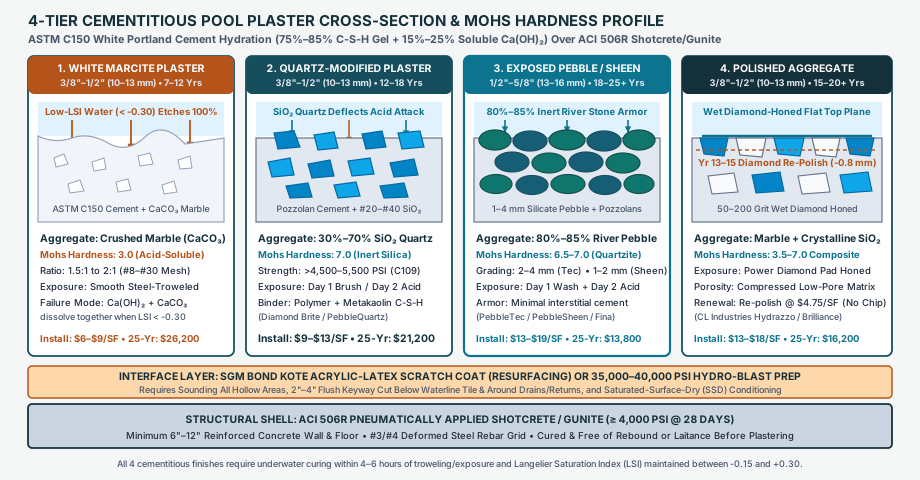
1. Cementitious Pool Interior Taxonomy & Mineral Composition (ASTM C150 & ACI 506R)
Every cementitious pool finish—whether white marcite, quartz, polished aggregate, or exposed pebble—relies on hydraulic Portland cement paste that generates 15% to 25% water-soluble calcium hydroxide (Ca(OH)₂) during hydration. The mineralogical difference between a 9-year finish and a 22-year finish lies in two engineering variables: whether the aggregate grains embedded in that cement paste are acid-soluble calcium carbonate (Mohs 3.0) or acid-inert crystalline silica (Mohs 6.5–7.0), and whether pozzolanic admixtures convert free Ca(OH)₂ into insoluble structural gel.
Why Hydrated Portland Cement Paste Is Vulnerable to Low-LSI Water
Under ASTM C150 / C150M (Standard Specification for Portland Cement), swimming pool plaster uses Type I or Type II white hydraulic Portland cement manufactured with ferric oxide restricted to Fe₂O₃ ≤ 0.5% by weight to achieve high light reflectance. Before applying the interior finish, the structural shell must complete its gunite and shotcrete wet-curing schedule (gunite vs. shotcrete compressive strength specs are detailed in our ACI 506R structural shell comparison). As documented in American Shotcrete Association (ASA) Position Statement #7 (Curing of Shotcrete for Swimming Pools, Synthesizing ACI 506R and the NPC Technical Manual), mixing white Portland cement with water triggers the exothermic hydration of tricalcium silicate (C₃S / alite) and dicalcium silicate (C₂S / belite):
2 Ca₃SiO₅ (Tricalcium Silicate) + 6 H₂O → 3CaO·2SiO₂·3H₂O (Insoluble C-S-H Gel, 75%–85%) + 3 Ca(OH)₂ (Soluble Calcium Hydroxide, 15%–25%)
While calcium silicate hydrate (C-S-H gel) forms the dense, insoluble load-bearing backbone of cured plaster, 15% to 25% of the hydrated cement paste by weight consists of crystalline calcium hydroxide (Ca(OH)₂, mineral name portlandite). Portlandite is highly alkaline (pH ~12.4) and water-soluble. Whenever pool water becomes undersaturated with calcium carbonate (LSI < -0.30), aggressive water penetrates capillary pores and leaches Ca(OH)₂ out of the cement matrix (Ca(OH)₂(s) → Ca²⁺(aq) + 2OH⁻(aq)), opening micro-voids, chalking the surface, and loosening the surrounding aggregate.
To close this chemical vulnerability, premium quartz, pebble, and polished aggregate blends incorporate pozzolanic supplementary cementitious materials (SCMs)—specifically calcined kaolin clay (metakaolin, Al₂O₃·2SiO₂) and micro-silica (silica fume)—at 10% to 20% cement replacement:
Al₂O₃·2SiO₂ (Metakaolin) + Ca(OH)₂ (Free Portlandite) + H₂O → Secondary Insoluble C-S-H + C-A-S-H Gel
This secondary pozzolanic reaction consumes leachable Ca(OH)₂ inside the curing paste, reducing capillary pore connectivity by 35% to 50% and dramatically curtailing Day 1–14 plaster dust formation.
Engineering Breakdown of the 4 Pool Plaster Tiers
- Tier 1: Traditional White Marble Plaster (
Marcite—7 to 12 Years):- Composition & Application: Blended on site or factory-bagged using
ASTM C150white Portland cement and crushed white marble aggregate (CaCO₃calcite dust and"#8"to"#30"mesh marble chips) at a1.5:1 to 2:1aggregate-to-cement weight ratio. Applied in two hand-troweled passes (scratch coat + finish coat) to a nominal thickness of3/8 inch to 1/2 inch(10–13 mm) over an open-pored, saturated-surface-dry (SSD) ACI 506R shotcrete or gunite substrate. Per National Plasterers Council guidelines, calcium chloride (CaCl₂) set accelerator must never exceed2%by cement weight in white marcite and is strictly prohibited in colored plaster because chloride ions induce differential hydration blotching and steel rebar corrosion. - Dominant Failure Mode: Because crushed white marble is pure calcium carbonate (Mohs Hardness
3.0), 100% of a marcite pool interior—both the cement binder and the marble aggregate—dissolves in acidic or negative-LSI water (CaCO₃ + H⁺ → Ca²⁺ + HCO₃⁻). Even minor winter chemistry neglect or trichlor tablet acidity etches the smooth troweled skin within 3 to 5 years, exposing sharp marble grains that trap dirt and green algae until resurfacing is required at Year 7–12.
- Composition & Application: Blended on site or factory-bagged using
- Tier 2: Quartz-Modified Cementitious Plaster (
Quartz Aggregate—12 to 18 Years):- Composition & Strength: Per the SGM Diamond Brite Technical Data Sheet (April 2025 Revision) and product specification, quartz finishes replace
30% to 70%of the soluble marble aggregate with insoluble, ceramic-coated crystalline silica quartz (SiO₂,"#20"to"#40"mesh, Mohs Hardness7.0) blended into polymer- and pozzolan-modified Portland cement with inorganic metal-oxide pigments. Troweled at3/8 inch to 1/2 inch(10–13 mm, yielding40–45 sq. ft.per80 lbbag), cured Diamond Brite achieves 28-day compressive strength> 4,500 to 5,500 PSI(ASTM C109), flexural strength> 850 PSI(ASTM C348), and tensile strength> 600 PSI(ASTM C190). - Exposure & Chemical Armor: Standard quartz blends are brush water-washed on Day 1 (or lightly acid-washed on Day 2 for high-density quartz lines like
PTI PebbleQuartz) to remove the thin top cement film and expose theMohs 7.0quartz crystals. Because crystallineSiO₂is completely inert to muriatic acid (HCl), chlorine, and salt, low-LSI water can only attack the narrow pozzolan-densified cement channels between quartz grains, extending functional service life to12–18 years.
- Composition & Strength: Per the SGM Diamond Brite Technical Data Sheet (April 2025 Revision) and product specification, quartz finishes replace
- Tier 3: Exposed Pebble, Mini-Pebble & Glass Bead (
18 to 25+ Years):- Composition & Grading: Per the PebbleSheen Architectural & Engineering Submittal Packet and PebbleTec specification, exposed pebble systems embed
100%natural, water-worn silicate and quartzite river pebbles (Mohs Hardness6.5–7.0) or smooth borosilicate glass beads into a pozzolan-modified hydraulic cement matrix applied at1/2 inch to 5/8 inch(13–16 mm) thickness. Aggregate grading controls underfoot texture:- Standard Pebble (
PebbleTec):2.0 to 4.0 mmriver pebbles (natural riverbed texture,20–25+ yearfield longevity). - Mini-Pebble (
PebbleSheen): Precision-sieved1.0 to 2.0 mmpebbles (refined texture,18–22+ yearlongevity) — often enhanced with5%–15%iridescent abalone shell or luminous glass beads. - Micro-Pebble (
PebbleFina): Sub-millimeter (< 1.0 mm) silicate aggregate blended with pozzolans (smooth texture,15–20 yearlongevity).
- Standard Pebble (
- Two-Stage Exposure: Installers water-wash and steel-scrape surface laitance on Day 1, followed on Day 2 by a controlled muriatic acid wash and high-pressure rinse that exposes
80% to 85%inert stone surface coverage. Because only15%–20%of the wetted boundary consists of recessed cement paste, exposed pebble exhibits the highest resistance to chemical etching and mechanical abrasion of any cementitious finish.
- Composition & Grading: Per the PebbleSheen Architectural & Engineering Submittal Packet and PebbleTec specification, exposed pebble systems embed
- Tier 4: Polished Aggregate (
CL Industries Hydrazzo/PebbleBrilliance—15 to 20+ Years):- Composition & Wet Diamond Honing: Per the CL Industries Hydrazzo specification, polished aggregate blends coarse graded crystalline marble (
Mohs 3.0–3.5) and crystalline silica quartz (Mohs 7.0) into pozzolan-modified white Portland cement (3/8"–1/2"thick). Instead of stripping cement paste with a harsh acid wash, crews wet-hone the cured shell on Day 1–2 using high-speed hand grinders fitted with50-gritthrough200+ gritdiamond polishing pads. - Mid-Life Renewal Advantage: Wet diamond honing shears the marble and quartz crystals completely flat and mechanically compresses surface capillary pores. After
12 to 15 yearsof service, a Hydrazzo interior can be drained and re-polished with diamond pads (removing 0.5–1.0 mmof weathered surface at$4.00–$5.50/SF) to restore factory smoothness without paying for a pneumatic chip-out.
- Composition & Wet Diamond Honing: Per the CL Industries Hydrazzo specification, polished aggregate blends coarse graded crystalline marble (
Rule of thumb: If bare-foot smoothness on shallow sun shelves, steps, and benches is your highest priority but you want a 15–20 year service life, specify polished aggregate (Hydrazzo) or mini-pebble (PebbleSheen) rather than traditional white marcite; if maximum chemical durability and lowest 25-year ownership cost are paramount, specify exposed pebble or mini-pebble.
Takeaway: White marcite leaves 100% of the pool interior soluble in low-LSI water (Mohs 3.0), whereas quartz (Mohs 7.0), polished aggregate, and exposed river pebble (80%–85% Mohs 6.5–7.0 stone armor) shield the pozzolan-modified cement binder to double or triple interior lifespan.
2. Langelier Saturation Index (LSI) & Saltwater Pool vs. Chlorine Chemistry (3,000–4,000 ppm NaCl)
Dissolved salt (3,000–4,000 ppm NaCl) does not chemically dissolve quartz or silicate pebble aggregates; rather, a saltwater chlorine generator (SWG) subjects pool plaster to summer cathode pH spikes (LSI > +0.30 scaling) and winter cold-water high-TDS drops (LSI < -0.30 calcium hydroxide leaching). Controlling those two seasonal thermodynamics explains why an identically plastered pool lasts 22 years on one property and scales or pits in 6 years on another.
The Governing Langelier Saturation Index (LSI) Equation
Both the National Plasterers Council (NPC), ANSI/PHTA/ICC-1, and the Pebble Technology International Pool Care Instructions evaluate water aggressiveness using the Langelier Saturation Index (LSI), which measures whether water is undersaturated, in equilibrium, or supersaturated with respect to calcium carbonate (CaCO₃):
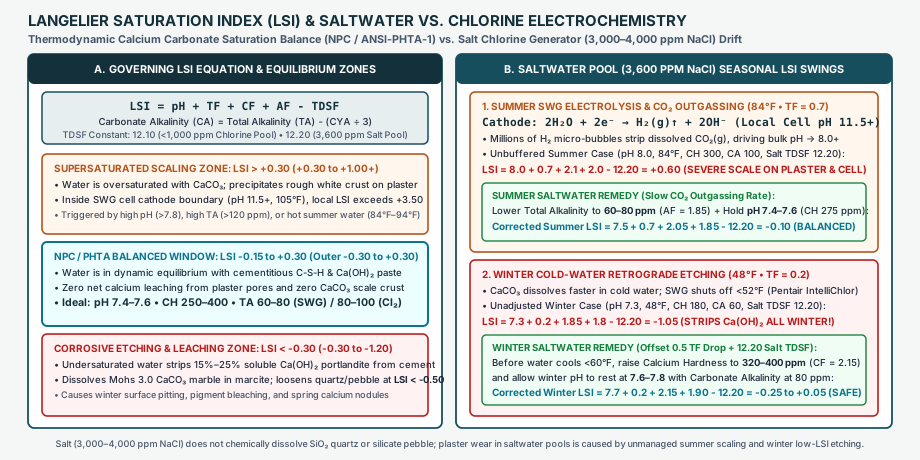
LSI = pH + TF + CF + AF - TDSF
Where the five thermodynamic terms are defined as follows:
pH: Measured bulk pool waterpH(ideal operating range 7.4 to 7.6).TF(Temperature Factor): Accounts for the retrograde solubility of calcium carbonate (which becomes more soluble as water cools and less soluble as water warms):TF = 0.1at37°F,0.2at46°F,0.3at53°F,0.4at60°F,0.5at66°F,0.6at76°F,0.7at84°F,0.8at94°F, and0.9at105°F.CF(Calcium Hardness Factor): Derived from dissolved calcium (Ca²⁺asppm CaCO₃):CF = 1.6at100 ppm,1.8at150 ppm,1.9at200 ppm,2.0at250 ppm,2.1at300 ppm, and2.2at400 ppm.AF(Carbonate Alkalinity Factor): Derived from Carbonate Alkalinity (CA) after subtracting the cyanuric acid (CYA) isocyanurate buffer contribution atpH 7.4–7.8:Carbonate Alkalinity (ppm) = Total Alkalinity (TA, ppm) - (Cyanuric Acid [CYA, ppm] ÷ 3)Once corrected,AF = 1.7at50 ppm CA,1.8at60 ppm CA,1.9at80 ppm CA,2.0at100 ppm CA, and2.1at125 ppm CA.TDSF(Total Dissolved Solids Constant): Equals12.10for standard freshwater chlorine pools (TDS < 1,000 ppm),12.15for1,000–2,000 ppm TDS, and12.20for a saltwater pool operating at3,000 to 4,000 ppm NaCl.
Mandatory LSI Operating Bounds: Maintain LSI strictly within -0.15 to +0.30 (with NPC/PHTA absolute outer boundaries at -0.30 to +0.30). When LSI < -0.30, undersaturated water dissolves soluble Ca(OH)₂ portlandite out of the cement binder (and dissolves CaCO₃ marble in marcite); when LSI > +0.30, supersaturated water precipitates rough CaCO₃ crystal scale across the plaster and inside heater and salt-cell plates.
Electrochemistry of Saltwater Pool vs. Chlorine on Cementitious Finishes
Per the Pentair IntelliChlor Plus & LT Salt Chlorine Generator Installation and User’s Guide (P/N 523854 Rev. B) and our modern pool equipment pad layout and automation guide, a saltwater pool is a chlorine pool that manufactures hypochlorous acid (HOCl) on site via electrolysis of dissolved salt (3,000–4,000 ppm NaCl, 3,600 ppm optimum):
- Titanium Anode Reaction:
2 Cl⁻ → Cl₂(g) + 2 e⁻followed byCl₂ + H₂O ⇌ HOCl (Hypochlorous Acid) + H⁺ + Cl⁻ - Titanium Cathode Reaction:
2 H₂O + 2 e⁻ → H₂(g)↑ (Hydrogen Micro-Bubbles) + 2 OH⁻ (Hydroxide Ions, local boundary pH 11.0–12.0+)
Although the anode and cathode reactions are stoichiometrically neutral once HOCl sanitizes organic waste and photolyzes in sunlight (2HOCl → 2H⁺ + 2Cl⁻ + O₂), two physical mechanisms inside the salt cell create severe LSI divergence between a saltwater pool vs. chlorine (liquid/tablet) system:
1. Summer SWG Cathode Scaling & CO₂ Outgassing (LSI Driven Positive)
As water passes across the energized titanium plates, the cathode generates a turbulent plume of microscopic hydrogen gas (H₂) bubbles alongside concentrated hydroxide ions (OH⁻). Those micro-bubbles violently aerate the return water stream, stripping dissolved carbon dioxide (CO₂(aq)) out of solution (H⁺ + HCO₃⁻ → H₂CO₃ → H₂O + CO₂(g)↑). Losing carbonic acid drives bulk pool pH steadily upward toward 7.9–8.2+, especially when Total Alkalinity is held at legacy trichlor levels (100–120 ppm).
- Worked Uncorrected Summer Saltwater Calculation: In an
84°Fsummer saltwater pool (TF = 0.7) whereCO₂outgassing pushespHto8.0, withCalcium Hardness = 300 ppm(CF = 2.1),Total Alkalinity = 110 ppmandCYA = 30 ppm(Carbonate Alkalinity = 110 - 10 = 100 ppm,AF = 2.0), and3,600 ppmsalt (TDSF = 12.20):LSI = 8.0 + 0.7 + 2.1 + 2.0 - 12.20 = +0.60(Severely scale-forming!) Even worse, inside the105°F(TF = 0.9),pH 11.5boundary layer touching the titanium cathode plates, localLSIexceeds+3.50, flaking white calcium carbonate chunks into the return line and depositing rough white haze across dark quartz or pebble finishes. - Summer Engineering Remedy: Lower target
Total Alkalinityin a saltwater pool to60–80 ppm(withCYA = 45 ppm → CA = 55 ppm,AF = 1.85) to slowCO₂outgassing, and dose muriatic acid to holdpHat7.4–7.6withCH = 275 ppm(CF = 2.05):Corrected Summer LSI = 7.5 + 0.7 + 2.05 + 1.85 - 12.20 = -0.10(Balanced equilibrium).
2. Winter Cold-Water + High-TDS Etching (LSI Driven Negative)
As detailed in the Pentair IntelliChlor Manual, saltwater chlorine generators automatically shut off chlorine production when water temperature drops below 52°F (±3°F), stopping cathode H₂ aeration and pH rise. Simultaneously, cooling water from 84°F (TF = 0.7) to 48°F (TF = 0.2) slashes the Temperature Factor by -0.50 LSI units, while the 3,600 ppm salt load continues subtracting -12.20 (TDSF).
- Worked Unadjusted Winter Saltwater Calculation: At
48°F(TF = 0.2),pH = 7.3,CH = 180 ppm(CF = 1.85),TA = 75 ppmwithCYA = 45 ppm(CA = 60 ppm,AF = 1.8), andSalt TDSF = 12.20:LSI = 7.3 + 0.2 + 1.85 + 1.8 - 12.20 = -1.05(Aggressively corrosive!) Throughout the winter,-1.05 LSIwater silently stripsCa(OH)₂portlandite from cement paste and dissolvesCaCO₃marble in marcite, causing rough winter etching and spring calcium carbonate nodules (volcano-like white bumpswhere water-borne carbonate reacts with leaching subsurfaceCa(OH)₂). - Winter Engineering Remedy: Before autumn water cools below
60°F, raiseCalcium Hardnessto320–400 ppm(CF = 2.15–2.20) and allow winterpHto rest naturally at7.6–7.8(CA = 80 ppm,AF = 1.90):Corrected Winter LSI = 7.7 + 0.2 + 2.15 + 1.90 - 12.20 = -0.25 to +0.05(Protected through winter).
Scroll horizontally to read all columns.
| Water Chemistry Parameter | Traditional Chlorine Pool (Liquid / Cal-Hypo / Trichlor) |
Saltwater Pool (SWG — Summer 80°F–94°F) |
Saltwater Pool (SWG — Winter < 60°F) |
Governing Thermodynamic Mechanism (LSI) |
|---|---|---|---|---|
| pH Target Range | 7.4–7.6 (7.2–7.8 outer limit) |
7.4–7.6 (Dose HCl before pH hits 7.8) |
7.6–7.8 (Allow slightly higher winter pH) |
Offsets summer cathode OH⁻ rise and winter TF drop (0.7 → 0.2) |
Total Alkalinity (TA) |
80–100 ppm (100–120 ppm with acidic trichlor) |
60–80 ppm |
80–100 ppm |
Lower summer TA reduces dissolved HCO₃⁻ pressure and slows CO₂ outgassing from H₂ micro-bubbles |
Calcium Hardness (CH) |
200–400 ppm (250–350 ppm ideal) |
250–350 ppm (CF = 2.0–2.1) |
320–400 ppm (CF = 2.15–2.20) |
Higher winter CH compensates for retrograde CaCO₃ solubility in cold water + 12.20 salt TDSF |
Cyanuric Acid (CYA) |
30–50 ppm |
50–70 ppm (30–50 ppm in low-UV zones) |
30–50 ppm (SWG off < 52°F) |
Subtract CYA ÷ 3 from TA to obtain true Carbonate Alkalinity (CA) for AF lookup |
Salt (NaCl) / TDSF |
< 1,000 ppm TDS (TDSF = 12.10) |
3,000–4,000 ppm NaCl (3,600 opt, TDSF = 12.20) |
3,000–3,600 ppm NaCl (TDSF = 12.20) |
3,600 ppm salt lowers LSI by -0.10 across all temperatures; never add salt before Day 28–30 |
Net LSI Target Window |
-0.15 to +0.30 |
-0.15 to +0.15 (Prevents cell plate scaling) |
-0.05 to +0.20 (Prevents winter etching) |
Keeps water in dynamic CaCO₃ saturation equilibrium year-round |
Also verify the chemistry of your makeup water source in our automatic pool fill systems guide, since low-calcium municipal water or high-alkalinity well water fed through an auto-fill valve shifts LSI continuously during peak summer evaporation.
Takeaway: Balance LSI between -0.15 and +0.30 using Carbonate Alkalinity (TA - CYA ÷ 3) and TDSF = 12.20 for saltwater pools, holding summer TA at 60–80 ppm to stop cathode scaling and raising winter CH to 320–400 ppm before water drops below 60°F.
3. National Plasterers Council (NPC) 28-Day Start-Up Chemistry Protocol
The first 28 days of underwater curing govern the surface density, porosity, color uniformity, and warranty validity of every cementitious pool finish. As shown in Stage 9 and Stage 10 of our complete inground pool construction stages guide, freshly troweled or acid-exposed plaster must be submerged within 4 to 6 hours of completion (as soon as the floor resists thumbprint indentation) to prevent evaporative capillary shrinkage cracking (check-cracking / crazing).
What “Plaster Dust” Is & Why Twice-Daily Brushing Is Mandatory
During Days 1 through 28 of underwater hydration, tricalcium silicate (C₃S) in the fresh cement paste continuously liberates soluble calcium hydroxide (Ca(OH)₂, pH 12.4) into the water boundary layer. When escaping Ca(OH)₂ reacts with dissolved bicarbonate ions (HCO₃⁻) in the pool water, it precipitates as a fine white cloud of calcium carbonate (“plaster dust”):
Ca(OH)₂ (Leaching Hydroxide) + HCO₃⁻ (Bicarbonate) → CaCO₃(s)↓ (White Plaster Dust) + H₂O + OH⁻
If pH climbs above 7.8 or the floor goes unbrushed for 24–48 hours, that freshly precipitated CaCO₃ dust sinters onto the curing plaster as an immovable, sandpaper-rough scale crust that traps dirt and blotches pigmented finishes. Brushing 100% of the pool walls, benches, steps, and floor twice daily (2×/day) with a soft 100% nylon-bristle brush sweeps the precipitate into suspension so the main drain and circulation filter capture it.
Chronological Day-by-Day NPC, SGM & PTI Start-Up Sequence
Follow the combined start-up specifications from the SGM Diamond Brite Technical Data Sheet, PTI Pool Care Instructions, and Pentair IntelliChlor Manual:
- Day 0 — Source Water Test & Uninterrupted Cloth-Sock Hose Fill:
- Test the tap/source water for
pH,Total Alkalinity,Calcium Hardness, iron, copper, and manganese before plastering day, and log the baseline readings in your new pool project checklist. Never fill a newly plastered pool with ion-exchange softened water (0 ppm CHaggressively strips fresh cement paste on contact). - Remove metal hose nozzles, wrap the end of each garden hose in multiple layers of clean white cotton cloth or a lint-free filter sock tied securely with cord, and lay the hose flat in the deepest main-drain sump so the hose cannot whip or metal fittings cannot scratch the floor.
- Fill continuously at full flow until water reaches the middle of the waterline tile and skimmer throat. Never pause or shut off the hose mid-fill—stopping the water rise for even 30 minutes leaves a permanent horizontal waterline fill ring. Never allow a secondary hose to cascade down vertical walls or steps before the deep-end water cushion forms.
- Test the tap/source water for
- Day 1 — Start
24/7Circulation, Sequester Metals, BalanceTA(80–100 ppm) &pH(7.2–7.6):- Prime and start the filtration pump immediately once water reaches mid-skimmer; run the pump continuously (
24 hours/day) for the first48 to 72 hours. - Add a startup dose of metal sequestering agent (
16–32 oz per 10,000 gallons) to lock up trace iron and copper. - Test and adjust
Total Alkalinityto80–100 ppmfirst (using pre-dissolved sodium bicarbonate if low, or pre-diluted muriatic acid if high). - Adjust
pHto7.2–7.6by pre-diluting31.45%muriatic acid (HCl) at a10:1water-to-acid ratio in a 5-gallon plastic bucket and pouring slowly into the deep-end return jet plume. - Brush all vertical walls, steps, sun ledges, and floors twice daily (
2×/day) toward the main drain using a100%nylon pool brush.
- Prime and start the filtration pump immediately once water reaches mid-skimmer; run the pump continuously (
- Day 2 to Day 3 — Two-Step Calcium Hardness Ramp (
150 → 200+ ppm):- Because curing cement paste releases alkaline
Ca(OH)₂, bulkpHwill spike toward8.0–8.4every 12 to 24 hours during Week 1. TestpH,TA, andCHdaily and add pre-diluted muriatic acid to keeppHlocked between7.2 and 7.6. - Raise
Calcium Hardnessto a minimum of150 ppmon Day 2 and ramp to200–250+ ppmby Day 3–4. Always pre-dissolve calcium chloride (CaCl₂, which generates exothermic heat in water) in a 5-gallon bucket of water, broadcast in increments of no more than10 lbs per 10,000 gallons, and wait at least4 hoursbetween sodium bicarbonate (TA) and calcium chloride (CH) additions to prevent instant whiteCaCO₃precipitation clouding.
- Because curing cement paste releases alkaline
- Day 4 to Day 7 — Sanitizer (
1.5–3.0 ppm FC), Stabilizer (30–50 ppm CYA) & Filter Pressure Checks:- Beginning on Day 4, slowly introduce pre-dissolved liquid chlorine (sodium hypochlorite) to establish
1.5 to 3.0 ppmFree Chlorine (FC), and add cyanuric acid conditioner (30–50 ppm CYA) via a skimmer sock or pre-dissolved slurry. Never drop undissolved trichlor pucks, dichlor granules, or cal-hypo shock onto fresh plaster—undissolved oxidizer granules bleach pigment and pit the cement paste within minutes. - After
72 hoursof continuous24/7operation, transition the variable-speed pump to its normal daily filtration turnover schedule (12–16 hours/day). Check the filter tank pressure gauge daily and clean the cartridges (or backwash DE/sand) whenever pressure rises8 to 10 PSIabove the clean Day-1 baseline as captured plaster dust loads the media.
- Beginning on Day 4, slowly introduce pre-dissolved liquid chlorine (sodium hypochlorite) to establish
- Day 8 to Day 28 — Curing Stabilization & Three Mandatory Equipment Lockouts:
- Continue daily nylon brushing and
pH(7.2–7.6Days 8–14;7.4–7.6Days 15–28) adjustments until white plaster dust ceases completely, maintainingLSIbetween-0.15 and +0.20. - Strictly enforce three non-negotiable warranty lockouts:
- Lockout 1 (Days 1–14/21): No Gas Heater or Heat Pump Operation. Firing a pool heater while suspended
Ca(OH)₂plaster dust is still forming bakes calcium scale directly onto the internal copper/cupronickel heat-exchanger tubes. - Lockout 2 (Days 1–28): No Wheeled, Suction, Pressure, or Robotic Pool Cleaners. Automatic cleaner wheels, tracks, and suction skirts indent and burnish uncured cement paste, leaving permanent gray wheel tracks across the floor. If leaf debris must be removed after Day 7, use only a brush-bottom manual vacuum head (zero wheels!).
- Lockout 3 (Days 1–30): No Salt (
NaCl) Addition and No Saltwater Chlorine Generator (SWG) Operation. Per SGM, PTI, and Pentair (P/N 523854 Rev. B), wait a full 28 to 30 days before adding3,000–4,000 ppmof pool salt. Sanitize with liquid chlorine during Month 1; on Day 30, broadcast fine food-grade/pool-grade evaporatedNaCl(99.8%pure, zero yellow prussiate of soda anti-caking agents) into the shallow end with the SWG powered off and brush until 100% dissolved before energizing the cell.
- Lockout 1 (Days 1–14/21): No Gas Heater or Heat Pump Operation. Firing a pool heater while suspended
- Continue daily nylon brushing and
Scroll horizontally to read all columns.
| Start-Up Window | Target TA, pH & CH |
Filtration & Nylon Brushing | Permitted Chemical Additions | Mandatory Equipment & Cleaner Lockouts |
|---|---|---|---|---|
| Day 0 (Initial Fill) | Log tap water pH, TA, CH, Fe, Cu (No 0-CH soft water) |
Cloth-wrapped hose in deep drain; continuous full-flow fill (0 stops) | None until water reaches mid-skimmer / tile line | No walking on plaster; no cascading wall hoses; no stopping mid-fill |
| Day 1 (Start-Up) | TA: 80–100 ppm • pH: 7.2–7.6 |
Start pump 24/7 (48–72 hrs) • Brush entire pool 2×/day (100% nylon) |
Metal sequestering agent + 10:1 pre-diluted 31.45% HCl (muriatic acid) |
No chlorine shock; no wire brushes; no wheeled vacuum heads |
Days 2–3 (CH Ramp) |
CH: 150 ppm (Day 2) → 200+ ppm (Day 3) • pH: 7.2–7.6 |
Pump 24/7 • Brush 2×/day • Clean filter if +8–10 PSI rise |
Pre-dissolved CaCl₂ (≤10 lb/10k gal per dose, ≥4 hr apart from bicarb) |
Do not let pH exceed 7.8 (causes plaster dust to sinter into scale crust) |
| Days 4–7 (Sanitize) | FC: 1.5–3.0 ppm • CYA: 30–50 ppm • pH: 7.2–7.6 |
Shift pump to 12–16 hr/day after Hr 72 • Brush 2×/day |
Pre-dissolved liquid chlorine + CYA conditioner slurry | Never drop undissolved trichlor tablets or granular shock on floor |
| Days 8–28 (Cure Hold) | LSI: -0.15 to +0.20 • CH: 200–400 ppm • pH: 7.4–7.6 |
Brush 1–2×/day through Day 14, then daily through Day 28 |
Daily/every-other-day diluted HCl to counter declining Ca(OH)₂ pH drift |
NO Heater (Days 1–14/21) • NO Wheeled/Robotic Cleaners (Days 1–28) • NO Salt (Days 1–30) |
Takeaway: Fill the newly plastered shell continuously through a cloth-wrapped hose without stopping, brush twice daily with 100% nylon bristles while holding pH at 7.2–7.6 and TA at 80–100 ppm, and enforce the 14-day heater, 28-day wheeled cleaner, and 30-day salt lockouts.
4. Pool Resurfacing Materials, Substrate Prep (Hydro-Blasting vs. Chip-Out vs. Bond Kote) & 25-Year TCO
When resurfacing an existing concrete pool, mechanical bond preparation dictates whether the new $10,000–$15,000 finish stays anchored to the gunite shell or delaminates in hollow blisters within 24 months, while aggregate hardness dictates whether you pay to resurface once or twice over 25 years. Coordinate interior resurfacing with any tile or coping upgrades using our coping and waterline tile waterproofing guide.
Three Engineered Resurfacing Substrate Preparation Methods (ACI 506R & SGM Bond Kote)
Per ACI 506R-16 (Guide to Shotcrete) and the SGM Bond Kote Two-Component Cementitious Bond Coat Specification, troweling fresh plaster over chalky, painted, scaled, or delaminated existing plaster causes shear bond failure as the curing finish shrinks. Specify one of three engineered substrate preparation scopes in the resurfacing contract:
- Ultra-High-Pressure Hydro-Blasting (
35,000 to 40,000 PSIWater Jetting —$3.50 to $5.50 / sq. ft.):- Uses rotating
35,000–40,000 PSIwater jets to strip deteriorated surface paste, epoxy/rubber paint, and weak plaster down to sound, open-pored concrete/aggregate without hammering micro-fractures into the shell. Hydro-blasting produces an high-relief mechanical profile (CSP 5–7) yielding tensile pull-off bond strengths> 200 to 300 PSI.
- Uses rotating
- Full Pneumatic Flat-Chisel Chip-Out (
$4.00 to $6.00 / sq. ft.):- Crews use pneumatic air hammers fitted with flat chisels (held at a shallow
30°–45°angle to avoid gouging the structural brown coat) to strip100%of the old3/8"–1/2"plaster layer down to bare structural shotcrete/gunite. - When Full Chip-Out Is Mandatory: Required whenever hammer-sounding reveals that
> 15% to 20%of the existing plaster is hollow/delaminated, whenever two or more plaster layers already exist on the shell, or when upgrading from deteriorating marcite to a heavy1/2"–5/8"exposed pebble finish.
- Crews use pneumatic air hammers fitted with flat chisels (held at a shallow
- Hammer Sounding +
2"–4"Flush Keyway Undercuts + Scarification +SGM Bond Kote($1.75 to $3.00 / sq. ft.):- Permitted only over a single, structurally sound, non-painted plaster layer. The preparation crew must:
- Sound 100% of the Shell: Tap every square foot with a steel hammer and chip out all hollow or blistered areas down to bare gunite.
- Saw and Chip
2-Inch to 4-InchFlush Keyways: Cut a1/2-inchdeep,2-to-4-inchwide recessed keyway trench directly below the waterline tile perimeter, along step/bench nosings, and around every main drain frame, return fitting, skimmer mouth, and light niche so the new3/8"–1/2"finish terminates flush rather than feather-edging. - Acid Wash, Neutralize & Apply Scratch Bond Coat: Acid-wash and pressure-rinse (
3,000+ PSI) the shell, neutralize residual acid with sodium bicarbonate or trisodium phosphate (TSP), and roller/trowel a two-component acrylic-latex-modified cementitious bond coat (SGM Bond Kote) to lock the new finish mechanically and chemically to the prepared substrate.
- Permitted only over a single, structurally sound, non-painted plaster layer. The preparation crew must:
Worked 25-Year Total Cost of Ownership (TCO) Model (800 Sq. Ft. Interior Pool)
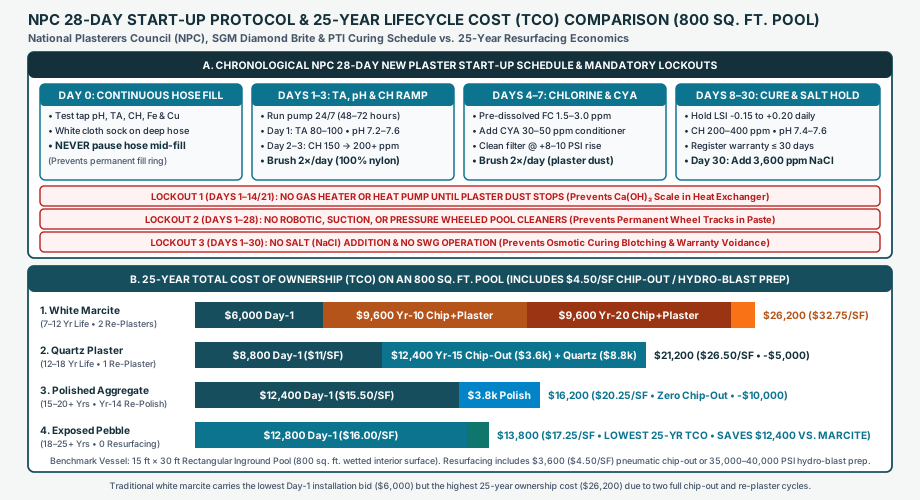
To compare pool plaster types on true ownership economics rather than Day-1 bid price alone, consider a standard residential 15 ft × 30 ft rectangular inground concrete pool (450 sq. ft. water surface area, 3.5 ft to 6.5 ft depth), which has an 800 sq. ft. wetted interior surface area (Wall + Floor perimeter area). In this conditional calculation example—using regional midpoint installation rates and a full $4.50/SF ($3,600) pneumatic chip-out or 35,000–40,000 PSI hydro-blast preparation at each resurfacing cycle—the 25-year cash flows compare as follows:
- Traditional White Marcite (
$6.00–$9.00/SFinitial;$7.50/SFmidpoint):Day-1 Installation (800 SF × $7.50/SF) = $6,000Year 10 Full Resurfacing ($3,600 Chip-Out/Hydro-Blast + $6,000 Marcite) = $9,600Year 20 Full Resurfacing ($3,600 Chip-Out/Hydro-Blast + $6,000 Marcite) = $9,600Mid-Cycle Maintenance (2 Professional Acid Washes @ Year 5 & Year 15) = $1,00025-Year Total Cost of Ownership = $6,000 + $9,600 + $9,600 + $1,000 = $26,200($32.75 / sq. ft.cumulative •$1,048 / year)
- Quartz-Modified Plaster (
$9.00–$13.00/SFinitial;$11.00/SFmidpoint):Day-1 Installation (800 SF × $11.00/SF) = $8,800Year 15 Full Resurfacing ($3,600 Chip-Out/Hydro-Blast + $8,800 Quartz) = $12,40025-Year Total Cost of Ownership = $8,800 + $12,400 = $21,200($26.50 / sq. ft.cumulative •$848 / year— Saves$5,000vs. Marcite)
- Polished Aggregate (
Hydrazzo,$13.00–$18.00/SFinitial;$15.50/SFmidpoint):Day-1 Installation (800 SF × $15.50/SF) = $12,400Year 14 Wet Diamond-Pad Re-Polishing (800 SF × $4.75/SF, Zero Chip-Out) = $3,80025-Year Total Cost of Ownership = $12,400 + $3,800 = $16,200($20.25 / sq. ft.cumulative •$648 / year— Saves$10,000vs. Marcite)
- Exposed Pebble / Mini-Pebble (
PebbleTec / PebbleSheen,$13.00–$19.00/SFinitial;$16.00/SFmidpoint):Day-1 Installation (800 SF × $16.00/SF) = $12,800Year 12 Mid-Life Scale / Power-Wash Buffer (Zero Resurfacing in 22–25 Yrs) = $1,00025-Year Total Cost of Ownership = $12,800 + $1,000 = $13,800($17.25 / sq. ft.cumulative •$552 / year— Saves$12,400[47%] vs. Marcite)
Scroll horizontally to read all columns.
Finish Category (800 SF Interior) |
Day-1 Rate ($/SF Midpoint) |
Day-1 Install Cost (800 SF) |
Typical Service Life | Resurfacing / Renewal Events in 25 Years (Incl. $3,600 Prep) |
Mid-Life Acid / Scale Allowance | 25-Year Total Cost (TCO) |
Annualized Cost ($/Yr) |
|---|---|---|---|---|---|---|---|
| 1. White Marcite Plaster | $6.00–$9.00 ($7.50/SF) |
$6,000 |
7–12 yrs (10 yr avg) |
2 Full Resurfacings (Yr 10 & Yr 20 @ $9,600 each = $19,200) |
$1,000 (2 acid washes) |
$26,200 ($32.75/SF) |
$1,048 / yr (Highest) |
| 2. Quartz-Modified Plaster | $9.00–$13.00 ($11.00/SF) |
$8,800 |
12–18 yrs (15 yr avg) |
1 Full Resurfacing (Yr 15 @ $3,600 prep + $8,800 = $12,400) |
$0 (Included in Yr 15) |
$21,200 ($26.50/SF) |
$848 / yr (-$200/yr) |
3. Polished Aggregate (Hydrazzo) |
$13.00–$18.00 ($15.50/SF) |
$12,400 |
15–20+ yrs (w/ re-polish) |
0 Chip-Outs • 1 Wet Diamond Re-Polish at Yr 14 ($4.75/SF = $3,800) |
$0 (Honed at Yr 14) |
$16,200 ($20.25/SF) |
$648 / yr (-$400/yr) |
| 4. Exposed Pebble / Mini-Pebble | $13.00–$19.00 ($16.00/SF) |
$12,800 |
18–25+ yrs (22+ yr avg) |
0 Full Resurfacings within 22–25 year horizon ($0) |
$1,000 (Yr 12 scale wash) |
$13,800 ($17.25/SF) |
$552 / yr (Lowest) |
Compare these finish budgets against all 10 construction phases in our inground pool cost breakdown by stage.
Takeaway: Traditional white marcite carries the lowest upfront bid ($6,000) but the highest 25-year ownership cost ($26,200) because paying $3,600 for chip-out/hydro-blast prep plus $6,000 for re-plastering twice over 25 years costs $12,400 more than a single $12,800 exposed pebble installation.
5. Pre-Plaster & Resurfacing Contractor Bid Verification Checklist
Before signing a new-build finish schedule or a pool resurfacing contract, require the applicator to itemize seven technical specifications in writing and record them in your new pool project checklist:
Scroll horizontally to read all columns.
| Contract Verification Item | Written Specification to Require | Bid Red Flag to Reject |
|---|---|---|
| 1. Exact Brand, Line & Pigment | Factory-bagged brand (PTI PebbleSheen, SGM Diamond Brite, CL Hydrazzo), color name, and batch count |
Generic "blue quartz plaster" or "pebble-style finish" mixed from unbranded bulk sand |
2. Calcium Chloride (CaCl₂) Limit |
0% CaCl₂ set accelerator in pigmented finishes; ≤ 2% max in white plaster (NPC rule) |
Dumping unmeasured flake CaCl₂ into colored mixes to speed cold-weather troweling (causes severe mottling) |
| 3. Resurfacing Substrate Prep | Full chip-out or 35,000–40,000 PSI hydro-blast (>15%–20% hollow or 2+ layers); or 2"–4" keyway + SGM Bond Kote |
Acid-washing over multi-layer or hollow marcite without sounding or cutting tile/fitting keyways |
| 4. Nominal Finish Thickness | 3/8" to 1/2" (10–13 mm) for marcite, quartz, and polished aggregate; 1/2" to 5/8" (13–16 mm) for pebble |
Feather-edging plaster under < 1/4" at tile lines or steps (causes rapid delamination) |
| 5. Day 1–2 Exposure Protocol | Named exposure method (Day-1 brush wash, Day-2 diluted acid + rinse, or 50–200 grit wet diamond honing) |
Uncontrolled raw muriatic acid pouring down dry walls (etches deep channels in cement paste) |
| 6. Days 1–7 Start-Up Ownership | Named party responsible for Day 0 sock fill, Day 1 24/7 pump start, and Days 1–7 daily acid/calcium dosing |
Contractor walks away after acid wash leaving fill and Week-1 pH/CH balance unassigned |
7. Warranty Registration (≤ 30d) |
Builder/applicator serial number + online registration confirmation within 30 days of fill (PTI/SGM terms) | Verbal "10-to-20-year warranty" claim without submitting the 30-day manufacturer registration |
Takeaway: Require every resurfacing or new-finish bid to specify the exact factory-bagged product line, substrate removal or Bond Kote keyway scope, zero CaCl₂ accelerator in pigmented mixes, assigned Days 1–7 NPC start-up technician, and 30-day warranty registration.
Frequently asked questions
What are the main pool plaster types and how long does each last?
Cementitious pool finishes fall into four mineralogical categories: (1) Traditional white marcite (ASTM C150 white cement plus Mohs 3.0 crushed marble) lasts 7 to 12 years; (2) Quartz-modified plaster (30%–70% Mohs 7.0 ceramic-coated SiO2 quartz in polymer/pozzolan cement, such as SGM Diamond Brite or PTI PebbleQuartz) lasts 12 to 18 years; (3) Polished marble-and-quartz aggregate (such as CL Industries Hydrazzo) lasts 15 to 20+ years and can be wet diamond-polished at mid-life without chipping out; and (4) Exposed river pebble and mini-pebble (80%–85% surface coverage of 1–4 mm Mohs 6.5–7.0 silicate stone, such as PebbleTec and PebbleSheen) lasts 18 to 25+ years.
Does a saltwater pool wear out pool plaster faster than traditional chlorine?
Sodium chloride at 3,000 to 4,000 ppm (0.3%–0.4% salinity) does not chemically dissolve SiO2 quartz or silicate river pebbles. Instead, a saltwater chlorine generator (SWG) accelerates plaster wear only when two seasonal Langelier Saturation Index (LSI) shifts go unmanaged: in summer, hydrogen micro-bubble aeration at the titanium cathode strips dissolved CO2 and drives bulk pH above 8.0 (LSI > +0.30, precipitating rough calcium scale); in winter, cold water (TF = 0.2 at 48°F) combined with the higher salt TDS factor (12.20 vs. 12.10 for freshwater) drives LSI below -0.30, leaching soluble calcium hydroxide from the cement binder unless Calcium Hardness is raised to 320–400 ppm.
Why can't you add salt or run a robotic pool cleaner for 28 to 30 days after replastering?
Freshly hydrated Portland cement requires 28 days of underwater curing to convert tricalcium and dicalcium silicate into a dense calcium silicate hydrate (C-S-H) matrix. Running a wheeled suction, pressure, or robotic cleaner before Day 28 compresses the soft curing cement paste along the wheel paths, leaving permanent gray tracks across the floor. Adding 3,000–4,000 ppm of salt (NaCl) before Day 28–30 introduces high osmotic chloride pressure during early hydration, causing surface mottling, soft spots, and immediate voidance of NPC, SGM, PTI, and Pentair warranties.
What happens if you stop the garden hose while filling a newly plastered pool?
Pausing or turning off the fill hose before water reaches the middle of the waterline tile creates a permanent horizontal bathtub ring around the pool wall at the temporary water line. While the submerged plaster below the line begins underwater hydration, the exposed ribbon at the air-water boundary wicks dissolved calcium salts and cures under evaporative shrinkage, etching a discolored textural seam that cannot be brushed or acid-washed away.
What is the difference between a bond coat and a full chip-out or hydro-blast when resurfacing?
A cementitious bond coat (such as SGM Bond Kote) is a two-component acrylic-latex scratch coat applied over a single, structurally sound existing plaster layer after the crew sounds the shell with hammers, chips out hollow spots, and cuts a 2-to-4-inch flush keyway beneath the tile line and around all fittings ($1.75–$3.00/SF). A full pneumatic chip-out or 35,000–40,000 PSI ultra-high-pressure hydro-blast ($3.50–$6.00/SF) strips 100% of the old finish down to bare structural gunite/shotcrete and is mandatory whenever more than 15%–20% of the existing plaster is hollow, when multiple plaster layers already exist, or when upgrading to heavy exposed pebble.
Which pool resurfacing material has the lowest 25-year lifecycle cost?
On a standard 800 sq. ft. wetted interior concrete pool (15 ft by 30 ft footprint), exposed pebble/mini-pebble has the lowest 25-year Total Cost of Ownership at $13,800 ($17.25/SF cumulative, or $552/year), followed by polished aggregate at $16,200 ($20.25/SF) and quartz-modified plaster at $21,200 ($26.50/SF). Traditional white marcite has the lowest Day-1 bid ($6,000 at $7.50/SF) but the highest 25-year lifecycle cost at $26,200 ($32.75/SF) because its 7-to-12-year lifespan forces two complete $9,600 chip-out and re-plaster cycles inside 25 years.
Sources
- ASA Position Statement #7: Curing of Shotcrete for Swimming Pools (ACI 506R & NPC Synthesis) — American Shotcrete Association (ASA) / National Plasterers Council (NPC)
- ACI 506R-16: Guide to Shotcrete — Substrate Preparation and Bond Strength for Finishes — American Concrete Institute (ACI)
- Diamond Brite Exposed Aggregate Pool Finish — Technical Data Sheet & 28-Day Start-Up Spec — SGM, Inc. (Southern Grouts & Mortars)
- SGM Diamond Brite Quartz Aggregate Finish — Product Engineering & Lifespan Specification — SGM, Inc. (Southern Grouts & Mortars)
- SGM Bond Kote — Two-Component Cementitious Pool Resurfacing Bond Coat Specification — SGM, Inc. (Southern Grouts & Mortars)
- PebbleSheen Exposed Mini-Pebble Pool Finish — Architectural & Engineering Submittal Packet — Pebble Technology International (PTI)
- Pebble Technology International (PTI) — Pool Care Instructions, 28-Day Start-Up & LSI Guide — Pebble Technology International (PTI)
- PebbleTec Original Exposed Aggregate Pool Finish — Product & Durability Specification — Pebble Technology International (PTI)
- CL Industries Hydrazzo — Polished Marble & Crystalline Quartz Aggregate Pool Finish Spec — CL Industries
- Pentair IntelliChlor Plus & LT Salt Chlorine Generator Installation and User's Guide — Pentair Aquatic Systems
- ASTM C150 / C150M: Standard Specification for Portland Cement — ASTM International